
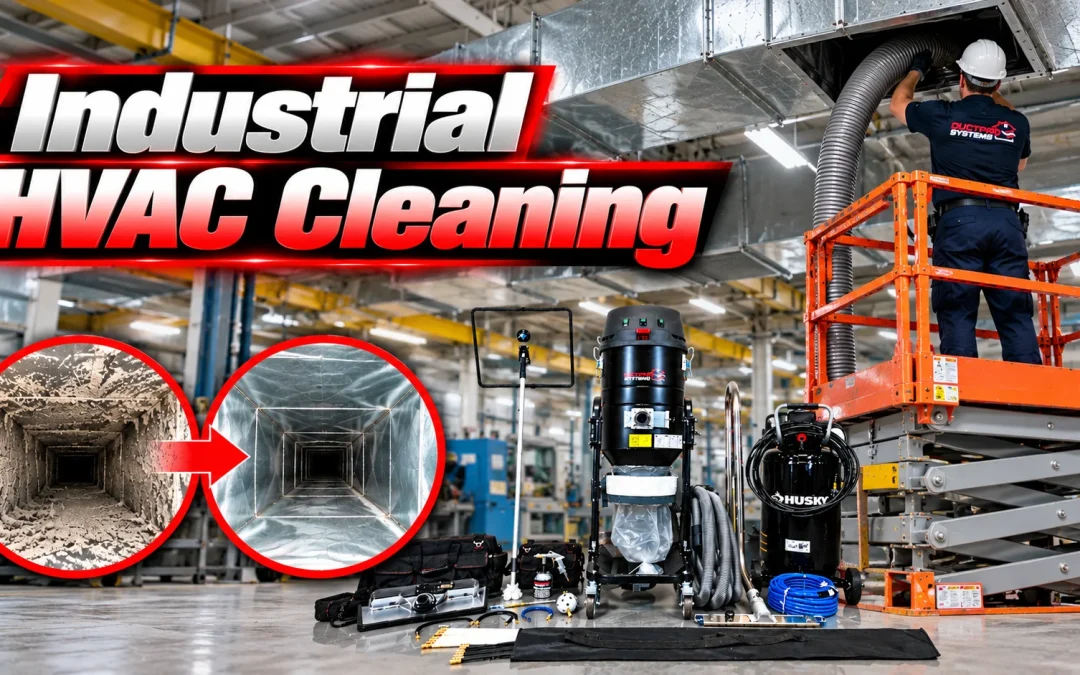
IIndustrial HVAC cleaning is not simply commercial duct cleaning with larger ductwork. Manufacturing facilities can present different contamination sources, access constraints, production schedules, and, in some cases, combustible-dust or other hazards that affect how cleaning work must be planned.
The work starts long before the vacuum switches on. A contractor needs to understand what the plant manufactures, what contamination may be entering the building HVAC system, where the extraction path will run, and which facility safety procedures govern the job. Some production processes require dedicated exhaust or dust-collection systems rather than ordinary building HVAC ductwork, and that distinction must be established before work begins. For contractors evaluating professional duct cleaning equipment, equipment specifications matter, but they come second to a sound plan.
For facility managers, the evaluation question changes accordingly. Asking whether a contractor owns a powerful vacuum is the wrong question. The right one is whether that contractor has a technically sound plan for controlling contamination, maintaining effective extraction, protecting the work area, and documenting what was done.
Why Manufacturing Plants Need a Different HVAC Cleaning Approach
An office building often accumulates ordinary dust, fibers, and general building debris. Manufacturing facilities can also have production-related particulate in surrounding areas, but whether that material enters the building HVAC system depends on the process, source-capture systems, and ventilation design.
Depending on the facility, that system may be handling:
- Wood dust
- Metal particulate
- Food dust
- Plastic particulate
- Textile fibers
- Mineral dust
- Chemical process dust
- General airborne industrial particulate
These materials behave differently. Particle size, density, shape, moisture content, concentration, and adhesion to duct surfaces all affect how contamination settles and how it should come out.
The building itself changes the job too. Long duct runs. Elevated air handlers. Production machinery parked beneath access points. Restricted work zones. Schedules that make isolation complicated.
So the cleaning plan has to come from the facility, not from a generic procedure. And the goal is bigger than a cleaner-looking duct interior. The contractor must decide how loosened material will be controlled, where it will be collected, how filtration will be handled, how hoses will be routed, and how the work interacts with the operating HVAC system.
Building HVAC Ductwork vs. Process Dust Collection
This distinction gets blurred more often than it should.
Building HVAC ductwork conditions and moves air for the occupied space: supply, return, and the air handling equipment that serves production floors, offices, and support areas.
Process exhaust and dust-collection systems exist for a different reason. They capture particulate at the source (saws, grinders, mixers, conveyors, transfer points) and carry it to a collector. They are engineered around different transport conditions, contamination loads, and hazard controls, and in facilities with combustible dust they are often central to the plant’s explosion-protection strategy.
The two systems can share a building. They do not share a scope of work by default.
A cleaning method that suits building HVAC ductwork is not automatically appropriate for process dust-collection equipment. Neither is a standard portable duct vacuum. When a project touches process systems, the facility’s engineering and EHS personnel need to define what is in scope, what methods are permitted, and what equipment qualifies. This article focuses on building HVAC ductwork serving manufacturing environments.
What Builds Up in Industrial HVAC Systems?
Start with the right question. Not “how much dust is in the duct?” but “what is the dust, and where did it come from?”
A woodworking operation can introduce wood particulate into surrounding areas. Metal fabrication may produce metal dust. Food production creates food-related dust. Textile manufacturing generates fibers. Each one settles, sticks, and responds to agitation in its own way.
Before planning the cleaning method, a contractor should establish:
- The material being processed.
- How that material becomes airborne.
- Where airborne particulate can enter the HVAC system.
- How long contamination has been accumulating.
- Whether deposits are loose, compacted, adhered, or mixed with other material.
- Whether moisture, grease, or other substances are present.
- Whether the material presents a known facility-specific hazard.
Industrial dust is not one category. Its hazard depends on the material, concentration, particle characteristics, process, facility design, and the requirements that apply to that site. That point becomes critical the moment combustible dust enters the conversation.
How the Manufacturing Process Changes the Cleaning Plan
Picture two plants with nearly identical ductwork. One weaves textiles. The other processes wood.
Same duct dimensions. Completely different jobs.
The contamination, work practices, access requirements, and safety controls can diverge sharply, and the same holds across food manufacturing, metal fabrication, plastics, pharmaceuticals, chemical processing, and general industrial work. These environments are not interchangeable.
Before mobilizing, the contractor should be able to answer:
- What products or materials are manufactured?
- Where is particulate generated?
- Which HVAC systems serve production areas?
- Which duct sections are in scope?
- Where are the access points?
- Can equipment be positioned close to the system being cleaned?
- What production activities will continue during the work?
- What facility procedures apply to contractors?
- Are there existing hazard assessments or safety documents relevant to the work?
- What containment arrangements are needed?
- How will extracted material be collected and handled?
- Which compressed-air tools are planned?
- What filtration and collection configuration will be used?
- How will cleaned areas be inspected afterward?
Those answers are the plan. Without them, the contractor is guessing.
Combustible Dust and Industrial Cleaning Safety
Some manufacturing processes create combustible-dust hazards. Many do not. And among those that do, wood dust, metal particulate, food dust, plastic particulate, mineral dust, and chemical-process dust carry different risks with different controls. Treating them as one hazard is a mistake.
The Current NFPA Standard
For years, contractors and facility managers referenced NFPA 652 as the fundamentals standard for combustible dust. NFPA has since consolidated its combustible-dust standards into a single document: NFPA 660, Standard for Combustible Dusts and Particulate Solids, 2025 edition, published in December 2024. It combines the former NFPA 652 fundamentals with the material- and industry-specific standards previously issued as NFPA 61 (agricultural and food processing), NFPA 484 (combustible metals), NFPA 654 (chemical and other particulate solids), NFPA 655 (sulfur), and NFPA 664 (wood processing and woodworking).
NFPA 660 also addresses hazards such as self-heating and water reactivity. Its provisions for portable vacuum cleaners used in combustible-metal housekeeping are specific to the material, application, and location, and equipment used under those provisions must meet the applicable requirements for the metal being handled. These provisions should not be interpreted as approval for general-purpose vacuums to collect combustible dust.
Whether NFPA 660 governs a particular job, and which chapters and provisions apply, depends on the process, the material, the hazard conditions, the jurisdiction, the codes the authority having jurisdiction has adopted, and the scope of work. Some jurisdictions may still reference earlier editions or legacy standards. Confirm what is actually in force rather than assuming.
Equipment Suitability Is a Separate Question
The DuctPro Tri-Motor Vacuum’s published performance specifications do not, by themselves, establish its suitability for combustible-dust collection or for use in a hazardous classified location. Where the facility’s hazard assessment identifies those requirements, equipment documentation must confirm suitability for the specific material and area classification.
No vacuum becomes appropriate for combustible dust simply because it is used for industrial cleaning. Equipment should never be described as explosion-proof, intrinsically safe, ATEX-certified, NFPA-certified, OSHA-approved, or rated for a classified location unless the manufacturer’s documentation explicitly establishes that specific claim.
The same caution applies to wet methods. Wet-down injection can help control fine particulate in many applications, but water is not compatible with every material. Some metal dusts react with water. The facility’s hazard information should confirm that any wet-down approach is appropriate for the material involved.
Where Equipment Fits in the Safety Framework
Before work begins, contractors should review the facility’s hazard documentation, including any dust hazard analysis, along with the controls the facility already has in place. Depending on the circumstances, EHS personnel, qualified safety professionals, industrial hygienists, or engineers may need to be involved. Applicable OSHA requirements, fire and process-safety standards, and locally adopted codes should be evaluated for the specific facility and activity.
DuctPro equipment does not replace a facility’s hazard assessment, engineering evaluation, applicable safety requirements, or EHS procedures.
Establish the hazard conditions first. Then select the equipment and work practices that fit them.
What Contractors Should Evaluate Before the Job
A pre-job assessment catches problems before people and equipment arrive on site. Its depth should reflect the facility, the process, the HVAC system, the contamination, and the governing safety procedures.
Facility and production process. Know what the plant manufactures and where airborne contamination originates.
System type. Confirm whether the work involves building HVAC ductwork, process exhaust or dust-collection equipment, or both, and who defined that scope.
Duct configuration. Review sizes, routing, branches, access points, transitions, fittings, and anything else that affects cleaning and extraction.
Contamination. Identify the apparent material and condition of deposits. Visible dust in one area may not match dust generated elsewhere in the plant.
Access. Locate available openings and determine whether additional access must be planned.
Equipment placement. Find practical locations for the vacuum and other equipment that keep hose paths as direct as reasonably possible.
Hose routing. Plan around excess length, sharp bends, restrictive fittings, elevation changes, machinery, and walls.
Filtration and collection. Determine how loosened material will be captured and whether the equipment’s collection arrangement suits the contamination.
Electrical and compressed-air requirements. Verify the facility’s actual supply and the requirements of every tool on the job.
Containment and work-zone isolation. Decide how the work area will be controlled so loosened material does not migrate into occupied or sensitive areas.
Production schedule. Coordinate around production activity, shutdowns, and access restrictions.
Facility safety procedures. Review contractor orientation, access rules, lockout or isolation procedures where applicable, PPE requirements, and emergency procedures.
Hazard documentation. Review the safety information the facility supplies before choosing work methods.
Post-cleaning verification. Agree in advance on how completed work will be inspected and documented.
Facility managers can use this list as a filter. A contractor who asks detailed questions about the plant before arriving is operating at a different level from one who treats every facility as the same job.
Containment and Negative Pressure
Agitation loosens material that was attached to duct surfaces. Without controlled extraction, that material can drift into areas that were never meant to receive it.
Containment and airflow control give the debris a deliberate path: from the duct, through the extraction system, into collection. Equipment location, hose routing, access points, filtration, and the duct system’s own configuration all shape how well that path works.
Negative pressure, then, is a strategy. Not a number on a gauge.
There is no single negative-pressure value that applies to every industrial duct cleaning project, and no single reading proves that containment worked or that the system is clean. The right approach depends on the system, the scope, the contamination, and the facility’s procedures. For the underlying principles, see our guide on how to establish negative pressure during duct cleaning.
How CFM, Static Pressure, and Water Lift Affect Extraction
CFM is useful. It is not the whole story.
Volumetric airflow, air velocity, static pressure, and water lift are four distinct concepts. Mixing them up is one of the most common reasons equipment gets misjudged in the field.
Air velocity relates to airflow this way:
Velocity = Volumetric Flow Rate / Cross-Sectional Area
In plain terms: push the same volume of air through a larger duct, and it moves more slowly. Squeeze it through a smaller one, and it moves faster. That is exactly why no single velocity or airflow figure can be applied to every industrial duct without accounting for its actual geometry and operating conditions.
Real extraction performance depends on the complete path:
- Duct dimensions and geometry
- System resistance
- Hose length and diameter
- Bends and fittings
- Filters
- Access openings
- Contamination load and particulate characteristics
- Extraction configuration
- Equipment operating conditions
Comparing a duct’s diameter against a vacuum’s CFM rating will not tell a contractor whether that duct can be cleaned effectively.
Static pressure describes resistance within an airflow system. Airflow describes the volume of air moving. Water lift is an equipment specification describing sealed suction capability, and it should not be read as a measurement of the static pressure present at a job site. A vacuum’s published airflow and water-lift figures describe the machine. What the operator experiences during cleaning depends on the resistance of everything connected to it.
For a deeper look at measuring resistance in the field, see our HVAC static pressure analysis guide.
Hose Routing, Equipment Placement, and System Resistance
A vacuum’s specifications never operate in isolation. The hose between the machine and the duct is part of the system.
Unnecessary hose length, repeated bends, and restrictive fittings can increase resistance in the extraction path. Vertical routing and elevation changes can also affect operating conditions. Difficult access may make the extraction path more complicated.
That is why equipment placement deserves real attention during planning. If the vacuum can sit closer to an appropriate access point without interfering with production or creating a safety problem, the extraction path usually becomes more practical. Parking the equipment wherever is convenient tends to produce a longer, more complicated hose route.
There is no universal maximum hose length for industrial cleaning. The relevant question is how the complete hose and duct configuration affects the system you are actually running. Our guide to optimizing vacuum hose routing to maintain vacuum performance covers this in more detail.
Placement must also account for containment, operator movement, forklift and foot traffic, electrical access, and the facility’s safety rules. The goal is not the shortest possible distance. It is a practical, controlled setup.
DuctPro Tri-Motor Vacuum as an Equipment Example
The DuctPro Tri-Motor Vacuum is a good illustration of why specifications should be reported precisely rather than stretched into performance promises.
Confirmed manufacturer specifications:
| Specification | DuctPro Tri-Motor Vacuum |
| Airflow | 330 CFM |
| Air watts | 900 air watts |
| Water lift | 220 inches |
| Motor configuration | Three independent vacuum motors |
| Debris capacity | 12 gallons |
| Voltage | 120 volts |
| Black suction hose | 25 ft, 1½-inch diameter |
| Gray suction hose | 25 ft, 2-inch diameter |
These figures describe the equipment. They are not a guarantee of a particular cleaning result in a manufacturing plant.
A few interpretation rules keep the numbers honest:
- The 330 CFM rating should not be divided into an assumed figure per motor, and it should not be compared against a theoretical airflow requirement to decide automatically whether a given industrial duct can be cleaned.
- The 220-inch water-lift rating is an equipment specification, not the static pressure that will exist at a job site.
- The three independent motors and 12-gallon capacity are specifications of the machine. They do not establish a cleaning capacity, a duct-size limit, or uninterrupted operation under every condition.
- The two included hose diameters change the resistance of the extraction path. Hose selection belongs in the job plan, not as an afterthought.
The Tri-Motor Vacuum’s operation manual states that the unit is intended for dry pickup and requires the dust bag and filter to be installed. The separate Dust Downer accessory should not be treated as evidence that this vacuum is suitable for wet collection or combustible-dust applications. Before selecting a Dust Downer or another collection method for industrial particulate, confirm compatibility with DuctPro and the facility’s material-specific hazard assessment.
Contractors evaluating the machine itself should refer to the current DuctPro Tri-Motor Vacuum product information.
Compressed-Air Agitation
For DuctPro’s pneumatic agitation setup, the operation manual specifies a compressor operating range of 120 to 175 PSI, with 120 PSI as the minimum. That range applies to the DuctPro setup it documents. It is not a universal requirement for every pneumatic tool or industrial project, so contractors should confirm the requirements of the specific tools and procedure in use.
Filtration, Collection, and Chemical Treatment
Filtration should match the job. Not every industrial duct cleaning project requires HEPA filtration. The appropriate configuration depends on the contamination, the equipment, the facility’s procedures, and the applicable safety controls.
Collected material deserves the same discipline. It should not automatically be classified as hazardous waste, and it should not automatically be treated as ordinary debris either. Disposal requirements depend on what was collected and which waste-management rules apply. Know what you are removing and how the facility expects it handled before the first bag fills.
Chemical treatment is a separate decision.
Physical debris removal, grease removal, microbial concerns, and chemical application are different activities. A manufacturing facility does not automatically need a sanitizing or antimicrobial treatment because its ductwork was cleaned. Where a chemical product is justified, follow the manufacturer’s label and documentation, confirm material compatibility, control runoff where relevant, and record the product used. Concentrations, dwell times, pH values, and application rates come from the product documentation. Never from a generic duct cleaning checklist.
PPE and Worker Safety
No single PPE list fits every manufacturing plant.
Protection should follow the facility’s hazard assessment, the contamination involved, the applicable requirements, and the contractor’s established procedures. A protective approach suited to textile fibers may be inadequate for a metal or chemical dust, and the reverse can also be true.
Coordinate with the facility before work begins. Complete site orientation. Understand access restrictions, electrical safety requirements, compressed-air hazards, work-zone controls, and any lockout or isolation procedures that apply to the air handling equipment. Where the hazard assessment calls for specialized protection or controls, build those into the cleaning plan.
Hazards first. Equipment and PPE second.
Documentation and Post-Cleaning Verification
Good industrial HVAC cleaning leaves a record that stays useful long after the crew is gone.
A practical service record can capture:
- Pre-cleaning condition
- Systems and areas included in the scope
- Access points used
- Equipment used
- Visible contamination observed
- Unusual conditions encountered
- Areas cleaned
- Sections that were inaccessible or excluded
- Post-cleaning condition
- Photographs where appropriate
- Date of service
Before-and-after photographs taken at comparable locations carry the most weight. Notes about inaccessible sections or unusual deposits prevent confusion at the next service visit.
Documentation does not, by itself, establish regulatory compliance or guarantee any insurance outcome. Its value is a clear record of what was observed, what was included, and what was performed.
Verification should match the agreed scope. Visual inspection may be enough for some projects. Others call for measurements. Where airflow readings are part of the scope, our overview of post-cleaning airflow performance testing explains how to approach them.
Questions Facility Managers Should Ask a Duct Cleaning Contractor
How a contractor plans the work tells you more than any equipment brochure.
What do you need to know about our manufacturing process before the job?
A qualified contractor wants to understand the contamination source and facility conditions before quoting.
Is the work limited to building HVAC ductwork, or does it include process dust-collection systems?
The answer should show the contractor understands these are different systems with different requirements.
How will you control loosened material during cleaning?
Expect a discussion of extraction, containment, airflow direction, filtration, and work-zone control.
How will you decide where the equipment goes?
A sound answer covers access, hose routing, system resistance, production activity, and site safety rules.
How will you evaluate the contamination?
The contractor should recognize that different industrial materials behave differently and may need different handling.
How will combustible-dust considerations be handled if they apply to our process?
Listen for a commitment to work within the facility’s hazard controls, and be wary of blanket claims that a vacuum suits every dust environment.
What do you need from our EHS or safety department?
This reveals whether the contractor understands that industrial cleaning happens inside an existing safety framework.
How will the work be documented and verified?
Ask what photographs, scope records, and post-cleaning observations you will receive, and how verification ties to the agreed scope.
These questions move the conversation away from a single CFM number and toward the complete cleaning system.
The Bottom Line for Plant Managers and Contractors
Industrial HVAC cleaning succeeds or fails on planning.
The process determines what particulate is present. The system type determines what is even in scope. Duct geometry, hose routing, and equipment placement set the resistance the extraction system has to overcome. Containment and filtration decide where loosened material ends up. And where combustible dust is a factor, the facility’s hazard assessment, the applicable edition of NFPA 660, and the jurisdiction’s adopted requirements govern which methods and equipment are acceptable.
Treat specifications as what they are. The DuctPro Tri-Motor Vacuum is specified at 330 CFM, 900 Air Watts, and 220 inches of water lift, with three independent vacuum motors, a 12-gallon debris capacity, and a 120-volt supply. These figures describe the equipment; determining its suitability for a particular plant requires evaluating the contamination, hazard conditions, duct configuration, extraction path, and facility requirements.
Next step: before scheduling the work, put the facility’s hazard documentation, system drawings, and production schedule in front of your contractor, and ask them to walk you through their extraction path. Their answer will tell you whether you are buying a service or a controlled maintenance operation.