
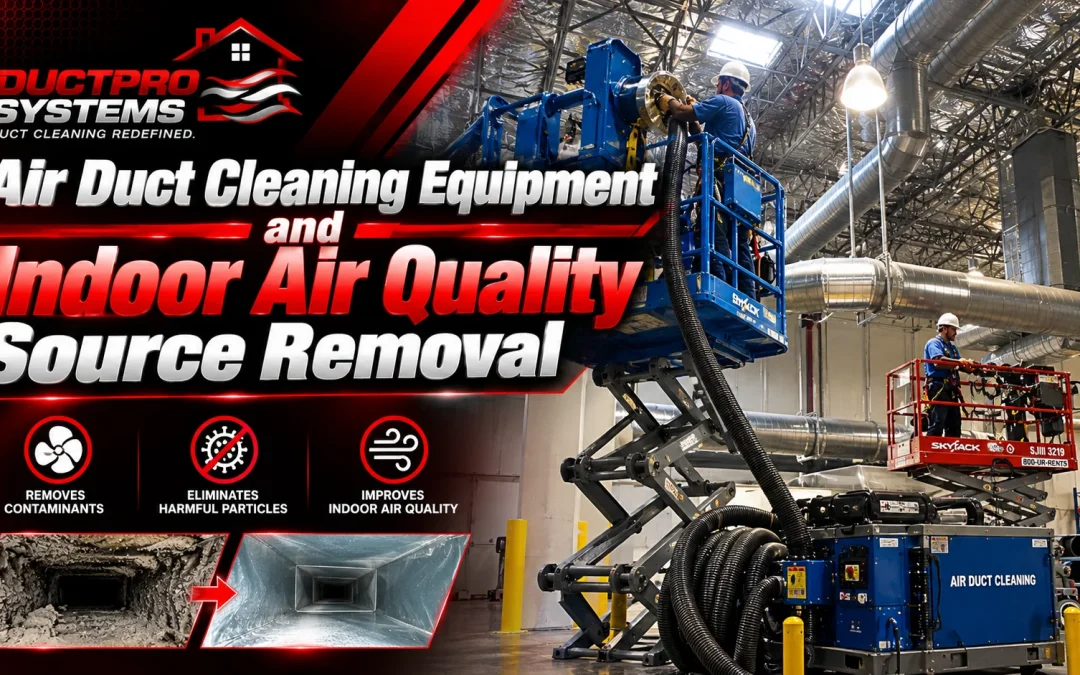
Your building’s ductwork is a dust reservoir that gets refilled every day. Every supply trunk, return drop, and plenum in a working HVAC system holds a settled layer of particulate. That layer doesn’t stay put. It waits for the next blower cycle, and then part of it goes back into the air people breathe. If you want to explore DuctPro’s commercial air duct cleaning equipment systems, start with this fact, because it explains why source removal works and why filtration alone keeps falling short.
Indoor air quality work is not about making a duct look clean on a camera feed. It is about mass removal: physically pulling bonded debris out of the air distribution system so it stops re-entering the occupied space. This guide covers the physics, the procedure, and the economics of doing that correctly in commercial and residential buildings.
The Ductwork as a Recirculation Reservoir
Ductwork collects particulate continuously. Return air pulls in skin-cell dander, textile fibers from carpets and upholstery, pet hair, and the coarse dust people track in on their shoes. In buildings that have been renovated, the system also takes in fine drywall and sanding dust, which is the worst of the categories because it is small, abundant, and it holds onto surfaces.
None of this stays in a neat, inert layer.
What Actually Accumulates Inside the System
| Particulate Class | Typical Sources | Behavior Inside Ductwork |
| PM10 (coarse, ≤10 µm) | Tracked-in soil, pollen, general household and office dust | Settles quickly in horizontal trunks and at the base of return drops |
| PM2.5 (fine, ≤2.5 µm) | Drywall sanding, renovation debris, soot, combustion byproducts | Stays airborne longer and forms a dense, clinging film on sheet metal and flex liners |
| Dander and skin cells | Occupants and pets | Mixes into the settled layer and feeds microbial growth when moisture is present |
| Textile fibers and lint | Carpets, upholstery, clothing, dryer exhaust paths | Interlocks with finer dust and forms mats that trap more particulate |
| Compacted debris | Years of accumulation, construction leftovers | Bonds to the duct wall and can only be removed by mechanical agitation |
The Blower Cycle Is the Re-Entrainment Trigger
Air moving through a duct is not uniform. Velocity is highest in the center of the airstream and drops toward zero at the duct wall. That slow layer, the boundary layer, is where dust settles and builds up.
When the blower is off, the boundary layer is calm and particulate accumulates. When the blower starts, airflow ramps up from zero in seconds. That startup velocity spike sends a burst of shear stress across the settled surface. The loosest particles, mostly fine material sitting on top of the deposit, break free and are carried downstream to the supply registers.
This repeats every cycle, many times a day, all year.
A loaded duct system doesn’t just hold dirt. It meters dirt back into the building, a little at a time, every time the thermostat calls. Debris also adds resistance, which you can confirm with HVAC static pressure analysis before and after the job. Higher resistance means harder blower work, uneven room delivery, and more stress on the equipment.
Why Filtration Alone Cannot Fix a Loaded System
Facility managers often respond to air quality complaints by upgrading filters. Moving to a higher MERV rating in the building’s air handler filter rack is a reasonable step. It catches more of what passes through the rack.
But consider what that filter actually sees.
Dilution vs. Source Removal
Filtration and air purification are dilution strategies. They capture particulate already moving in the airstream at one point in the system. The building’s AHU filter rack sits upstream of the blower, on the return side. Everything downstream of it, including supply trunks, branch runs, the blower housing, and the supply plenum, is outside its protection.
Dust that has already settled downstream of the rack is re-entrained during each blower cycle and delivered straight to the supply registers. It never goes back through the filter before reaching occupants. Upgrading the filter does nothing for that inventory.
That is the central argument for physical cleaning, and it matches the source-control logic in NADCA’s ACR standard and the ventilation principles behind ASHRAE 62.1. Removing a contaminant at the source beats trying to dilute it once it is already circulating.
| Strategy | What It Addresses | What It Misses |
| Higher-MERV filter in the building’s AHU rack | Particulate moving through the return airstream at the rack | Settled debris downstream in supply trunks, blower, coil, and plenum |
| Portable room air purifiers | Airborne particulate in a single room | The duct reservoir that keeps re-seeding every room |
| Increased outdoor air ventilation | Dilutes indoor concentrations | Adds an outdoor contaminant and humidity load; leaves deposits in place |
| Mechanical source removal | Bonded and settled debris across returns, supplies, coils, and plenums | Nothing structural, as long as agitation and extraction are both done correctly |
Our position is direct: until bonded debris is mechanically dislodged and pulled out of the system, the ductwork keeps re-seeding the occupied space. Filters work well as a second line of defense. They cannot replace cleaning.
The Mechanics of True Source Removal: Agitation + High Static Lift
This is where many cleaning jobs fail. Suction by itself does not clean ductwork.
Why Suction Alone Leaves the Boundary Layer Behind
Negative air pressure moves air, and moving air carries loose particulate. But the debris doing the most damage is not loose. Fine dust packed against galvanized sheet metal, or worked into the ribs of flex duct, sits in the same slow boundary layer that let it settle. A vacuum pulling air through the duct mostly moves the faster core of the airstream. The film on the wall stays.
To remove it, you have to break its bond with the surface. That requires mechanical energy delivered directly at the wall: pneumatic agitation.
Pneumatic Agitation: Breaking the Bond
DuctPro’s agitation system runs on a contractor-grade portable compressor at 120–175 PSI. A 25 ft. black air hose connects to a red rubber supply hose through quick-connects with an inline ball valve, so the technician controls air delivery at the work point.
Pressure choice is a tactical decision, not a set-it-once number:
- 150–175 PSI: Use this for the first blast on heavily compacted debris. It hits hardest, but line pressure falls below the 60–90 PSI working band sooner.
- 120–130 PSI: Use this for sustained cleaning on long runs. Line pressure stays above 60–90 PSI longer, so the tool keeps working along the full length of a trunk.
- 120 PSI: This is the minimum operating pressure. Below it, agitation loses effectiveness.
The compressor runs on a standard 15A or 20A, 120V outlet and refills its tank in about two minutes, which sets the pace of the work. For a closer look at the tradeoff between blast strength and duration, see our guide on compressor PSI selection for duct agitation.
Matching the Agitation Tool to the Run
Choosing the wrong tool pushes debris away from the vacuum instead of toward it. Each attachment has a specific job:
| Attachment | Primary Application | Debris Direction |
| Reverse Air Ball | Supply ducts | Pulls particulate backward toward the Vacuum Box collection point |
| Forward Blasting Air Ball | Return air systems and dryer vents | Drives particulate forward along the run toward the extraction point |
| Air Gun & Cleaning Brushes | HVAC coils, blower fans, and plenums | Detailed, targeted agitation on components a whip or ball can’t reach properly |
The coil, blower wheel, and plenum need particular attention. They are the closest surfaces to the blower, they see the strongest airflow, and debris left there spreads to every supply branch.
High Static Lift: Capturing the Suspended Cloud
When agitation frees the debris, it becomes a suspended cloud that has to be captured right away before it resettles. The vacuum handles that capture.
DuctPro’s tri-motor platform runs three independent commercial-grade vacuum motors producing:
- 330 CFM continuous operating airflow under static load
- 220″ static water lift
- 900 air watts
The 220″ of static lift is the key number. Ductwork, the Vacuum Box interface, and the suction hose all add resistance. Static lift measures how well the machine keeps pulling against that resistance. A vacuum with high free-air CFM but little lift loses much of its capture power once you connect it to a real duct system. For the full physics, read our explanation of understanding static lift versus airflow volume.
Hose velocity also matters. Using V = Q / A:
- 2-inch hose: cross-sectional area ≈ 0.0218 ft². At 330 CFM, V ≈ 15,100 ft/min.
- 1½-inch hose: cross-sectional area ≈ 0.0123 ft². At 330 CFM, V ≈ 26,900 ft/min.
These are idealized values based on the rated operating airflow. Even so, they show why the smaller hose keeps heavy debris moving and the larger hose favors volume. The package includes both a 25 ft. black 1½-inch suction hose and a 25 ft. gray 2-inch suction hose, so the technician can pick based on the debris load in front of them.
Agitation breaks the bond. Static lift collects the debris. Skip either one and you have not done source removal.
Controlling Fine Particulate (PM2.5) with Wet-Down Pre-Separation
Coarse debris is easy to handle. It is heavy, it drops into the recovery tank, and it stays there. Fine particulate is harder.
How Fine Dust Behaves During Extraction
Drywall dust, soot, and fine allergens weigh very little relative to their surface area. In a high-velocity airstream, they behave more like a gas than a solid. They don’t settle quickly in the tank. They stay suspended, travel to the filter, and coat it in a dense layer that cuts airflow fast. When a filter blinds, suction at the duct drops, capture weakens, and particulate you thought you were removing can escape at the register.
Renovation cleanups are where this becomes most obvious. A system that took in sanding dust during a remodel can carry more fine material than a dry vacuum stream can handle cleanly.
The Dust Downer: Agglomeration at the Collar
The Dust Downer wet-down injection assembly, in 1.5″ or 2″ size, connects the vacuum hose to the Vacuum Box barb. When needed, it injects moisture into the incoming airstream right at the collar.
The physics is simple. Fine particles hit water droplets, stick to them, and clump together. A wet clump is much heavier than the particles that formed it. It drops out of the airstream and settles in the 12-gallon recovery tank instead of staying airborne and loading the filter.
DuctPro’s vacuum filtration and separation consists of:
- 12-gallon recovery tank: Collects heavy debris and wet agglomerated particulate.
- Replaceable dust collection bag: Captures dry material; reference service life runs 6–18 months depending on commercial volume.
- Machine-washable cage filter: Protects the motors; air dry only, never tumble dry.
- 1.5″ or 2″ Dust Downer: Pre-separates fine particulate before it reaches the tank.
For heavy renovation dust and soot cleanups, we treat wet-down pre-separation as standard procedure, not an optional extra. It keeps suction consistent through the whole job and keeps the cage filter from clogging halfway through.
Protecting the Building Envelope During Remediation
This IAQ issue gets overlooked often, and truck-mounted rigs consistently do poorly on it.
The Problem With Propped-Open Doors
A truck-mounted system stays in the driveway or parking lot. Getting its suction hose to the air handler means running 100–150+ feet of hose through an exterior door, and that door stays open for the whole job.
That means you are trying to clean a building’s air while leaving an opening to outdoor pollen, vehicle exhaust, humidity, and unconditioned air, whether that is freezing winter air or humid summer air. For a sensitive occupant, a healthcare suite, or a tight modern building, that undermines the purpose of the job.
Staging the Tri-Motor Unit Indoors
The portable tri-motor vacuum works inside the building. It rides on a lightweight protective dolly, sets up near the work zone, and connects with the 25 ft. 1½” or 2″ hoses. Doors stay shut. The building envelope stays sealed. Conditioned air stays inside.
| Factor | Indoor-Staged Tri-Motor Unit | Truck-Mounted Rig |
| Exterior door status | Closed throughout the job | Propped open for hose routing |
| Hose run | 25 ft. 1½” or 2″ suction hose | 100–150+ ft. through the building |
| Outdoor contaminant intrusion | Envelope stays sealed | Pollen, exhaust, and humidity enter through the open door |
| Thermal load on the building | Conditioned air retained | Unconditioned air enters during the job |
| Electrical | Standard nominal 120V grounded outlet | Dedicated vehicle-powered setup |
One electrical rule matters here: run the vacuum on a properly grounded 120V outlet. Never use a two-prong adapter.
Sealing the Interface at Every Opening
Containment at the register determines whether negative pressure actually reaches the duct. DuctPro’s interface hardware covers the openings you’ll see in the field:
- Vacuum Box: Seals directly over vents and registers.
- 24″ x 24″ Commercial Duct Cleaning Plate: Seals oversized commercial grilles, ceiling diffusers, and large returns.
- Extension Pole: Holds the Vacuum Box against ceiling registers so one technician can keep a steady seal without a ladder partner.
- Toe Kick Adapter Plate: Seals under-cabinet toe-kick vents in kitchens and break rooms, where many crews skip the job because they lack the right fitting.
A leaking seal pulls room air instead of duct air. A tight seal puts all 220″ of lift on the duct.
Contractor Economics & Verifiable IAQ Closeout
Clients don’t pay for vacuum runtime. They pay for a result they can see and trust. Closeout should prove that result.
Visual Verification With the Vacuum Box LED
The Vacuum Box includes integrated LED inspection lighting. When extraction finishes at an opening, the technician looks into the duct interior under that light and confirms that the settled particulate is gone. It is a direct, visual check at each opening, done on site, before moving on.
Pair that visual check with measured data. Before-and-after airflow readings show the client that removing debris lowered resistance and restored delivery. Our guide on validating CFM recovery after cleaning covers that procedure.
Cleaning the Immediate Work Zone
Agitation and extraction can leave debris around the register opening and on the floor below it. The stainless steel floor wand squeegee handles wet/dry extraction of the work zone, so the space is left cleaner than when the crew arrived. Clients notice, and it is the kind of thing that turns into repeat business.
Fewer Passes, Lower Labor Hours
Contractors moving from rotary-brush systems such as Rotobrush to high-lift negative air consistently report fewer passes needed per trunk run. A rotary brush relies on repeated mechanical agitation to work debris loose, with each pass covering ground the last pass partly cleaned. Continuous high static lift combined with targeted pneumatic agitation captures debris when it is freed, so fewer passes are needed. Fewer passes mean fewer labor hours per system.
One Technician, One Van
The portable tri-motor package lets a single technician complete full residential and light-commercial negative air setups. There is no need for the two-person crew that truck-mounted rigs and heavy single-motor units require. The vacuum, compressor, hoses, and Vacuum Box accessories fit in a standard service van, pickup bed, or small commercial vehicle. No dedicated PTO box truck is needed.
That reduces both labor and capital costs. Contractors adding duct cleaning consistently cite this package as the best output-per-dollar ratio available, without the five-figure debt service of a PTO rig.
Scaling IAQ Into Maintenance Contracts
The most successful pattern we see starts with HVAC mechanical contractors who already have preventative maintenance contracts. They begin with one pilot system, prove the margin on their existing customer base, and then scale to 2–5 dedicated van packages. Duct cleaning becomes a high-margin add-on sold to customers who already trust them with the mechanical equipment.
Ongoing maintenance costs are predictable. Inspect the carbon motor brushes after 500 operating hours, with a typical service interval of 3–5 years. Air dry the cage filter after washing. Replace the dust bag on schedule. Following those intervals keeps the platform working for years.
Where to Start on Your Next IAQ Job
Treat every air quality complaint as a source-removal question first and a filtration question second.
- Measure before you touch anything. Record static pressure and airflow so you have a baseline to prove recovery.
- Seal every opening. Use the Vacuum Box, the 24″ x 24″ plate, the Extension Pole, or the Toe Kick Adapter Plate to match each register type.
- Agitate with the right tool and pressure. Reverse Air Ball on supplies, Forward Blasting Air Ball on returns, Air Gun & Cleaning Brushes on the coil, blower, and plenum.
- Capture with high static lift. Keep 220″ of lift on the duct and choose the 1½” or 2″ hose based on the debris load.
- Wet down fine dust. Use the Dust Downer on renovation, soot, and allergen-heavy systems.
- Keep the envelope closed. Stage the unit indoors on its dolly and keep exterior doors shut.
- Verify and document. Check each opening under the LED light, clean the work zone, and retest airflow.
Filters catch what passes through them. Source removal eliminates what has been accumulating in the system for years. The healthiest buildings get both, in that order.