
For professional duct cleaning, vacuum performance cannot be reduced to one number.
CFM tells you about airflow. Water lift tells you about the vacuum’s ability to work against resistance. Static pressure describes the pressure conditions within the system. Hose dimensions, duct configuration, filters, debris loading, and equipment setup all affect how much of the vacuum’s capability reaches the point where debris is being extracted.
That distinction matters when evaluating a duct cleaning vacuum. A machine with a higher advertised CFM is not automatically the better choice for every application. The useful question is how the complete vacuum system performs when air has to move through the actual resistance created by the hose, ductwork, fittings, filtration, and debris.
What Does Vacuum Suction Mean in Duct Cleaning?
Vacuum suction is the pressure difference created by a vacuum system that causes air and loosened debris to move toward the collection equipment.
During professional duct cleaning, the vacuum system is normally used to establish negative pressure in the duct system while agitation equipment loosens material from duct surfaces. The vacuum then provides the airflow needed to transport that material toward the collection point.
This creates two related requirements.
First, the system needs enough airflow to move air and suspended debris through the extraction path. Second, it needs enough pressure capability to maintain useful suction as resistance increases.
Those requirements are connected, but they are not interchangeable.
A useful way to think about the difference is this:
CFM describes how much air is moving. Pressure describes the resistance against which the system can move it.
That is why looking at only CFM can produce a misleading equipment comparison.
CFM: What It Measures
CFM means cubic feet per minute. It is a measurement of volumetric airflow.
A CFM rating tells you how much air a vacuum system can move under a particular set of measurement conditions. It does not, by itself, tell you how much airflow will remain available at the end of a long hose connected to a restrictive duct system.
Air velocity is a separate concept. For a given airflow, velocity depends on the cross-sectional area through which that air is moving.
The basic relationship is:
V=AQ
where:
- V is air velocity
- Q is volumetric airflow
- A is cross-sectional area
The same airflow can therefore produce very different air velocities through different openings.
That distinction becomes especially important when discussing portable duct cleaning equipment. The vacuum is not simply being asked to move air through the full cross-section of an open trunk line. The extraction path includes a hose, fittings, access points, duct sections, and the material being removed.
Consequently, a CFM figure should always be considered in the context of the complete system.
For a more detailed explanation of how CFM applies to professional duct cleaning, see DuctPro’s CFM requirements for professional duct cleaning.
Why Advertised CFM Is Not the Same as Job-Site Airflow
A manufacturer’s airflow specification is measured under defined conditions. The airflow available during an actual cleaning operation can be different because the operating system introduces resistance.
Consider what happens when a contractor connects a vacuum to a job:
The air has to travel through the suction hose. It may pass through fittings, access openings, duct transitions, and contaminated sections of ductwork. Filters can accumulate debris during the job. Every component contributes resistance to the air path.
As resistance increases, the operating point of the vacuum system changes.
This is why a contractor should not take a free-air CFM number and assume that the same airflow will be available at the cleaning point under working conditions.
The practical question is not simply, “How much CFM does the machine advertise?”
It is, “How does the vacuum maintain useful airflow and negative pressure when the extraction system is actually connected and operating?”
Static Pressure and Water Lift
Static pressure describes pressure within a fluid system independent of the velocity component of the airflow. In vacuum equipment, manufacturers may express vacuum capability using water lift.
Water lift is a measurement of the vacuum pressure a system can generate under a specified test condition. It is commonly expressed in inches of water.
It should not be treated as another way of expressing CFM.
The two measurements describe different characteristics of vacuum performance.
A system can have substantial airflow capability while also needing sufficient pressure capability to overcome resistance. Conversely, a high water-lift specification by itself does not tell you how much airflow the system will deliver during an actual extraction operation.
This is why professional equipment should be evaluated using both airflow and pressure-related specifications.
Why Water Lift Matters When Resistance Increases
Every practical vacuum installation has resistance.
The hose itself creates resistance. Smaller hose diameters generally create greater resistance for a given airflow than larger ones. Longer hose runs add resistance. Bends and fittings add resistance. Filters become more restrictive as they load with material. The duct system itself can introduce additional resistance.
As these losses accumulate, the vacuum has to work against a more demanding air path.
This is where water lift becomes relevant.
A higher vacuum capability does not mean the system will magically maintain its original free-air CFM under every condition. Rather, pressure and airflow interact as the operating point of the system changes.
That is the fundamental reason contractors should examine the complete performance picture instead of ranking machines by one advertised figure.
CFM and Water Lift Must Be Evaluated Together
CFM and water lift answer different questions.
CFM addresses airflow volume.
Water lift addresses vacuum capability under resistance.
Neither measurement should be treated as a substitute for the other.
For equipment buyers, the most useful comparison is therefore not:
Which machine has the highest CFM?
A better question is:
Which vacuum system provides an appropriate combination of airflow and pressure capability for the extraction system I will actually operate?
That evaluation should also include the physical configuration of the equipment.
Motor configuration, hose size, hose length, filtration, collection capacity, duct configuration, and job-site setup can all affect the result.
Hose Length and Diameter Affect Vacuum Performance
The suction hose is part of the vacuum system. It is not merely an accessory connecting the machine to the duct.
Hose length affects the resistance that the vacuum must overcome. Diameter matters as well. A smaller passage creates greater resistance to airflow than a larger passage under comparable conditions.
That does not mean a larger hose is automatically better for every cleaning task. The appropriate hose configuration depends on the equipment, connection point, cleaning method, and the airflow the system is designed to handle.
The important point for equipment buyers is that the vacuum’s published specifications should be considered alongside the hose configuration used in the field.
A contractor comparing two machines should therefore ask what hose sizes are intended for the equipment and how the system is configured for the work being performed.
DuctPro’s guidance on optimizing vacuum hose routing provides a deeper look at how hose length, diameter, bends, connections, and routing affect the airflow path.
Duct Configuration Creates Additional Resistance
Duct systems are rarely simple, straight passages.
A cleaning system may encounter branches, transitions, elbows, dampers, restrictive sections, access openings, and different duct dimensions. The extraction path can therefore vary considerably from one job to another.
This is another reason a single CFM number cannot predict cleaning performance on every project.
A vacuum that performs well in one configuration may operate at a different point when connected to a longer or more restrictive air path.
Professional equipment selection should account for the type of duct systems being cleaned, the expected extraction setup, and the resistance the vacuum will encounter.
Filters and Debris Loading Matter
Filtration is another source of system resistance.
As debris accumulates, the filter or filtration path can become more restrictive. That can reduce the airflow available through the system and change its operating conditions.
This is particularly relevant during longer cleaning operations. The equipment may begin a job with a relatively clean filtration path and encounter greater resistance as material accumulates.
For that reason, vacuum performance should be considered as part of an operating system, not simply as a number printed on a specification sheet.
Proper equipment maintenance and filter management are part of maintaining the intended airflow path.
Negative Pressure Is Part of the Extraction Process
Negative pressure is the pressure condition created when the vacuum removes more air from the duct system than is entering through the controlled openings.
The objective is to establish the airflow direction needed for containment and extraction while agitation equipment loosens material from the duct surfaces.
The vacuum therefore has two jobs working together with the cleaning process:
- Establish and maintain the required pressure condition in the duct system.
- Provide the airflow needed to transport loosened material through the extraction path.
This helps explain why vacuum suction cannot be judged by CFM alone. A useful extraction system needs both adequate airflow and sufficient pressure capability for the resistance encountered during the work.
For contractors preparing a duct system for extraction, DuctPro’s guide to establishing negative pressure before duct cleaning provides additional context on the pressure condition discussed here.
DuctPro Tri-Motor Vacuum Specifications
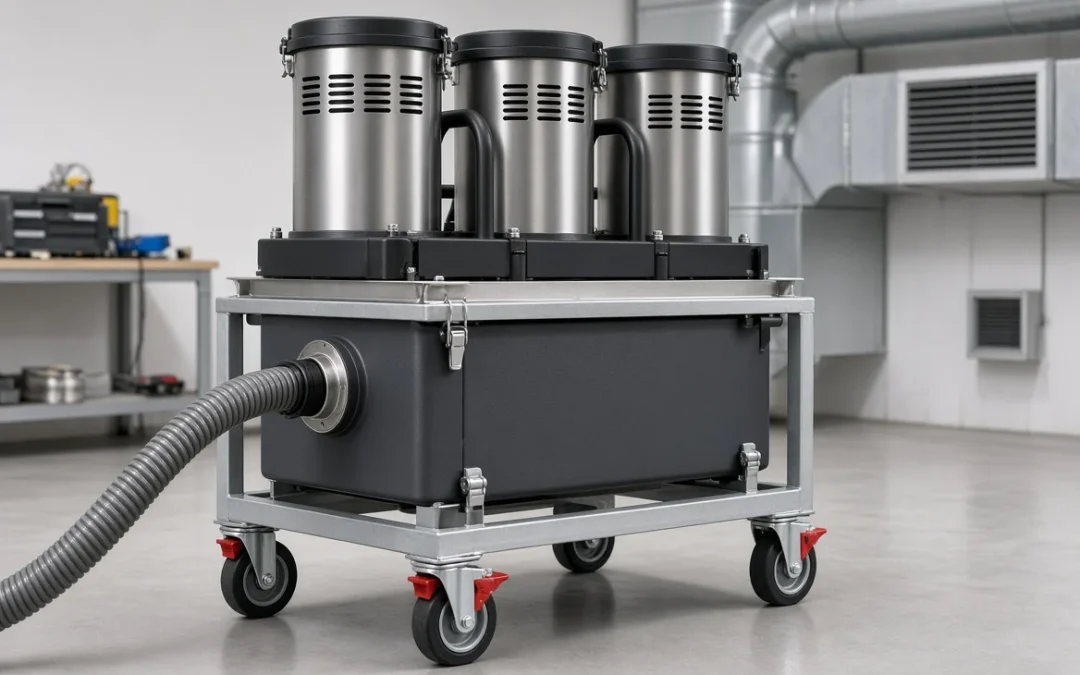
DuctPro’s Tri-Motor Vacuum System provides a useful real-world example of why multiple specifications matter.
The current confirmed specifications are:
| Specification | DuctPro Tri-Motor Vacuum |
| Airflow | 330 CFM |
| Air Watts | 900 Air Watts |
| Water Lift | 220 inches |
| Motor configuration | Three independent vacuum motors |
| Debris capacity | 12 gallons |
These are manufacturer-confirmed specifications and should be evaluated as a group rather than interpreted as independent guarantees of field performance.
The 330 CFM figure describes the system’s confirmed airflow specification. It should not be interpreted as a universal airflow requirement for duct cleaning, nor should it be presented as a measurement of airflow available under every field condition.
The 220 inches of water lift represents a different characteristic. It provides information about the vacuum’s pressure capability and should be considered alongside airflow when evaluating the system.
The 900 Air Watts specification is another measure of the system’s power characteristics. Air Watts should not be treated as interchangeable with CFM or water lift.
Finally, the three independent vacuum motors describe the system’s motor configuration. Motor count alone does not determine cleaning performance, but it is a relevant part of understanding how the vacuum is engineered.
For the complete product specifications, see the DuctPro Tri-Motor Vacuum.
What Are Air Watts?
Air Watts are often misunderstood because they appear alongside CFM and water lift on vacuum specifications.
Air Watts are a calculated measure associated with vacuum airflow and pressure performance. They are not simply another name for electrical watts, and they should not be substituted directly for CFM or water lift.
For equipment comparisons, the practical lesson is straightforward: if a manufacturer provides CFM, water lift, and Air Watts, keep those measurements separate. Each describes a different aspect of the vacuum system.
DuctPro’s current Tri-Motor specification is 900 Air Watts. That number should be presented as a manufacturer specification, not converted into an unsupported CFM or suction claim.
Does More CFM Always Mean Better Duct Cleaning?
No.
Higher airflow can be valuable, but airflow has to be considered with pressure capability and the resistance of the complete extraction path.
Suppose two machines have different advertised CFM ratings. That information alone does not tell you which machine will maintain the more useful operating condition once hoses, filters, fittings, and duct resistance are introduced.
Likewise, a machine with a higher water-lift rating is not automatically superior if its airflow characteristics are unsuitable for the intended application.
The meaningful comparison is the complete system.
This is why contractors shopping for air duct cleaning equipment should examine the relationship between airflow, pressure capability, hose configuration, filtration, collection capacity, and operating requirements rather than selecting equipment from a single headline specification.
What Specifications Should Contractors Compare?
When evaluating a professional duct cleaning vacuum, start with the following questions.
1. What is the manufacturer’s CFM specification?
Determine what airflow figure the manufacturer actually publishes. Do not assume that the number represents airflow available at the hose end under every operating condition.
2. What is the water-lift or vacuum specification?
This provides information about pressure capability and helps put the airflow rating into context.
3. How are the airflow and pressure specifications measured?
Specifications are only useful when their measurement conditions are understood. Avoid comparing numbers that were measured under materially different conditions as if they were equivalent.
4. What hose configuration is used?
Look at hose diameter, length, fittings, and the intended connection arrangement. The extraction path has a direct effect on resistance.
5. How does the filtration system affect the air path?
A vacuum needs an effective filtration system, but filtration also introduces resistance. Maintenance and debris loading therefore matter.
6. What is the motor configuration?
Motor count can provide useful information about how a system is designed, but it should never be used as a shortcut for predicting total cleaning performance.
7. What is the debris capacity?
Collection capacity affects how frequently the system needs to be interrupted for emptying or servicing. DuctPro’s Tri-Motor system has a confirmed 12-gallon debris capacity.
8. How does the complete setup match the work?
The best equipment comparison is ultimately application-specific. Consider the duct systems being cleaned, expected hose runs, access arrangements, filtration requirements, and the cleaning method used by the contractor.
DuctPro’s guidance on proper equipment placement also explains why the physical position of the vacuum can affect the resistance of the extraction path and the performance delivered at the working point.
A Better Way to Think About Vacuum Performance
The most useful mental model is not “CFM versus suction.”
It is a complete air path.
Vacuum motor → hose → fittings → access point → duct system → debris → filtration → collection system
Every part of that path affects the operating condition of the vacuum.
The vacuum’s published specifications describe its capabilities under defined conditions. The job-site configuration determines how those capabilities are translated into actual airflow and pressure at the working point.
That is why experienced equipment buyers look beyond a single number.
A professional duct cleaning vacuum should be evaluated by how its airflow and pressure characteristics work together with the physical extraction system.
For contractors who want to verify airflow rather than rely only on published specifications, DuctPro’s Airflow Performance Testing resource explains how measured airflow and operating conditions can be evaluated after cleaning.
The Bottom Line for Contractors
Vacuum suction power for duct cleaning is not a single specification.
CFM tells you about airflow volume. Water lift tells you about vacuum pressure capability. Air Watts provide another measure of the system’s airflow and pressure performance. Hose dimensions, duct configuration, filtration, debris loading, and equipment setup determine how those capabilities behave under actual operating conditions.
For contractors comparing equipment, the goal is not to find the biggest number on a specification sheet. The goal is to understand what each number measures and how the specifications interact when the vacuum is connected to a real duct-cleaning system.
That approach produces a more meaningful equipment comparison and avoids one of the most common mistakes in vacuum selection: assuming that advertised CFM alone tells the whole story.