
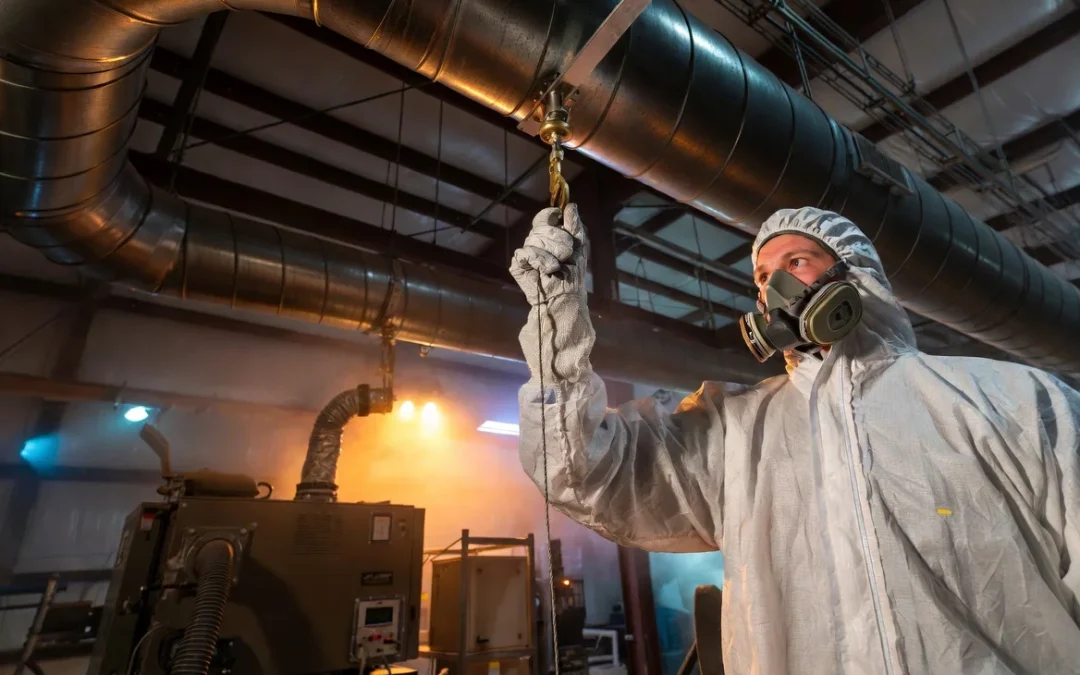
Industrial HVAC cleaning is not simply a larger version of commercial duct cleaning. Manufacturing plants introduce different contamination sources, larger and more complex duct systems, production constraints, access challenges, and, in some facilities, specific dust hazards that can affect how cleaning work is planned and performed.
A successful manufacturing plant HVAC cleaning project starts before the vacuum is switched on. The contractor needs to understand the manufacturing process, identify what is accumulating inside the HVAC system, evaluate access and extraction paths, coordinate with facility safety procedures, and select equipment based on the actual operating conditions.
For facility managers, the same principle applies when evaluating contractors. The important question is not simply whether a contractor owns a powerful vacuum. It is whether the contractor has a technically sound plan for controlling contamination, maintaining effective extraction, protecting the work area, and documenting the work performed.
Why Manufacturing Plants Need a Different HVAC Cleaning Approach
A commercial office building may primarily deal with ordinary dust, fibers, and general building debris. A manufacturing facility can introduce particulates directly from its production process.
The HVAC system may operate around:
- Wood dust
- Metal particulate
- Food dust
- Plastic particulate
- Textile fibers
- Mineral dust
- Chemical process dust
- General airborne industrial particulate
These materials do not behave identically. Particle size, density, shape, moisture content, concentration, adhesion to duct surfaces, and the source process can all affect how contamination accumulates and how it should be removed.
The physical configuration of the facility also changes the job. Manufacturing plants can have long duct runs, elevated equipment, difficult access points, production machinery around HVAC components, restricted work areas, and schedules that make shutdowns or isolation more complicated.
That means an industrial duct cleaning plan should be based on the facility rather than copied from a generic procedure.
The objective is also broader than making the inside of a duct look cleaner. The contractor must consider how loosened material will be controlled, where extracted material will go, how filtration will be handled, how hoses will be routed, and how the cleaning process interacts with the operating HVAC system.
For facility managers researching professional air duct cleaning equipment, these system-level considerations are as important as the equipment’s published specifications.
What Builds Up in Industrial HVAC Systems?
The first useful question is not “How much dust is in the duct?” It is “What is the dust, and where did it come from?”
Manufacturing processes can create very different contamination profiles. A woodworking operation, for example, can introduce wood particulates into surrounding areas. A metal fabrication operation may produce metal dust or particulate. Food production can create food-related dust, while textile manufacturing can generate fibers.
The source matters because contamination characteristics influence the cleaning approach.
A contractor should consider:
- The material being processed.
- How the material becomes airborne.
- Where airborne particulate can enter the HVAC system.
- How long contamination has been accumulating.
- Whether deposits are loose, compacted, adhered, or mixed with other material.
- Whether moisture, grease, or other substances are present.
- Whether the material presents a known facility-specific hazard.
Industrial dust should not automatically be treated as one category. The hazard associated with particulate depends on the material, concentration, particle characteristics, process, facility design, and applicable safety requirements.
This distinction becomes particularly important when combustible-dust considerations are involved.
How the Manufacturing Process Changes the Cleaning Plan
The manufacturing process should influence the cleaning plan from the beginning.
Consider two facilities with similar-looking ductwork. One may manufacture textiles while another processes wood. The duct dimensions could be comparable, but the contamination, work practices, access requirements, and safety considerations may be substantially different.
The same principle applies across food manufacturing, woodworking, metal fabrication, plastics manufacturing, textile production, pharmaceutical manufacturing, chemical processing, and general industrial facilities. These examples should not be treated as interchangeable environments.
Before mobilization, the contractor should understand what happens inside the facility and how that process relates to the HVAC system.
Useful questions include:
- What products or materials are manufactured?
- Where is particulate generated?
- Which HVAC systems serve production areas?
- Which sections of ductwork require cleaning?
- Where are the access points?
- Can equipment be positioned close to the system being cleaned?
- What production activities will continue during the work?
- What facility procedures apply to contractors?
- Are there existing hazard assessments or safety documents relevant to the work?
- What containment arrangements are needed?
- How will extracted material be collected and handled?
- What compressed-air equipment or pneumatic tools are planned?
- What filtration configuration will be used?
- How will the cleaned areas be inspected afterward?
This information gives the contractor a basis for planning rather than assuming that one industrial cleaning method will work everywhere.
Combustible Dust and Industrial Cleaning Safety
Some manufacturing processes can create combustible-dust hazards. That does not mean every manufacturing plant has a combustible-dust hazard, and it does not mean every type of industrial particulate presents the same risk.
Where combustible dust may be relevant, cleaning methods and equipment selection should be considered within the facility’s established hazard controls.
Before work begins, contractors should understand applicable facility documentation, hazard controls, and any relevant dust hazard assessment or other safety information available to the facility. The facility’s EHS personnel, qualified safety professionals, industrial hygienists, engineers, and other appropriate personnel may need to be involved depending on the circumstances.
Applicable OSHA requirements, fire and process-safety standards, and locally adopted requirements should also be evaluated for the specific facility.
NFPA 652 and other combustible-dust standards may be relevant in some environments, but the applicable edition, scope, and local adoption need to be verified rather than assuming that one provision applies universally.
A contractor should not represent a vacuum as automatically safe for combustible dust simply because it is used for industrial cleaning. Likewise, equipment should not be described as intrinsically safe, explosion-proof, ATEX-certified, NFPA-certified, OSHA-approved, or otherwise specially certified unless the applicable manufacturer documentation explicitly establishes that claim.
DuctPro equipment should not be treated as a substitute for a facility dust hazard assessment, qualified safety personnel, engineering evaluation, EHS procedures, or applicable regulatory requirements.
The safest approach is to establish the hazard conditions first, then determine what equipment and work practices are appropriate for those conditions.
What Contractors Should Evaluate Before the Job
A pre-job assessment gives the contractor an opportunity to identify problems before equipment and personnel arrive at the facility.
The assessment does not need to be identical for every manufacturing plant. Its scope should reflect the facility, production process, HVAC system, contamination, and applicable safety procedures.
Key areas to evaluate include:
Facility and production process. Understand what the plant manufactures and where airborne contamination originates.
Duct configuration. Review the size, routing, branches, access points, transitions, fittings, and other features that affect cleaning and extraction.
Contamination. Identify the apparent material and condition of deposits. Do not assume that visible dust has the same characteristics as dust generated elsewhere in the facility.
Access. Determine where access openings are available and whether additional access planning is required.
Equipment placement. Identify practical locations for the vacuum and other equipment while keeping hose paths as direct as reasonably possible.
Hose routing. Plan around unnecessary length, sharp bends, fittings, elevation changes, machinery, walls, and other obstacles.
Filtration and collection. Determine how loosened material will be captured and how the equipment’s filtration and collection arrangement fits the job.
Electrical and compressed-air requirements. Verify the actual facility requirements and the requirements of the equipment and tools being used. Do not assume that one electrical or compressor configuration fits every project.
Containment and work-zone isolation. Determine how the work area will be controlled so loosened material does not migrate into occupied or sensitive areas.
Production schedule. Coordinate cleaning with production activity, access restrictions, shutdowns, and facility scheduling requirements.
Facility safety procedures. Review contractor orientation, access rules, lockout or isolation procedures where applicable, PPE requirements, emergency procedures, and other facility-specific controls.
Hazard documentation. Review relevant safety information supplied by the facility before selecting work methods.
Post-cleaning verification. Decide how the completed work will be inspected and documented.
This preparation also gives facility managers a useful way to evaluate contractors. A contractor who asks detailed questions about the plant before arriving is demonstrating a different level of preparation from one that treats every facility as the same cleaning job.
Containment and Negative Pressure
Industrial cleaning can loosen material that was previously attached to duct surfaces. Without controlled extraction, that material can potentially migrate into areas that were not intended to receive the debris.
Containment and controlled airflow help establish a deliberate path for material to move from the duct system toward the collection equipment.
The basic concept is straightforward. The cleaning process loosens contamination, while the extraction system captures and transports that material. Equipment location, hose routing, access points, filtration, and the configuration of the duct system all influence how effectively that process works.
Negative pressure is therefore not just a number displayed on a gauge. It is part of an airflow-control strategy.
The appropriate approach depends on the system and the work being performed. There is no single negative-pressure value that should be presented as universally required for every industrial duct cleaning project.
For a deeper explanation of the principles involved, see how to establish negative pressure during duct cleaning.
How CFM, Static Pressure, and Water Lift Affect Extraction
CFM is useful, but CFM alone does not tell the whole story.
Air velocity can be expressed as:
Velocity = Volumetric Flow Rate / Cross-Sectional Area
That relationship explains why the same volumetric airflow can produce different air velocities in different duct sizes. It also shows why a universal industrial FPM requirement cannot be applied to every duct system without considering the actual geometry and operating conditions.
Real-world extraction depends on several interacting factors, including:
- Duct dimensions
- Duct geometry
- System resistance
- Hose length
- Hose diameter
- Bends
- Fittings
- Filters
- Access openings
- Contamination
- Particulate characteristics
- Extraction configuration
- Equipment operating conditions
A contractor therefore should not determine whether a particular industrial duct can be cleaned simply by comparing its diameter with a vacuum’s CFM rating.
The operating system matters.
Static pressure describes resistance within an airflow system, while airflow describes the volume of air being moved. Water lift is another equipment specification and should not be treated as a direct measurement of job-site static pressure.
The relationship between airflow and pressure is more useful than treating either number in isolation. A vacuum can have published airflow and water-lift specifications, but the performance experienced during an actual cleaning operation depends on the complete airflow path and its resistance.
For a more detailed discussion, see HVAC static pressure analysis for duct cleaning.
Contractors can also use the broader principles of CFM required for professional duct cleaning when evaluating how airflow should be considered in professional cleaning work.
Hose Routing, Equipment Placement, and System Resistance
A vacuum’s published specifications do not exist independently of the hose connecting the equipment to the duct system.
Hose routing introduces resistance into the extraction path. Unnecessary length, repeated bends, restrictive fittings, elevation changes, and difficult access can all affect the operating conditions experienced by the extraction system.
This is one reason equipment placement deserves attention during job planning.
If the vacuum can be positioned closer to an appropriate access point without interfering with production or creating a safety problem, the contractor may be able to establish a more practical extraction path. Conversely, placing equipment wherever it happens to be convenient can result in a more complicated hose route.
There is no universal maximum hose length that applies to every industrial cleaning project. The relevant question is how the complete hose and duct configuration affects the operating system.
See optimizing vacuum hose routing to maintain vacuum performance for a more detailed explanation.
Equipment placement should also account for access, containment, operator movement, production traffic, electrical requirements, and the facility’s safety procedures. The goal is not simply to put the vacuum as close as possible to the duct. It is to create a practical and controlled setup.
A useful reference for this part of job planning is air duct cleaning equipment setup guide.
DuctPro Tri-Motor Vacuum as an Equipment Example
The DuctPro Tri-Motor Vacuum provides a useful example of why equipment specifications should be reported precisely rather than replaced with generalized performance claims.
The current confirmed manufacturer specifications are:
| Specification | DuctPro Tri-Motor Vacuum |
| Airflow | 330 CFM |
| Air Watts | 900 Air Watts |
| Water Lift | 220 inches |
| Motor configuration | Three independent vacuum motors |
| Debris capacity | 12 gallons |
These are manufacturer specifications, not a guarantee of a particular cleaning result in a manufacturing plant. Actual extraction performance depends on the complete operating configuration, including system resistance, hose routing, duct geometry, contamination, filtration, access conditions, and equipment operation.
The 330 CFM specification should not be converted into an assumed performance figure for individual motors, nor should it be compared with a theoretical airflow requirement to determine automatically whether the equipment can clean a particular industrial duct.
The same principle applies to the 220-inch water-lift specification. It is an equipment specification, not a statement of the static pressure that will exist at every job site.
The three independent vacuum motors and 12-gallon debris capacity are also manufacturer specifications. They should be understood in the context of the complete cleaning setup rather than treated as standalone guarantees.
For contractors evaluating the equipment itself, the current DuctPro Tri-Motor Vacuum product information should be used for current product details.
When pneumatic agitation or compressed-air tools are part of the DuctPro operating setup, the confirmed recommended compressor operating range is 120 to 175 PSI. That range should not be interpreted as a universal compressor requirement for every pneumatic tool or every industrial cleaning application. Contractors should verify the requirements of the specific tools and operating procedure being used.
Filtration, Collection, and Chemical Treatment
Filtration is another part of the cleaning system that should be evaluated according to the job.
Not every industrial cleaning project requires HEPA filtration. The appropriate filtration configuration depends on the contamination, facility procedures, equipment configuration, and applicable safety requirements.
Similarly, captured material should not automatically be classified as hazardous waste. Disposal requirements depend on what the equipment collected and the applicable waste-management rules.
The contractor should understand what material is being removed and how the facility expects it to be handled.
Chemical treatment requires the same level of caution.
Physical debris removal, grease removal, microbial concerns, and chemical treatment are different activities. A manufacturing facility should not automatically receive a sanitizing treatment simply because its HVAC system has been cleaned.
Where chemical products are used, contractors should follow the product manufacturer’s instructions, consider material compatibility, control runoff where relevant, and document the product used when appropriate.
Chemical concentration, dwell time, pH, coverage rate, and other application details should come from the applicable product documentation rather than being invented as universal duct-cleaning requirements.
PPE and Worker Safety
There is no universal PPE list that is appropriate for every manufacturing plant.
PPE and work practices should be determined by the facility’s hazard assessment, the contamination involved, applicable safety requirements, and the contractor’s established procedures.
The difference matters because industrial particulates can vary substantially between facilities. A protective approach appropriate for one material may not be appropriate for another.
Contractors should coordinate with the facility before work begins and understand the site’s applicable safety procedures. Where the hazard assessment identifies a need for specialized protection or work controls, those requirements should be incorporated into the cleaning plan.
Equipment selection should follow the identified hazard conditions, not the other way around.
Documentation and Post-Cleaning Verification
Industrial HVAC cleaning produces information that can be useful long after the crew leaves the facility.
A practical service record can document:
- Pre-cleaning condition
- Areas included in the scope
- Access points used
- Equipment used
- Visible contamination
- Unusual conditions encountered
- Areas cleaned
- Post-cleaning condition
- Photographs where appropriate
- Date of service
- Scope of work performed
This documentation can support facility maintenance records and provide useful information for future service planning.
Photographs can be particularly useful when they show the condition before and after cleaning in comparable locations. Notes about inaccessible sections or unusual contamination can also prevent confusion during a later service visit.
Documentation does not, by itself, establish regulatory compliance or guarantee an insurance outcome. Its practical value is that it creates a clearer record of what was observed, what work was included, and what was performed.
Post-cleaning verification should also match the scope of the project. The appropriate verification method depends on the facility, system, contamination, and agreed scope.
For projects where airflow measurements are part of the service scope, airflow performance testing provides additional context on evaluating HVAC airflow performance.
Questions Facility Managers Should Ask a Duct Cleaning Contractor
Facility managers can learn a great deal about a contractor by asking how the work will be planned.
Useful questions include:
What do you need to know about our manufacturing process before the job?
A contractor should understand the contamination source and facility conditions rather than treating the project as generic duct cleaning.
How will you control loosened material during cleaning?
The answer should address extraction, containment, airflow direction, filtration, and work-zone control as appropriate.
How will you determine equipment placement?
A sound plan should consider access, hose routing, system resistance, production activity, and facility safety requirements.
How will you evaluate the contamination?
The contractor should recognize that different industrial materials can behave differently and may require different planning.
How will combustible-dust considerations be handled if they apply to our process?
The contractor should be prepared to work within the facility’s hazard controls and should not make unsupported claims about equipment being automatically suitable for every dust environment.
What information do you need from our EHS or safety department?
This question can reveal whether the contractor understands that industrial cleaning is performed within an existing facility safety framework.
How will the work be documented?
Ask what condition photographs, scope records, equipment information, and post-cleaning observations will be provided.
How will you verify the completed work?
The answer should reflect the agreed scope and the actual facility conditions rather than promise a universal verification method.
These questions shift the conversation away from a single CFM number and toward the complete cleaning system.
Conclusion
Industrial HVAC cleaning in manufacturing plants requires more planning than simply connecting a vacuum to a duct and removing visible debris.
The manufacturing process determines what particulate may be present. The duct configuration affects access and extraction. Hose routing and equipment placement influence system resistance. Containment and filtration affect how loosened material is controlled. Static pressure and airflow interact during operation. Facility safety procedures determine how the work should be planned and performed.
Combustible-dust considerations require particular care. Where such hazards may exist, contractors should work from the facility’s applicable hazard documentation and safety controls rather than assuming that a generic industrial cleaning method or vacuum is automatically appropriate.
Equipment specifications also need to be treated accurately. The current DuctPro Tri-Motor Vacuum specification is 330 CFM, 900 Air Watts, 220 inches of water lift, three independent vacuum motors, and a 12-gallon debris capacity. Those figures describe the equipment. They do not establish a universal industrial duct-cleaning requirement or guarantee a particular result at every facility.
For manufacturing-plant operators and contractors, the better approach is to evaluate the entire system: contamination, duct geometry, access, airflow, resistance, hose routing, containment, filtration, safety controls, equipment, and verification.
That is what turns industrial duct cleaning from a generic service into a controlled maintenance operation suited to the facility being cleaned.