
Restaurant HVAC duct cleaning requires a different approach from cleaning an ordinary residential or commercial air distribution system. A kitchen exhaust system can contain grease-laden deposits, particulate, and other residues that adhere to interior surfaces and become progressively harder to remove.
The cleaning challenge is not simply moving more air through a dirty duct. Contractors have to consider the contamination itself, system configuration, access, containment, extraction, filtration, hose routing, and the resistance created by the complete cleaning setup.
For restaurant owners and commercial kitchen operators, the practical goal is straightforward: keep the ventilation system maintained, control grease accumulation, minimize contamination during service, and document the work performed.
For contractors, that requires matching the cleaning method and air duct cleaning equipment to the actual system rather than relying on a single equipment specification.
Why Restaurant HVAC Cleaning Is Different
Commercial kitchen exhaust contamination is fundamentally different from ordinary household dust.
Cooking produces grease-laden vapors and particulate that enter the exhaust airstream. Some material is captured by grease removal devices, while other material can deposit on accessible and internal surfaces of the exhaust system. As deposits accumulate, they can become sticky, hardened, or otherwise difficult to remove with airflow alone.
That creates several practical differences.
First, the contamination can adhere strongly to duct surfaces. A vacuum that is effective at collecting loose dust is not automatically effective at removing adhered grease.
Second, cleaning can generate additional material that must be controlled. Mechanical agitation can loosen deposits, while chemical degreasing can turn adhered material into a form that must then be collected and managed.
Third, access matters. A contractor may need to work through existing access panels or establish appropriate access points so that the system can be inspected and cleaned without relying on a single opening.
Fourth, the surrounding restaurant is an operating food-production environment. Containment and work scheduling therefore matter as much as extraction.
Restaurant duct cleaning should not be treated as ordinary HVAC cleaning with a larger vacuum.
Kitchen Exhaust Systems Are Not the Same as Supply and Return Ductwork
A commercial kitchen may contain several distinct air pathways.
The kitchen exhaust system removes cooking-related air through components such as the hood, grease removal devices, exhaust ductwork, and exhaust fan. Supply and return HVAC systems perform a different function, distributing and returning conditioned air.
A restaurant can also contain shared plenums, air handlers, and other configurations where different air pathways interact. That does not mean cooking vapor automatically travels into every supply or return duct.
The actual configuration determines where contamination can travel and where inspection or cleaning is appropriate.
A contractor should identify the system before beginning work. That means determining which ductwork is part of the kitchen exhaust system, which components belong to the building HVAC system, where air handlers are located, how the systems connect, and which areas require protection during cleaning.
This distinction prevents a common mistake: assuming that every duct serving a restaurant should be cleaned using the same process.
Where Grease and Particulate Can Accumulate
Grease accumulation is influenced by the cooking operation, exhaust system design, operating conditions, system geometry, and maintenance history. Deposits should therefore be evaluated through inspection rather than predicted from a generic deposition rate.
Areas that may require attention include:
- Hood and plenum surfaces.
- Grease removal devices.
- Exhaust duct interiors.
- Accessible horizontal and vertical duct sections.
- Transitions and changes in duct geometry.
- Exhaust fan housings and accessible components.
- Access panels and other service locations.
The presence and severity of contamination will vary from one restaurant to another.
A high-volume cooking operation can present a different cleaning challenge from a small kitchen with limited cooking activity. Charbroiling, frying, wok cooking, solid fuel cooking, and other operations can also produce different contamination profiles.
The useful question is not how much grease should theoretically accumulate in a particular number of days. The useful question is what the inspection actually shows and what the applicable maintenance requirements call for.
Grease Management Is More Than Removing Visible Dirt
Grease management is a continuing maintenance issue, not simply a cleaning-day problem.
As grease accumulates, it can make surfaces more difficult to clean and may require a combination of mechanical agitation and chemical degreasing. Deposits can also create combustible material within portions of a commercial cooking exhaust system, which is one reason inspection and maintenance are addressed by fire-protection standards.
That does not mean every restaurant duct should be described as an immediate fire hazard. The condition of the system must be evaluated based on its actual contamination, construction, operation, and applicable requirements.
Good grease management therefore combines several practices:
- Appropriate cooking operation and grease removal practices.
- Regular inspection of the exhaust system.
- Cleaning when inspection or applicable requirements indicate it is necessary.
- Proper access to contaminated components.
- Controlled removal and collection of deposits.
- Documentation of inspection and cleaning work.
The objective is controlled maintenance, not alarmist predictions about how quickly a particular duct will become contaminated.
NFPA 96, Inspection, and Cleaning Requirements
NFPA 96 is the Standard for Ventilation Control and Fire Protection of Commercial Cooking Operations. It addresses commercial cooking ventilation and related fire-protection requirements, including procedures concerning inspection, testing, maintenance, and cleanliness. The current NFPA publication library identifies a 2024 edition, while newer editions and proposed changes may also exist.
This distinction matters because contractors should not assume that a provision from one edition automatically applies to every jurisdiction.
The applicable NFPA 96 edition depends on adoption and local requirements. The authority having jurisdiction, or AHJ, may also have requirements that affect how a particular installation is inspected or maintained.
Inspection Frequency Depends on the Cooking Operation
NFPA 96 inspection provisions use cooking type and volume to establish different inspection frequencies. The framework includes monthly inspection for systems serving solid fuel cooking operations, quarterly inspection for high-volume cooking operations, semiannual inspection for moderate-volume operations, and annual inspection for low-volume operations.
These categories should not be treated as a shortcut for classifying every restaurant. The applicable edition, local adoption, AHJ requirements, and actual cooking operation should be verified.
Inspection frequency also should not be confused with an automatic cleaning schedule. Inspection identifies the condition of the system and helps determine whether cleaning is necessary under the applicable requirements.
NFPA materials also address cleaning of exhaust systems when contamination from grease-laden vapors is found.
Avoid Universal Grease-Depth Claims
Grease-depth provisions have changed and evolved across NFPA 96 editions and related proposals. For that reason, contractors should not present a particular grease-depth number as a universal threshold for every restaurant.
For example, a measurement appearing in a particular NFPA edition or proposed revision should not automatically be transferred into a different jurisdiction or edition.
The correct approach is to identify the applicable NFPA 96 edition and verify the requirements that have been adopted by the relevant authority.
This is also why cleaning documentation should identify what was inspected, what was cleaned, when the work occurred, and what standard or local requirement governed the work.
Planning a Restaurant Duct Cleaning Job
A professional cleaning job begins before the vacuum is switched on.
A useful workflow includes:
- Pre-inspection
- System identification
- Access planning
- Containment planning
- Equipment setup
- Mechanical agitation where appropriate
- Chemical degreasing where appropriate
- Negative-pressure extraction
- Collection and waste management
- Post-cleaning inspection
- Documentation
The exact sequence can vary.
A heavily contaminated exhaust system may require more mechanical work than a lightly contaminated system. Materials, access, duct geometry, equipment configuration, chemical compatibility, and the contractor’s cleaning method all affect the appropriate procedure.
The point is to develop a job-specific plan instead of applying identical settings and procedures to every restaurant.
Containment and Food-Production Protection
Containment is one of the most practical parts of restaurant duct cleaning.
The contractor is working in or near an environment where food is prepared, equipment is operated, and employees may need access. Loosened particulate, grease residue, chemical runoff, and other cleaning materials therefore need to be controlled.
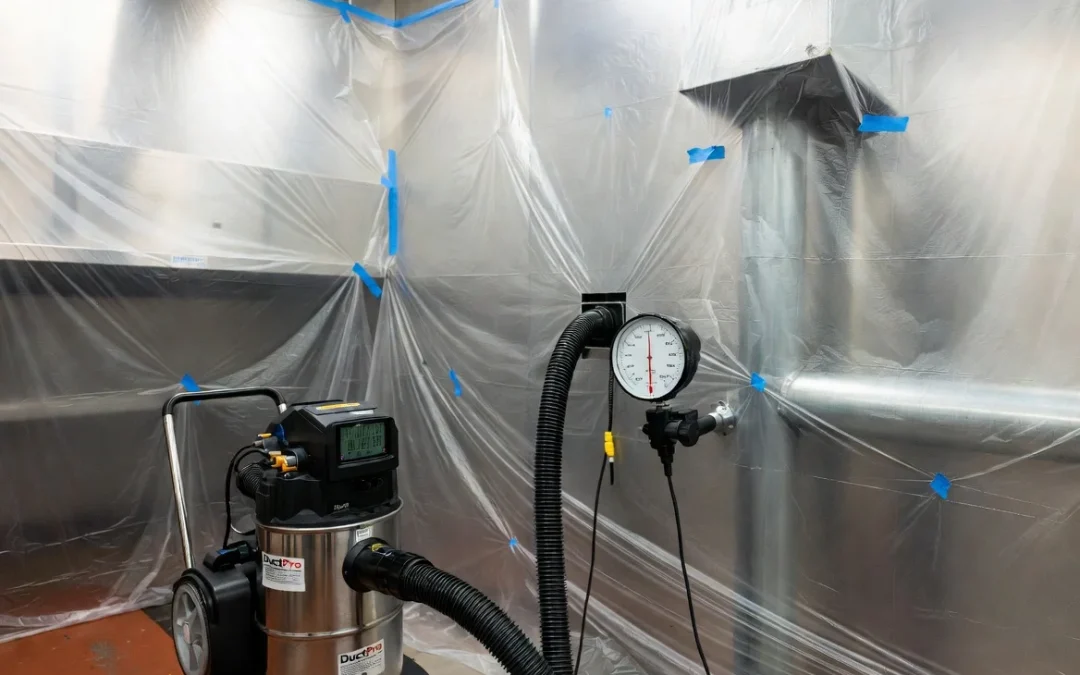
A reasonable containment plan can include:
- Protecting food-preparation surfaces.
- Protecting cooking and adjacent equipment.
- Covering or isolating areas that could be contaminated.
- Controlling debris generated during mechanical cleaning.
- Managing airflow so loosened material does not migrate unnecessarily.
- Protecting adjacent rooms and customer-facing areas.
- Establishing a controlled route for hoses and equipment.
- Collecting wastewater and cleaning residues appropriately.
- Scheduling work to minimize disruption to restaurant operations.
There is no universal rule requiring every restaurant to remain closed for a specific number of hours after cleaning. The appropriate return-to-production procedure depends on the cleaning process, chemical products, facility procedures, ventilation configuration, and applicable health, safety, fire-code, and operational requirements.
Restaurant operators and contractors should agree on the procedure before work begins.
Why Negative Pressure Helps During Cleaning
Controlled negative pressure can help create a predictable airflow direction during duct cleaning.
Instead of allowing loosened material to migrate unpredictably into surrounding areas, the extraction system can be configured so that air and dislodged contamination move toward the collection equipment.
This is particularly useful when mechanical agitation is being performed.
The concept is simple:
Containment controls where material can go. Negative pressure helps control the direction of airflow. Extraction removes the material from the system.
The actual pressure achieved will depend on the equipment, duct configuration, access points, hose arrangement, system leakage, and resistance. There is no single negative-pressure value that should be treated as universally required for every commercial kitchen cleaning job.
For a deeper explanation of the setup, see DuctPro’s guide to establishing negative pressure during duct cleaning.
Mechanical and Chemical Cleaning
Grease deposits often require more than suction.
Mechanical agitation can help break adhered contamination away from duct surfaces. Depending on the system and material, contractors may use brushes, air tools, scraping methods, or other appropriate equipment.
The objective is to loosen contamination without damaging the duct or associated components.
Chemical degreasing can then be used where appropriate to help break down residual grease and facilitate removal.
The chemical stage should be treated as a controlled process, not a fixed recipe.
Contractors should:
- Confirm that the chemical is compatible with the surfaces being cleaned.
- Follow the chemical manufacturer’s instructions.
- Use appropriate personal protective equipment and handling procedures.
- Allow the product to work according to its manufacturer’s directions and the conditions of the job.
- Prevent uncontrolled chemical runoff.
- Collect and dispose of residues according to applicable requirements.
There is no universal dwell time or concentration that should be applied to every restaurant duct. Galvanized steel, stainless steel, aluminum, coatings, sealants, and other materials may respond differently to cleaning chemicals.
A professional contractor therefore evaluates the system before selecting the chemical procedure.
Extraction Is the Other Half of Agitation
Loosening contamination is only half the job.
The material has to leave the system.
This is where extraction configuration becomes important. The vacuum, hoses, access openings, filters, collection container, duct geometry, and system resistance all influence what the contractor can achieve at the cleaning point.
A powerful-looking equipment specification does not automatically translate into the same airflow at the end of every hose configuration.
For contractors evaluating equipment, DuctPro’s CFM guide for professional duct cleaning provides additional context on airflow and application.
How CFM, Water Lift, and Static Pressure Relate
CFM and water lift describe different aspects of vacuum performance.
CFM describes volumetric airflow. Water lift describes the vacuum’s ability to develop suction against resistance. Both can matter when evaluating an extraction system.
A useful starting relationship for airflow and velocity is:
Velocity = Volumetric Flow Rate / Cross-Sectional Area
That relationship explains why a CFM rating cannot be converted into a universal transport velocity without knowing the cross-sectional area through which the air is moving.
For example, the same airflow passing through a small hose and a much larger duct will produce different air velocities. The actual operating point can also change because of hose length, bends, filters, access openings, duct leakage, transitions, contamination, and other sources of resistance.
Transporting loosened material therefore depends on more than a nameplate CFM value.
Debris characteristics matter as well. Loose dry particulate behaves differently from sticky grease deposits. A contractor may also change the airflow path during a job by changing hose routing, opening or closing access points, or altering the extraction configuration.
DuctPro’s explanation of vacuum suction power for duct cleaning provides a more detailed discussion of how these specifications should be interpreted.
Static Pressure and System Resistance
The extraction system operates against resistance.
Hose length, hose diameter, bends, filters, collection components, access openings, duct geometry, and contamination can all affect the pressure and airflow available at the cleaning point.
This is why a vacuum should not be evaluated only by its free-air or nameplate specifications.
Static pressure analysis can help contractors understand how the complete system is behaving under operating conditions. DuctPro’s HVAC static pressure analysis guide covers the relationship between system resistance and airflow in greater detail.
The practical lesson is straightforward: if extraction seems weak, inspect the complete airflow path before assuming the vacuum itself is the problem.
Hose Routing Can Change Extraction Performance
Long hose runs and unnecessary bends can add resistance.
The same vacuum can therefore behave differently depending on where it is positioned and how the hose is routed.
When troubleshooting weak extraction, check:
- Total hose length.
- Hose diameter.
- Number and severity of bends.
- Collapsed or restricted hose sections.
- Filter condition.
- Collection container condition.
- Access opening configuration.
- Connections and seals.
- Duct leakage.
- The amount and location of contamination.
DuctPro’s vacuum hose routing guide explains why hose configuration deserves attention when setting up a professional extraction system.
Equipment placement also matters. Positioning the vacuum appropriately can reduce unnecessary hose length and make the extraction path easier to manage. See the DuctPro equipment setup guide for additional setup considerations.
DuctPro Tri-Motor Vacuum as a Real-World Example
The DuctPro Tri-Motor Vacuum provides a useful example of how multiple equipment specifications should be evaluated together.
The current manufacturer specifications are:
| Specification | DuctPro Tri-Motor Vacuum |
| Airflow | 330 CFM |
| Air Watts | 900 Air Watts |
| Water Lift | 220 inches |
| Motor configuration | Three independent vacuum motors |
| Debris capacity | 12 gallons |
These specifications are confirmed by DuctPro’s current technical source.
The important point is not that one number makes the machine suitable for every restaurant.
The 330 CFM specification should be evaluated alongside the system’s 900 Air Watts and 220 inches of water lift, as well as the three independent vacuum motors and 12-gallon debris capacity. Actual extraction performance still depends on how the equipment is connected to the system and the operating resistance encountered during the job.
DuctPro does not specify a universal restaurant duct dimension that its 330 CFM airflow can clean successfully, and contractors should not infer one.
Likewise, the three-motor configuration should not be converted into an invented airflow figure for individual motors or into a claim that the machine produces some larger combined CFM number. The confirmed system airflow specification is 330 CFM.
For the complete product details, see the DuctPro Tri-Motor Vacuum page.
Compressed Air for Pneumatic Cleaning Tools
Compressed air may be part of a commercial duct-cleaning setup when pneumatic agitation tools are used.
DuctPro’s current operation guidance gives a recommended compressor operating range of 120 to 175 PSI.
That range should not be interpreted as a universal pressure requirement for every pneumatic duct-cleaning tool. The correct operating pressure depends on the specific tool and the manufacturer’s instructions.
DuctPro does not establish a universal compressor CFM, horsepower, or tank-capacity specification in the controlling technical source, so those numbers should not be invented or assumed.
Practical Troubleshooting When Extraction Seems Weak
Weak extraction does not always mean the vacuum is undersized.
Start with the airflow path.
Check whether the hose is excessively long, whether bends are creating unnecessary resistance, and whether the hose has collapsed or become restricted. Inspect filters and collection components. Verify that access points are configured correctly and that connections are sealed appropriately.
Then consider the duct itself.
A heavily contaminated section may create a different cleaning challenge from a lightly contaminated section. If mechanical agitation is producing material faster than the extraction path can remove it, the contractor may need to adjust the cleaning sequence or extraction configuration.
The following troubleshooting sequence is useful:
1. Check the equipment.
Verify that the vacuum is operating correctly and that collection and filtration components are not restricted.
2. Check the hose.
Inspect length, diameter, bends, connections, and physical restrictions.
3. Check the access configuration.
Make sure the extraction path and work openings are appropriate for the section being cleaned.
4. Check the system resistance.
Consider duct geometry, transitions, contamination, and leakage.
5. Check the agitation method.
Loosened material must be compatible with the extraction method being used.
6. Check containment.
If material is migrating outside the intended work zone, reassess the pressure boundary and airflow path.
This approach is more useful than simply declaring that a vacuum needs a higher CFM rating.
Post-Cleaning Inspection and Documentation
The job is not finished when the equipment is switched off.
A post-cleaning inspection gives the contractor and restaurant operator an opportunity to verify the condition of accessible surfaces and identify areas that require additional attention.
Depending on the project, useful documentation can include:
- Date and location of service.
- Areas and components inspected.
- Before-and-after photographs.
- Access points used.
- Cleaning methods employed.
- Equipment used.
- Chemical products used, where applicable.
- Areas that were inaccessible.
- Conditions requiring follow-up.
- Waste or residue handling information where relevant.
- Contractor and customer identification.
Photographs are particularly useful because they provide a visual record of the condition observed during the service.
Documentation should describe what was actually inspected and cleaned. Contractors should not claim that inaccessible areas were inspected or cleaned when they were not.
The applicable NFPA edition, local requirements, AHJ expectations, and customer procedures should also be considered when determining what documentation is appropriate for a particular project.
What Restaurant Operators Should Ask Their Cleaning Contractor
Restaurant owners do not need to understand every vacuum specification to evaluate a cleaning contractor.
They should, however, ask practical questions.
What parts of the system will you inspect?
A professional answer should identify the exhaust components and access points included in the service.
How will you control contamination during cleaning?
The contractor should be able to explain how food-preparation areas, adjacent spaces, equipment, and debris will be protected.
How will loosened grease and particulate be extracted?
The answer should address the complete extraction setup rather than simply naming a vacuum.
How will you handle chemical cleaning?
The contractor should identify the type of chemical process being considered and explain how material compatibility, manufacturer instructions, runoff, and worker safety will be addressed.
How will you verify the work?
Ask whether the contractor provides photographs, inspection notes, service documentation, or other evidence of the areas serviced.
Which NFPA 96 edition and local requirements apply?
The contractor should be willing to verify the applicable requirements rather than quoting a single grease threshold or inspection interval as universal law.
What areas cannot be accessed?
A credible contractor should identify limitations instead of implying that every internal surface was cleaned when access was unavailable.
These questions tell an operator much more about the quality of a service than a generic promise of “deep cleaning.”
DuctPro’s Practical Experience
Technical equipment decisions are easier to evaluate when they are grounded in field experience.
DuctPro Systems was founded by Tanner Bryant, who has more than 15 years of experience leading large-scale commercial and government duct-cleaning projects. Jeff Bryant serves as a consultant and has more than 22 years of hands-on experience in the air duct cleaning industry. He is NADCA-certified and holds California Contractor License #1119455.
That experience informs DuctPro’s focus on professional equipment and practical field requirements. The equipment specifications, however, should still be evaluated on their own terms. Experience does not turn a nameplate specification into a performance guarantee.
A Better Way to Think About Restaurant Duct Cleaning
Restaurant HVAC duct cleaning is best understood as a controlled contamination-removal process.
Grease changes the cleaning problem because deposits can adhere to surfaces and require mechanical or chemical assistance before they can be extracted. Containment helps protect the surrounding environment. Negative pressure helps establish controlled airflow toward the extraction system. Hose routing, filtration, collection, duct geometry, and resistance affect what the vacuum can accomplish at the cleaning point.
CFM matters, but CFM alone does not describe the entire extraction system.
Water lift matters, but water lift alone does not guarantee that a particular duct will be cleaned effectively.
The equipment has to work as part of a complete system.
For contractors, that means inspecting the job before selecting the setup, understanding the actual airflow path, controlling contamination during cleaning, and documenting the result. For restaurant operators, it means hiring contractors who can explain their process without relying on exaggerated equipment claims or universal code statements.
The strongest restaurant duct-cleaning program combines regular inspection, appropriate cleaning, controlled grease management, sound extraction practices, practical containment, and documentation.
That is a more defensible approach than treating kitchen exhaust maintenance as ordinary dust removal.