
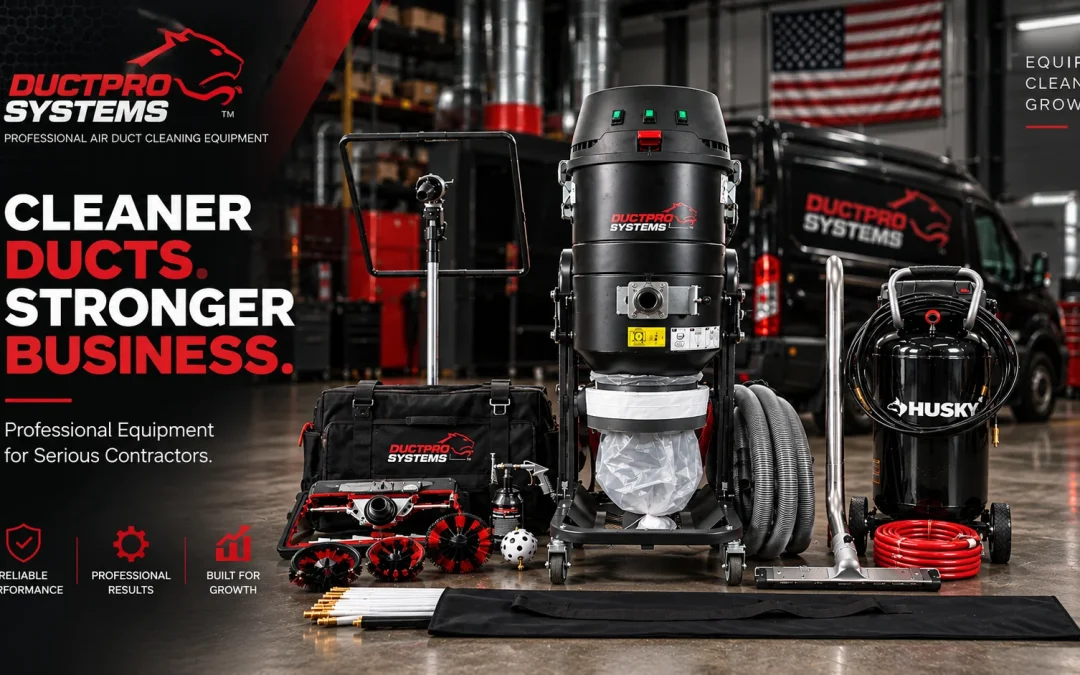
Professional air duct cleaning equipment can cost from a few thousand dollars for a basic setup to well over $10,000 for larger, more comprehensive systems. There is no single price for air duct cleaning equipment because contractors are buying different combinations of equipment: a vacuum, agitation tools, compressed-air equipment, hoses, containment accessories, sanitizing equipment, diagnostic instruments, or a complete package.
DuctPro provides a useful real-world price reference for professional contractors. The Tri-Motor Duct Vacuum is currently listed at $2,260, the Basic Duct Cleaning System at $2,185, and the Complete Duct Cleaning System at $4,475. DuctPro also offers the BioClean Sanitizing Duct Sprayer for $595. These prices show why contractors should compare not only the purchase price, but also what equipment is included in each configuration.
For a contractor entering the business, the more useful question is not simply, “What does an air duct cleaning machine cost?” It is, “What equipment do I actually need for the work I intend to perform?”
The price of a duct cleaning vacuum is only one part of the calculation. Equipment configuration, filtration, accessories, hose requirements, intended applications, and whether the package is ready to work all affect the actual investment.
What Does Professional Duct Cleaning Equipment Cost?
A practical way to think about duct cleaning equipment cost is to separate purchases into several categories.
| Equipment level | What you are generally buying | Cost consideration |
| Basic equipment | Agitation tools and accessories when a suitable vacuum source already exists | Lower initial investment |
| Professional vacuum | Dedicated portable duct cleaning vacuum plus essential connections | Mid-range equipment investment |
| Complete portable system | Vacuum, agitation equipment, hoses, containment, sanitizing equipment, and related tools | Higher initial investment |
| Large commercial or truck-mounted setup | Larger extraction equipment, vehicle integration, extensive tooling, and infrastructure | Highest investment |
These categories overlap. A contractor who already owns a suitable vacuum source may need far less new equipment than someone building an entire duct cleaning operation from scratch.
The same principle applies to commercial work. A contractor cleaning smaller residential systems does not necessarily need the same equipment configuration as a company targeting large commercial buildings, hospitals, industrial facilities, or government projects.
The equipment should be matched to the work, not the other way around.
Contractors comparing their options can review DuctPro’s air duct cleaning equipment alongside the specific equipment requirements discussed below.
Why Air Duct Cleaning Equipment Prices Vary So Much
The price of a duct cleaning machine reflects much more than the motor inside the cabinet.
A contractor is paying for a combination of airflow capability, pressure characteristics, filtration, motor configuration, collection capacity, portability, construction, hoses, controls, accessories, and support.
There is also a major difference between buying a single machine and buying an operating system.
A vacuum may be a reasonable purchase if you already have the compressor, hoses, agitation tools, access equipment, and other items required for the jobs you perform. The same vacuum is not a complete startup package if you have none of those things.
This is why comparing two advertised prices without comparing what is included can be misleading.
One supplier may be selling the extraction machine alone. Another may include the vacuum, hose, agitation tools, sanitizing sprayer, access equipment, training, and technical support.
The second package will naturally cost more. It may also require fewer additional purchases before the contractor can perform a job.
What Are You Actually Paying For?
The most useful way to evaluate professional duct cleaning equipment cost is to look beyond the machine’s headline specification.
The vacuum system
The vacuum is the central extraction component. It establishes the pressure differential that allows loosened debris to be pulled from the duct system toward the collection point.
But a vacuum is not simply a suction generator. Its usable performance depends on how airflow and pressure behave as resistance increases.
That resistance comes from hoses, fittings, filters, duct geometry, access points, leakage, and the duct system itself.
A machine that looks impressive on a specification sheet can behave differently once connected to a real duct system.
Agitation equipment
Vacuum extraction alone is not the entire cleaning process.
Debris that is loose enough to move easily can be transported by the airstream. More persistent accumulation may require mechanical or pneumatic agitation to break material away from duct surfaces so the vacuum can capture it.
This is why a complete duct cleaning package often contains whips, nozzles, rods, air tools, guide equipment, and other accessories in addition to the vacuum.
Hoses and connections
Hoses are easy to underestimate because they appear to be simple accessories.
They are part of the airflow system.
Every additional section, coupling, sharp bend, restrictive fitting, or poorly sealed connection can introduce resistance or leakage. A vacuum cannot deliver the same conditions at the duct opening when too much of its available pressure differential is consumed by the path leading to it.
DuctPro’s guidance on optimizing vacuum hose routing explains why hose length, diameter, bends, elevation changes, and couplings can affect the airflow path.
Filtration
Filtration is another cost that is easy to overlook when comparing machines.
The extraction system has to collect the material it removes. The filtration system therefore affects what happens after contaminated air enters the vacuum.
Filter design also creates resistance. As a filter loads with material, the extraction system has to work against additional resistance.
That creates a practical buying question: what happens to the system’s airflow as the filtration system becomes loaded during a job?
A vacuum should therefore be evaluated as a complete airflow path, not simply by the motor’s advertised airflow number.
Containment and access equipment
Professional duct cleaning frequently involves creating or using access points and controlling where air can move during extraction.
That requires equipment such as vacuum boxes, duct plates, register covers, plugs, hoses, access tools, sealing materials, and related hardware.
These items may represent a relatively small portion of the headline equipment price, but they are part of the cost of actually performing the work.
Why CFM Alone Is a Poor Buying Metric
CFM, or cubic feet per minute, is important. It is not enough by itself.
The problem is that airflow and pressure are connected.
A vacuum operating with little resistance can move a large volume of air. As resistance increases, its operating point changes. The practical airflow available at the working end depends on the machine’s characteristics and the resistance imposed by the complete system.
That resistance can come from the hose, filter, fittings, ductwork, access configuration, and other components.
A useful analogy is an engine and a road. Maximum speed tells you something about an engine, but it does not tell you how the vehicle behaves while climbing a hill. The load matters.
The same principle applies to duct cleaning vacuums.
When comparing equipment, ask:
- What airflow is being specified?
- Under what test conditions?
- What pressure or resistance accompanies that airflow?
- What happens after hoses, filters, and duct connections are added?
- How does the system behave as resistance increases?
- Is the specification for the machine alone or for a particular system configuration?
For a deeper explanation, see DuctPro’s guide to CFM requirements for professional duct cleaning. The important point is that CFM should be considered alongside the rest of the extraction system rather than treated as a single buying metric.
Airflow, Water Lift and Air Watts: How Should Contractors Read the Specifications?
The three numbers often seen on vacuum specifications describe different aspects of the system.
CFM describes airflow volume.
Water lift describes the vacuum’s ability to generate pressure differential under restriction.
Air watts combine airflow and pressure into a measure intended to represent vacuum power.
None of these numbers should be treated as a complete description of cleaning performance.
For example, high airflow with inadequate pressure characteristics can become less useful when system resistance rises. Conversely, a vacuum capable of generating substantial pressure but unable to move enough air may not provide the transport capacity needed to carry loosened debris through the extraction path.
The working system is the combination.
This is particularly important when a contractor is comparing machines from different manufacturers. Two CFM figures are not automatically equivalent if they were measured under different conditions.
For a DuctPro comparison, the same approach means looking beyond the Tri-Motor Vacuum’s 330 CFM specification and evaluating the complete combination of 330 CFM airflow, 900 Air Watts, 220 inches of water lift, three independent vacuum motors, 12-gallon debris capacity, and the equipment included with the selected configuration.
DuctPro Tri-Motor Vacuum: A Real-World Example
DuctPro’s Tri-Motor Vacuum provides a concrete example of how a professional extraction system should be evaluated. The current DuctPro specification is 330 CFM, 900 Air Watts, and 220 inches of water lift, using three independent vacuum motors and a 12-gallon debris tank. Rather than judging the machine from CFM alone, contractors can evaluate these specifications together with the vacuum configuration, filtration, hose setup, and intended application.
The current confirmed DuctPro specification is 330 CFM, 900 Air Watts, and 220 inches of water lift, using three independent vacuum motors and a 12-gallon debris tank. These are the current specifications confirmed by DuctPro.
For contractors comparing professional extraction equipment, these specifications provide a practical benchmark for evaluating airflow, pressure capability, motor configuration, and debris capacity together rather than reducing the purchase decision to a single CFM number.
The current DuctPro Tri-Motor Vacuum product page provides the manufacturer’s current product information and should be used when evaluating the machine’s configuration and included components.
View the DuctPro Tri-Motor Vacuum
How Hose Routing Changes the Value of a Vacuum
Suppose two contractors use identical vacuum systems.
One places the machine relatively close to the extraction point and runs a reasonably direct hose path.
The other leaves the machine farther away, adds hose sections, makes several tight turns, and uses multiple connections.
They own the same machine. They are not necessarily getting the same operating conditions.
Hose resistance consumes part of the pressure differential generated by the vacuum. Leakage at connections can further reduce useful airflow. Tight bends and unnecessary routing changes introduce additional resistance.
This is why equipment placement should be treated as part of the extraction setup.
For contractors, the practical takeaway is simple: buying a stronger vacuum does not eliminate the need for good airflow management.
Why Filtration Belongs in the Price Comparison
A vacuum’s purchase price tells you nothing about the recurring cost of maintaining its filtration system.
Filters are consumables. They load with material. Their condition affects resistance and therefore affects the extraction system’s operating conditions.
This creates two separate questions when comparing machines:
- What does the machine cost to purchase?
- What will it cost to keep the extraction system operating properly?
The second question is often missing from equipment comparisons.
A cheaper machine that requires frequent filter replacement, difficult cleaning, or other maintenance may not remain the cheaper option over years of use.
The same principle applies to bags, seals, hoses, couplings, wear components, and other consumables.
What Equipment Does a New Contractor Actually Need?
A new contractor should resist the temptation to buy every accessory immediately.
The first purchase should be built around the type of jobs you intend to perform.
At minimum, a dedicated duct cleaning operation needs a suitable extraction method, agitation capability appropriate to the ductwork, hoses and connections, access and containment equipment, and the supporting equipment required to operate those tools.
If pneumatic agitation is part of the intended workflow, the compressor becomes an important part of the system.
DuctPro’s current operating guidance specifies a 120 to 175 PSI compressor operating range for its equipment. The official specification source does not establish additional compressor specifications such as required CFM, horsepower, or tank capacity, so those figures should not be assumed when planning a purchase.
For more detail, see DuctPro’s air compressor PSI guide, which explains why pressure and sustained airflow need to be considered together.
If you already own a suitable vacuum source, a basic package can make more sense than purchasing another complete extraction machine.
DuctPro’s Basic Air Duct Cleaning Equipment System is intended for contractors whose existing equipment allows them to build around a more focused package.
What an Established Contractor May Add Later
An established contractor does not necessarily need to replace the original system simply because the business grows.
The next investment may be additional hose inventory, specialized access equipment, sanitization equipment, diagnostic instruments, another vacuum, or a second setup for another crew.
The correct addition depends on the bottleneck.
If technicians are waiting for equipment, another machine may have more value than a new accessory.
If jobs increasingly involve difficult access, additional hose and connection options may matter more.
If customers are requesting documented airflow results, measurement equipment may become a more useful investment than additional extraction capacity.
This is a better way to think about equipment investment: buy to remove an operational constraint.
Complete Equipment Packages: What Does the Extra Money Buy?
A complete package is attractive because it reduces the problem of assembling compatible equipment one component at a time.
At the current listed price of $4,475, DuctPro’s Complete System gives contractors a concrete reference point when calculating whether buying a package is more practical than purchasing the extraction equipment and supporting components separately. Contractors should compare the current package contents against the equipment they already own before making the decision.
DuctPro’s Complete Air Duct Cleaning Equipment System provides a broader equipment configuration than purchasing a vacuum alone. Contractors should use the current product page to confirm the package contents before making a purchase because package configurations can change.
That distinction matters.
A complete system costs more than a standalone vacuum because the contractor is acquiring an operating toolkit rather than a single extraction machine.
The right comparison is not:
“Vacuum A costs less than Package B. Why would I pay more?”
The better comparison is:
“What would it cost me to assemble everything included in Package B that I do not already own?”
That calculation can change the purchasing decision considerably.
Essential Accessories vs. Optional Additions
The word “essential” depends on the contractor’s existing equipment and service model.
For a new operation, extraction, agitation, hoses, connections, access, and containment are foundational.
Sanitizing equipment may be useful when the contractor intends to offer sanitization as part of the service, but it is not the same thing as the core extraction equipment.
Dryer vent equipment is similarly application-specific. It can make sense for a contractor deliberately adding dryer vent cleaning to the service offering, but it should not automatically be counted as part of the minimum cost of entering air duct cleaning.
DuctPro maintains a separate dryer vent cleaning equipment category for this type of work.
The same logic applies to diagnostic instruments. A contractor offering documented airflow performance testing has different equipment requirements from one whose service is limited to physical cleaning and visual inspection.
Equipment Cost Is Not the Same as Startup Cost
This distinction is critical.
The price of an equipment package does not mean that the same amount is the total cost of starting a duct cleaning business.
Startup expenses can also include a vehicle, insurance, licensing or certification requirements where applicable, marketing, software, payment processing, fuel, storage, replacement parts, consumables, training, and working capital.
The vehicle can be particularly significant.
A contractor who already operates an HVAC, carpet cleaning, restoration, or related service business may already own several of these assets. A brand-new company may need to purchase them.
That is why startup duct cleaning equipment investment should be kept separate from total business startup cost.
The equipment is one component of the business.
It is not the business itself.
How Much Should You Budget for a Professional Duct Cleaning Vacuum?
There is no single correct budget because contractors are not all buying the same configuration. A contractor who already owns supporting equipment may need only a standalone extraction system, while a contractor starting a complete duct-cleaning operation may prefer a package that combines the major components.
DuctPro’s current product pricing provides a concrete starting point: the Tri-Motor Duct Vacuum is listed at $2,260, the Basic Duct Cleaning System at $2,185, and the Complete Duct Cleaning System at $4,475. Contractors should compare those prices against what they already own and the additional equipment required to become ready for the work they intend to perform.
A contractor comparing these prices should first determine whether the competing products are actually serving the same purpose.
Compare:
- Vacuum only versus complete system
- Portable versus truck-mounted configuration
- Residential versus commercial applications
- Electrical versus gasoline-powered equipment
- Included hoses and fittings
- Agitation equipment
- Filtration system
- Collection capacity
- Access and containment tools
- Sanitization equipment
- Training and technical support
- Replacement and consumable costs
A price comparison that ignores those differences is not really a comparison.
Common Mistakes When Comparing Air Duct Cleaning Machine Prices
Looking only at CFM
A large CFM number can attract attention, but it does not tell you how the machine behaves under resistance.
Look at airflow together with pressure characteristics and the rest of the system.
Comparing a machine with a package
A standalone vacuum and a complete package are not necessarily competing products.
One may require additional purchases before it is ready for the intended work.
Ignoring hose losses
The vacuum is only one part of the airflow path.
Poor routing can reduce usable airflow regardless of how impressive the machine looks on paper.
Forgetting the compressor
If the cleaning method depends on pneumatic tools, the compressor is part of the equipment equation.
Do not assume the compressor is included in a package unless the manufacturer says it is.
Buying equipment for jobs you do not have
A contractor beginning with residential work may not need to build a large commercial configuration on day one.
Extra capacity has value only when the business can use it.
Treating the cheapest purchase price as the lowest cost
A machine that is inexpensive to buy but poorly matched to the work can create additional expenses through replacement equipment, accessories, downtime, maintenance, or the need to upgrade prematurely.
The purchase price is the first number on the invoice, not necessarily the final equipment cost.
How to Compare Two Equipment Packages Fairly
The simplest method is to build an apples-to-apples comparison.
Start with the extraction system. Then list every component needed to perform the same scope of work with each option.
| Cost category | Package A | Package B |
| Vacuum | Included? | Included? |
| Hoses | Included? | Included? |
| Agitation tools | Included? | Included? |
| Compressor | Included? | Included? |
| Access equipment | Included? | Included? |
| Containment equipment | Included? | Included? |
| Sanitizing equipment | Included? | Included? |
| Training/support | Included? | Included? |
| Initial consumables | Included? | Included? |
| Total purchase price | $X | $Y |
| Additional equipment required | $X | $Y |
Then calculate the actual ready-to-work cost.
That is the number worth comparing.
A package that costs more but eliminates a substantial list of additional purchases can be less expensive in practical terms than a cheaper machine that leaves the contractor with a long list of missing equipment.
| DuctPro option | Current listed price | Best fit |
|---|---|---|
| Tri-Motor Duct Vacuum | $2,260 | Contractors who need the DuctPro extraction system as a standalone purchase |
| Basic Duct Cleaning System | $2,185 | Contractors who already have supporting equipment |
| Complete Duct Cleaning System | $4,475 | Contractors looking for a broader equipment package |
| BioClean Sanitizing Duct Sprayer | $595 | Contractors adding duct sanitization equipment |
The prices above are the current DuctPro listings and should be checked on the individual product pages before purchase because pricing and package contents can change.
When the Cheapest Machine Becomes the More Expensive Choice
The cheapest equipment becomes expensive when it forces you to solve the same problem repeatedly.
Imagine a contractor buys a machine that is suitable for a narrow range of work, then discovers that the jobs being sold require additional hose, different agitation equipment, better containment, or another extraction source.
The original purchase was cheap.
The final equipment inventory was not.
There is another form of cost: operational mismatch.
If the equipment is poorly suited to the duct configuration, the contractor may spend more time setting up, repositioning equipment, managing airflow losses, or addressing incomplete work.
That does not mean the most expensive machine is automatically the right machine. It means fit matters more than sticker price.
A lower-cost machine that matches an existing operation can be a better purchase than a much more expensive system filled with capabilities the contractor rarely uses.
Conversely, a very inexpensive machine can be false economy if it cannot support the work the contractor actually intends to sell.
Think About the Equipment as an Airflow System
The most useful mental shift a contractor can make is to stop thinking of the vacuum as an isolated machine.
Think of the entire extraction path:
Vacuum → filtration → hose → fittings → access point → duct system → debris → collection
Every component influences the operating conditions.
The vacuum creates the pressure differential. The hose and fittings consume part of it through resistance. The duct system introduces its own resistance and leakage. Filtration affects both collection and airflow resistance. Hose routing determines how much of the machine’s potential reaches the work.
That is why the equipment purchase should be evaluated as a system.
DuctPro’s airflow performance testing resource also illustrates the broader principle: airflow is something to measure and verify, not simply assume from a machine’s nameplate.
Where Equipment Placement Fits Into the Cost Equation
Equipment placement costs nothing on the invoice.
It can still affect the value you get from the equipment.
A vacuum positioned closer to the work may allow a shorter hose route. A better position can reduce bends, connections, and unnecessary elevation changes.
On larger projects, those details can become more important because the hose path can become long and complicated.
The contractor has already paid for the vacuum’s capacity. Good equipment placement helps preserve more of that capacity at the point where extraction actually occurs.
This is also why negative-pressure setup should be treated as an operating procedure rather than simply turning on a machine.
DuctPro’s Approach to Equipment Investment
DuctPro’s product lineup gives contractors several ways to enter or expand within duct cleaning rather than forcing every buyer into the same equipment configuration.
The Tri-Motor Vacuum is the standalone extraction option.
The Basic Air Duct Cleaning Equipment System provides a more focused package for contractors whose existing equipment supports that configuration.
The Complete Air Duct Cleaning Equipment System combines a dedicated vacuum with a broader set of cleaning and support equipment.
That structure matters because contractors are at different stages.
A carpet cleaning company with an existing vacuum source does not have the same equipment needs as someone starting a dedicated duct cleaning company.
Likewise, an established HVAC contractor adding duct cleaning to an existing service portfolio may prefer to expand incrementally rather than purchase every possible tool at once.
The Experience Behind the Equipment
Equipment decisions are easier to evaluate when the people behind the equipment understand the field conditions in which it will be used.
Tanner Bryant is the owner and founder of DuctPro Systems and has more than 15 years of experience leading large-scale commercial and government duct cleaning projects.
Jeff Bryant serves as a DuctPro consultant and has more than 22 years of hands-on experience in the air duct cleaning industry. He is NADCA-certified and holds California Contractor License #1119455.
That field experience is relevant to the equipment question because duct cleaning does not happen on a specification sheet. Equipment has to be moved through buildings, connected to real duct systems, operated around access limitations, and maintained between jobs. The practical design of the system matters alongside its published specifications.
The current DuctPro technical specification source confirms the Tri-Motor Vacuum’s 330 CFM airflow, 900 Air Watts, 220-inch water lift, three independent motors, and 12-gallon debris capacity.
What Should You Buy First?
For a new contractor, the answer depends on what is already in the shop.
If you have a suitable vacuum source, start by identifying the agitation, hose, access, containment, and supporting equipment needed for your target jobs.
If you do not have a suitable extraction system, a dedicated professional vacuum becomes a major part of the initial equipment investment.
If you want a more complete setup with the major cleaning accessories included, a complete equipment package may simplify procurement and reduce the risk of discovering missing components after the first sale.
If your business already has a functioning duct cleaning operation, the next purchase should address the bottleneck that is actually limiting production.
Do not buy capacity merely because a specification sheet makes it look impressive.
Buy the equipment that supports the work you can realistically sell and perform.
Final Answer: What Does Air Duct Cleaning Equipment Cost?
The cost of professional air duct cleaning equipment depends on whether you are buying a standalone extraction system, a focused equipment package, or a more complete operating setup. DuctPro’s current listings provide a clear reference point, with the Tri-Motor Duct Vacuum at $2,260, the Basic Duct Cleaning System at $2,185, and the Complete Duct Cleaning System at $4,475. The total investment depends on the configuration selected, the equipment already owned, and the additional tools required for the contractor’s intended work.
The better calculation is:
Equipment price + missing components + consumables + maintenance + operational fit = actual equipment cost.
For the vacuum itself, compare airflow with pressure characteristics rather than buying on CFM alone. Consider filtration and collection. Account for hose length and routing. Check exactly what the package includes. Determine whether a compressor is required and whether it is included. Separate equipment investment from the much larger question of total business startup cost.
Most importantly, buy for the duct cleaning work you intend to perform.
A contractor who already owns part of the required infrastructure may need only a targeted equipment purchase. A new operation may benefit from a complete package that puts the major components together from the beginning. An established company may be better served by adding equipment only where capacity, access, production, or verification requirements have created a genuine bottleneck.
The cheapest machine is not always the cheapest system.
The most expensive machine is not automatically the best investment.
The right equipment is the equipment whose capability, configuration, and operating cost match the work you actually plan to put on the schedule.