
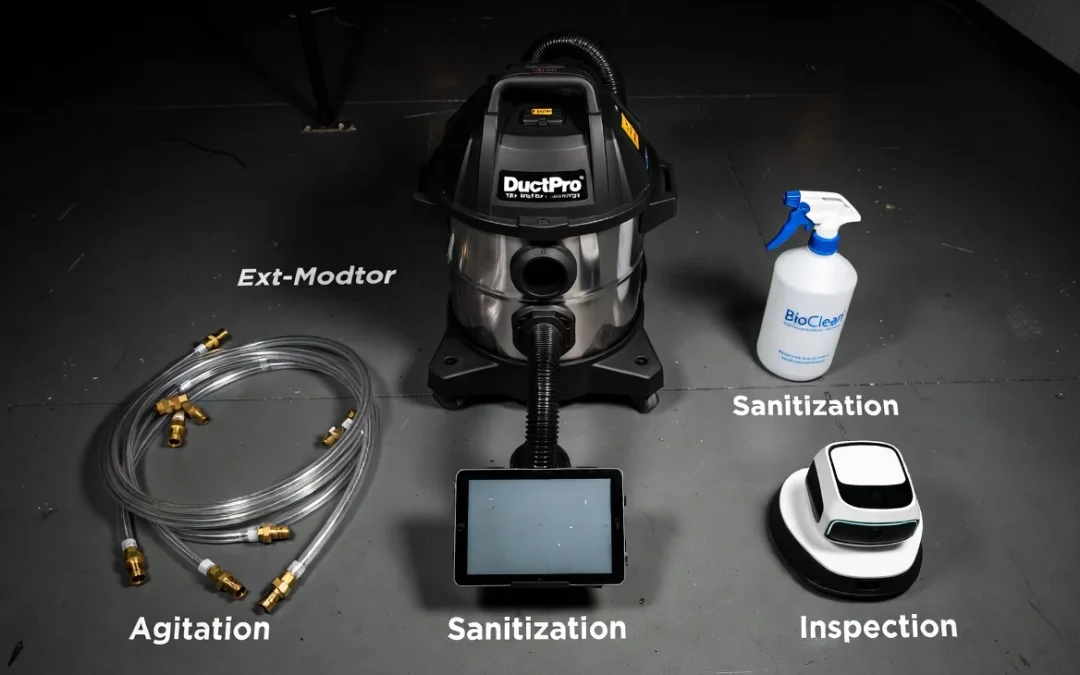
A vacuum with strong suction still produces a mediocre result if nothing agitated the duct walls first. Dust and lint bonded to sheet metal do not release on their own just because negative pressure is present somewhere downstream. This is the part of duct cleaning that gets skipped in most equipment overviews: the job is not one machine doing one thing. It is four separate hardware functions working in sequence, and a weak link in any one of them shows up as a callback three weeks later.
This article goes past the general overview on our air duct cleaning equipment homepage and gets into the hardware itself, category by category. The homepage covers the full product lineup and how to choose between packages. This article expands on the four specific hardware categories referenced there: extraction, agitation, sanitization, and inspection, at the level of detail a contractor actually needs before deciding what to run on a truck.
The Four-Pillar Framework
Every professional duct cleaning system, regardless of manufacturer, is built around four distinct functions:
- Extraction. Creating and holding negative pressure so loosened material leaves the duct instead of recirculating.
- Agitation. Mechanically dislodging material bonded to duct walls.
- Sanitization. Applying antimicrobial treatment to duct surfaces after mechanical cleaning is complete.
- Inspection and verification. Confirming the duct interior is actually clean before the job is closed out.
Treating these as one undifferentiated category, “the equipment,” is where a lot of contractors get their spec comparisons wrong. Each pillar has its own performance variables, and improving one does not compensate for weakness in another.
Pillar One: Extraction and Filtration
Extraction hardware does two jobs at once. It has to generate enough negative pressure to hold the duct system under vacuum across its full run, and it has to capture what agitation dislodges before that material can settle back onto duct walls or escape into the occupied space.
The performance variable contractors watch most closely is CFM, cubic feet per minute of airflow. CFM alone does not tell the whole story. Static pressure capacity, how much resistance the vacuum can overcome before airflow collapses, matters just as much on longer runs or systems with tight elbows and undersized branch takeoffs. A machine with impressive CFM on an open bench test can still lose the fight against duct friction on a real job if its static pressure performance is weak. We cover this relationship, and the transport velocity math behind it, in more detail in our guide to vacuum suction power in duct cleaning.
Motor architecture is the other variable worth understanding. A single large motor concentrates its full electrical draw on one circuit and one thermal load path. Our Tri-Motor Duct Vacuum System takes a different approach: three independent motors running in parallel, which spreads the electrical load across standard 120-volt power instead of concentrating it behind a single draw point. The rated output is 285 CFM at 900 Air Watts, with 220 inches of water lift, a 12-gallon debris capacity, and a unit weight of 74 pounds. Because the three motors operate independently, a technician can continue running the system if one motor needs service, rather than losing the job entirely to a single point of failure.
Filtration sits downstream of extraction and does work that is easy to underestimate. Fine particulate that escapes the collection stage does not just get pushed back into the duct. It circulates through the vacuum’s own internal components and, if containment is weak, into the space the technician is standing in. A well-designed filtration path protects the motor assembly from abrasive fine debris and manages the biologically significant particulate, mold spores, allergen fragments, fine dust, that duct cleaning is specifically meant to remove. Filtration performance varies by manufacturer and by filter stage design, and any contractor evaluating a system should ask for the manufacturer’s own certified test data rather than relying on category-wide industry figures, which do not automatically apply to a specific machine.
Pillar Two: Agitation
Extraction alone does not clean a duct. It removes what agitation dislodges, and nothing more. Agitation hardware is what actually breaks the bond between accumulated dust and the duct wall, and this is where compressed air tooling does most of the work.
A 175 PSI air compressor powers the rotary brush and air whip assemblies that run the length of the duct, spinning or whipping against the interior surface to knock loose material free while the extraction side holds negative pressure and pulls it away. The relationship between the two pillars is sequential and continuous: agitation dislodges, extraction captures, and the two have to be running at the same time for either one to do its job correctly. A technician who agitates a section of duct before the vacuum has established negative pressure is just relocating dust rather than removing it.
Brush and whip selection depends on duct material and diameter. Flexible duct requires a gentler touch than rigid sheet metal, and undersized brushes leave a ring of untouched material around the duct’s inside edge, a common cause of a job that looks clean on inspection but fails a swab test. Matching tool diameter to actual duct diameter, not a rounded estimate, is one of the details that separates an experienced crew from one working off a checklist.
Pillar Three: Sanitization
Sanitization is the only pillar that is optional on a standard job, and it should always come after mechanical cleaning is complete, never before. Applying an antimicrobial treatment to a duct that still has loose debris on its walls treats the surface layer of dust rather than the duct itself, and the treatment loses most of its effectiveness once material accumulates over it again.
Our BioClean Sanitizing Duct Sprayer applies chemical mist directly to duct walls using a two-foot wand, with mist reach of up to twenty feet down the duct run. This lets a technician apply antimicrobial treatment evenly across the interior surface rather than relying on ambient fogging, which tends to under-treat the far end of longer runs. The end sections near supply and return registers deserve particular attention here. Air pressure is lowest at that point in the system, which is also where debris tends to concentrate, so under-treating the last few feet of duct undermines the value of the whole sanitization step.
Sanitization adds meaningful time and material cost to a job, and most customers accept that cost once they understand what mechanical cleaning does and does not address on its own. Mechanical cleaning removes bulk debris. Sanitization addresses the microbial layer that remains on the duct surface after that debris is gone.
Pillar Four: Inspection and Verification
The final pillar is the one that gets skipped most often, and it is the one that protects both the contractor and the customer. Inspection and verification means confirming, with evidence, that the duct interior is actually clean before the job is marked complete.
A borescope or duct camera lets a technician visually confirm duct wall condition at points along the run that cannot be checked by eye through a register opening. Before-and-after photo documentation serves two purposes. It gives the customer visible proof of the work performed, and it protects the contractor if a dispute comes up later about whether the job was actually completed to standard. NADCA’s ACR standard treats visual verification as part of a compliant cleaning process, not an optional add-on, and inspection findings should be documented the same way agitation and extraction steps are.
Skipping this step does not save meaningful time. It removes the only objective record that the first three pillars were executed correctly, which is a poor trade for the ten minutes it takes to run a camera through the completed system.
How the Four Pillars Work Together
None of these four functions substitutes for another. A powerful vacuum cannot compensate for weak agitation. Thorough agitation without adequate extraction just redistributes dust inside the duct. Sanitization applied before mechanical cleaning treats the wrong layer. Skipped inspection removes the evidence that any of the other three steps happened correctly.
Evaluating equipment by looking at one spec in isolation, CFM on a vacuum, PSI on a compressor, misses this interaction entirely. A crew that understands how the four pillars depend on each other will get a better result from mid-tier equipment operated correctly than a crew running top-tier hardware without that framework.
For the full product lineup covering all four categories in one system, our main air duct cleaning equipment page remains the starting point, with individual packages built around DuctPro’s 22 years of field experience, NADCA certification, and government-contract-approved equipment standards. For contractors building a service line from the ground up, our guide to starting an air duct cleaning business walks through how these hardware categories translate into an actual equipment budget, including the Complete Air Duct Cleaning System, which packages extraction, agitation, and sanitization hardware into a single starting configuration.