
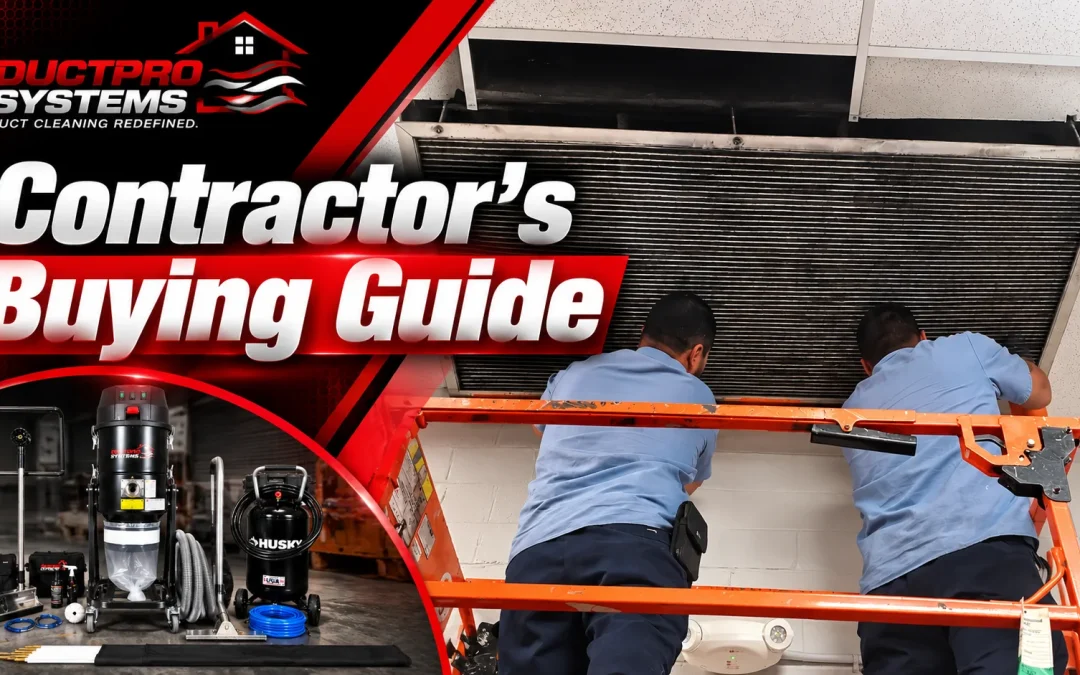
The rig that looks most powerful in the parking lot is often the weakest machine at the register. Duct cleaning is a resistance problem. Debris sits behind elbows, takeoffs, flex runs, and compacted trunk sections, and the only performance that counts is what your vacuum can still pull once all that resistance is in the circuit. Open-intake ratings don’t measure that.
This guide is written for HVAC mechanical contractors and dedicated duct cleaning operators who buy on engineering and return on investment, not brochure numbers. If you want to see the full hardware lineup before working through the numbers, explore DuctPro’s commercial air duct cleaning equipment systems. Everything below rests on one principle: buy the machine that performs under static load, from the closest possible staging point, with the smallest crew.
The Metrics That Actually Move Debris
Three numbers decide whether a negative air vacuum earns its keep: airflow under load, static water lift, and air watts. Read any one of them alone and you’ll misjudge the machine. Read them together and you can predict real field performance.
Free-Air CFM vs. 330 CFM Under Load
Free-air CFM is measured with nothing restricting the intake. No hose. No duct. No Vacuum Box. That condition never happens on a job.
DuctPro’s tri-motor platform is rated at 330 CFM of continuous operating airflow under static load. That figure describes the machine while it’s actually working against hose friction, the containment interface, and the duct system itself. It’s the number your technician experiences at the register.
When you evaluate any vacuum, ask one question: at what static pressure was that CFM measured? A rating without a load condition tells you nothing about extraction.
220″ Static Water Lift: The Pulling Force Behind Every Pass
Static water lift measures how much negative pressure the vacuum can generate when airflow is restricted. On a duct job, restriction is constant. Long trunk lines, multiple branch takeoffs, and settled debris all push back.
At 220 inches of static water lift, the DuctPro system keeps pulling where low-static machines flatten out. This is why the high-lift approach works. The vacuum maintains a pressure differential deep into the system, so debris agitated far downstream still has somewhere to go.
For the underlying aerodynamics, our breakdown of understanding static lift versus airflow volume walks through how fan curves trade one for the other.
900 Air Watts: Where Airflow and Lift Meet
Air watts combine airflow and suction into a single measure of usable work. High CFM with weak lift moves air but stalls under resistance. High lift with no airflow holds pressure but can’t carry debris.
The DuctPro vacuum delivers 900 air watts from three independent commercial-grade vacuum motors. That pairing of 330 CFM, 220″ lift, and 900 air watts is balanced for exactly what duct cleaning demands: enough velocity to entrain particulate and enough pressure to keep it moving through restriction.
Hose Length Physics: 25 Feet Indoors vs. 150 Feet From the Curb
Here is where portable equipment quietly wins the engineering argument.
Friction loss in a hose scales with length. A simplified form of the Darcy relationship makes the point:
ΔP ≈ f × (L / D) × (ρ × V² / 2)
Where ΔP is pressure loss, f is the friction factor, L is hose length, D is hose diameter, ρ is air density, and V is velocity. Velocity itself follows V = Q / A, airflow divided by cross-sectional area.
Hold diameter and velocity constant, and pressure loss rises in direct proportion to length. A truck-mounted system routing 100 to 150+ feet of corrugated hose from the curb to the air handler spends a large share of its suction just overcoming the hose. Corrugation raises the friction factor on top of that.
The DuctPro vacuum stages inside the building. It ships with a 25 ft. black 1½-inch suction hose and a 25 ft. gray 2-inch suction hose. A 25-foot run carries roughly one-fifth to one-sixth of the length-driven friction loss of a 125–150-foot run at the same velocity. That retained pressure goes into the duct, not the hose.
Proximity is a performance spec. Treat it like one.
Equipment Evaluation Matrix
| Evaluation Metric | Low-Static / Free-Air Rated Units | Truck-Mounted PTO Rigs | DuctPro Portable Tri-Motor System |
| Airflow rating basis | Open-intake; load condition rarely stated | High volume at the truck, reduced at the duct | 330 CFM continuous under static load |
| Static water lift | Low; flattens under duct resistance | Depends on hose length to the job | 220″ static water lift |
| Usable work | Not matched to duct resistance | Diminished by long hose runs | 900 air watts |
| Hose run to the duct | Varies | 100–150+ ft of corrugated hose | 25 ft. 1½” and 25 ft. 2″ suction hoses, staged indoors |
| Motor architecture | Typically single motor | Driven by the truck’s engine via PTO | Three independent commercial-grade motors |
| Crew requirement | Varies | Two-person crew | Single technician |
| Vehicle requirement | Varies | Dedicated PTO box truck | Standard service van, pickup bed, or small commercial vehicle |
| High-rise access | Limited by unit weight | Hose length limits upper floors | Elevator transport on lightweight vacuum dolly |
| Building envelope | Varies | Door or window propped open for hose | Doors stay closed |
| Filtration upkeep | Varies | Varies | Machine-washable cage filter + replaceable dust bag |
| Capital exposure | Low, but performance-limited | Five-figure debt service common | High output-per-dollar without PTO financing |
The Portability and Access Advantage
A machine you can’t get to the air handler earns nothing. Access determines which jobs you can bid, and portability determines access.
High-Rise Condominiums and Multi-Story Buildings
Truck-mounted systems hit a hard wall on upper floors. Hose length runs out, and the friction penalty above makes long vertical runs a losing proposition.
The DuctPro vacuum rides the elevator on its lightweight protective vacuum dolly. The technician stages the unit in the unit’s mechanical closet or hallway, connects a 25-foot suction hose, and works at full static lift on the 20th floor exactly as on the ground floor. Condo associations and property managers become a bidable market instead of a pass.
Winter Climates: The Door Stays Closed
Running hose from the curb means a door or window stays propped open for the duration of the job. In January, that’s a heating complaint waiting to happen and an uncomfortable afternoon for the occupant.
Staging indoors removes the issue entirely. The building envelope stays sealed, and your crew stays on schedule through the cold months when truck-mount operators lose days.
Restricted Commercial Properties and Critical Environments
Hospitals, labs, data rooms, and secured facilities frequently restrict where vehicles can park and how long a door can be held open. A self-contained portable system clears those constraints.
High-security and critical-environment contractors rely on this portable footprint when facility access rules prohibit running hoses through perimeter doors. For example, Sani Effect Environmental, Inc. which maintains indoor air quality at the NASA facility in Florida started with three DuctPro complete systems and expanded their fleet to five units after validating the platform against their facility standards.
Zone Sealing Hardware That Makes Containment Work
Negative pressure is only as good as the seal. The DuctPro interface hardware is built to isolate the work zone without improvisation:
- Vacuum Box with integrated LED inspection lighting: seals directly over vents and registers while giving the technician a visual on debris extraction.
- 24″ x 24″ Commercial Duct Cleaning Plate: covers oversized grilles and return openings common in light-commercial systems.
- Extension Pole: holds the Vacuum Box tight against ceiling registers so one technician can seal overhead without a second set of hands.
- Toe Kick Adapter Plate: seals the under-cabinet vents in kitchens and bathrooms that standard boxes can’t reach.
- 1.5″ or 2″ Dust Downer assembly: connects the vacuum hose to the Vacuum Box barb and provides wet-down injection to suppress fine particulate when needed.
Pairing this hardware with a deliberate commercial HVAC zone isolation strategy lets you work section by section, concentrating the full 220″ of lift on one branch at a time instead of spreading it across an open system.
Total Cost of Ownership and Consumable Economics
Purchase price is the smallest part of what equipment costs you. Downtime, consumables, and service intervals decide the real number over three years.
Filtration You Wash, Not Reorder
DuctPro’s vacuum filtration is deliberately simple. Debris collects in the 12-gallon recovery tank, captured by a replaceable dust collection bag and a machine-washable cage filter.
The cage filter is washed and reused. Air dry only. Never tumble dry, because heat distorts the filter and compromises the seal. Handled correctly, it’s a recurring cost you largely don’t pay.
The dust bag carries a reference service life of 6 to 18 months depending on job volume. A busy residential operator lands toward the shorter end; a contractor running duct cleaning as a maintenance add-on lands toward the longer end. Either way, it’s a predictable, budgetable line item.
Dust Downer Pre-Separation
The Dust Downer wet-down injection assembly controls fine particulate before it ever reaches the tank. Less fine dust loading means less strain on the bag and cage filter, which stretches both service intervals. It’s a small component with an outsized effect on consumable spend.
500-Hour Carbon Brush Inspection
Every universal vacuum motor wears its carbon brushes. The question is how often you have to deal with it.
DuctPro specifies a carbon motor brush inspection after 500 operating hours, with an average service interval of 3 to 5 years in typical contractor use. That’s a scheduled, planned maintenance event, not a surprise. The equipment setup guide covers how to stage and connect the system so you aren’t putting unnecessary hours or strain on the motors through poor configuration.
Three-Motor Redundancy: The Feature That Saves the Job
This is the most underrated line on the spec sheet.
A single-motor vacuum has one point of failure. When that motor needs service mid-job, the job ends. You reschedule, lose the day’s revenue, and explain the delay to the customer.
With three independent commercial-grade motors, a single motor needing service doesn’t shut the machine down. The technician finishes the job, collects payment, and schedules the brush service on their own timeline. Over 36 months, the avoided callbacks and lost days compound into real money.
36-Month Total Cost of Ownership and Operational Comparison
| Cost / Operational Driver | Single-Motor / Rotary Brush Systems | Truck-Mounted PTO Systems | DuctPro Tri-Motor Package |
| Upfront capital | Lower entry cost | Five-figure investment, often financed | High output-per-dollar; no PTO debt service |
| Vehicle cost | Standard vehicle | Dedicated PTO box truck required | Existing service van, pickup, or small commercial vehicle |
| Crew labor per job | Varies; repeated passes add hours | Two-person crew | Single technician |
| Passes per trunk run | Repeated mechanical agitation passes | Varies with hose length | Fewer passes driven by continuous static pressure |
| Motor or drive failure | Single point of failure ends the job | Engine or PTO issue halts operations | Three-motor redundancy lets the job finish |
| Filtration consumables | Varies | Varies | Washable cage filter; dust bag at 6–18 months |
| Fine particulate control | Varies | Varies | Dust Downer wet-down pre-separation |
| Scheduled maintenance | Brush heads and cables as wear items | Vehicle engine plus vacuum service | 500-hour carbon brush inspection; 3–5 year average interval |
| Job eligibility | Limited by suction under load | Limited on high-rise and restricted sites | High-rise, winter, restricted, and critical environments |
| Fleet expansion cost | Moderate | Another truck per crew | Another van package per technician |
Labor and Fleet Scalability ROI
Labor is the largest recurring cost in any duct cleaning operation. Equipment that removes a crew member from every job changes the business model.
Single-Technician Deployment
Truck-mount setups need two people: one managing the hose and the truck, one working inside. That’s double the labor on every ticket.
Operational data from DuctPro deployments confirms the portable tri-motor package allows a single-technician crew to complete full residential and light-commercial negative air setups. The Extension Pole holds the Vacuum Box against ceiling registers. The dolly handles transport. The 25-foot hoses keep everything within one person’s working radius. One tech, one ticket, full margin.
Deploying From the Vehicles You Already Own
The entire package deploys out of a standard service van, pickup bed, or small commercial vehicle. No dedicated PTO box truck. No separate vehicle insurance, fuel, and maintenance budget tied to a single-purpose rig.
For HVAC mechanical contractors, this matters even more. The van already rolling to preventative maintenance calls can carry the duct cleaning package. Freight-wise, the heavy-duty recovery tank and dolly are built to ship and stage reliably, so the system arrives job-ready.
If you’re still weighing the two platforms, our analysis of portable vs. truck-mounted air duct cleaning equipment compares them head to head across access, labor, and capital.
Capital Efficiency Without the PTO Debt
Contractors entering or expanding duct cleaning services consistently cite DuctPro’s package as delivering the highest output-per-dollar ratio on the market. The math is direct: you avoid five-figure debt service on a PTO rig, so revenue from the first jobs goes to margin instead of loan payments.
Independent operators use this low-overhead, single-tech package to bootstrap a dedicated duct cleaning division profitably from day one. No financing hangover. No pressure to book volume just to cover a truck note.
Fewer Passes Than Rotary Brush Systems
Rotary-brush systems, such as Rotobrush, rely on repeated mechanical agitation passes to dislodge debris. Every pass is labor time.
Contractors who transitioned from rotary-brush equipment to high-lift negative air report fewer required passes per trunk run and a significant reduction in labor hours. The reason is physical. Continuous static pressure at 220″ keeps debris moving toward collection once it’s agitated, so the technician isn’t re-brushing the same section to chase particulate that never left the duct.
Scaling From One Pilot Unit to a Fleet
The growth path is clean. HVAC mechanical contractors frequently start with a single pilot system, prove the margins, and scale to 2–5 dedicated van packages. Duct cleaning becomes a high-margin add-on to existing preventative maintenance contracts, sold to customers who already trust your technicians.
Each new package adds capacity for one more technician. No second truck purchase, no second crew member per job. Scaling is linear and predictable.
Pneumatic Agitation and Electrical Site Readiness
Suction removes debris. Agitation releases it. The DuctPro pneumatic system is designed to match agitation to duct direction and line pressure to run length.
Matching Air Balls to Duct Direction
The system connects a 25 ft. black air hose to a red rubber supply hose through quick-connects with an inline ball valve. Choosing the right head is the difference between moving debris toward the vacuum and blowing it deeper into the system.
- Forward Blasting Air Ball: drives particulate forward. Use it on return air systems and for pushing lint through dryer vents.
- Reverse Air Ball: draws particulate backward toward the Vacuum Box. Use it on supply ducts so debris travels toward collection.
- Air Gun & Cleaning Brushes: detailed agitation for HVAC coils, blowers, and plenums where precision matters more than reach.
Get the direction wrong and you fight your own airflow. Get it right and the vacuum does half the work for you.
PSI Strategy: 120–130 vs. 150–175
The system operates between 120 and 175 PSI, with 120 PSI as the minimum threshold. Where you set the compressor depends on what the run demands.
| Compressor Setting | Line Pressure Behavior | Best Application |
| 150–175 PSI | Stronger initial blast; line pressure drops below 60–90 PSI faster | Breaking loose compacted debris on short, heavily loaded sections |
| 120–130 PSI | Holds line pressure above 60–90 PSI for a longer duration | Sustained cleaning across long trunk runs and extended branches |
Higher isn’t automatically better. On a long commercial run, starting at 120–130 PSI keeps the air ball working effectively through the whole pass instead of fading halfway down the trunk. Save 150–175 PSI for the stubborn sections that need a hard initial hit.
Electrical Checklist Before You Power Up
The DuctPro system runs on standard site power. That’s part of its portability advantage, but it means the technician confirms circuits before starting.
- Vacuum: operates on standard nominal 120V grounded outlets. Never use a two-prong adapter.
- Compressor: a portable job-site compressor runs on a standard 15A or 20A, 120V outlet, with roughly a two-minute tank fill time.
- Circuit check: confirm grounding at the outlet and avoid stacking the vacuum and compressor on a breaker already carrying heavy household or tenant loads.
Two minutes of verification prevents a tripped breaker and an unhappy occupant halfway through the job.
Making the Buying Decision
Strip away the marketing, and the decision comes down to five questions. Ask them of every system on your shortlist.
- What is the CFM under static load, and at what pressure was it measured? Demand the loaded number.
- How far is the vacuum from the duct? Every foot of hose costs suction.
- What happens when a motor needs service mid-job? Redundancy protects revenue.
- How many technicians does every ticket require? Crew size sets your margin ceiling.
- Which vehicle carries it, and what does that vehicle cost you? A PTO truck is a second business expense.
Run the numbers on your own job mix: your average run length, your share of multi-story and commercial work, your current crew structure. Then compare each platform against the 36-month cost table above. The machine that wins at the register, on the 20th floor, and on the balance sheet is the one worth buying.