
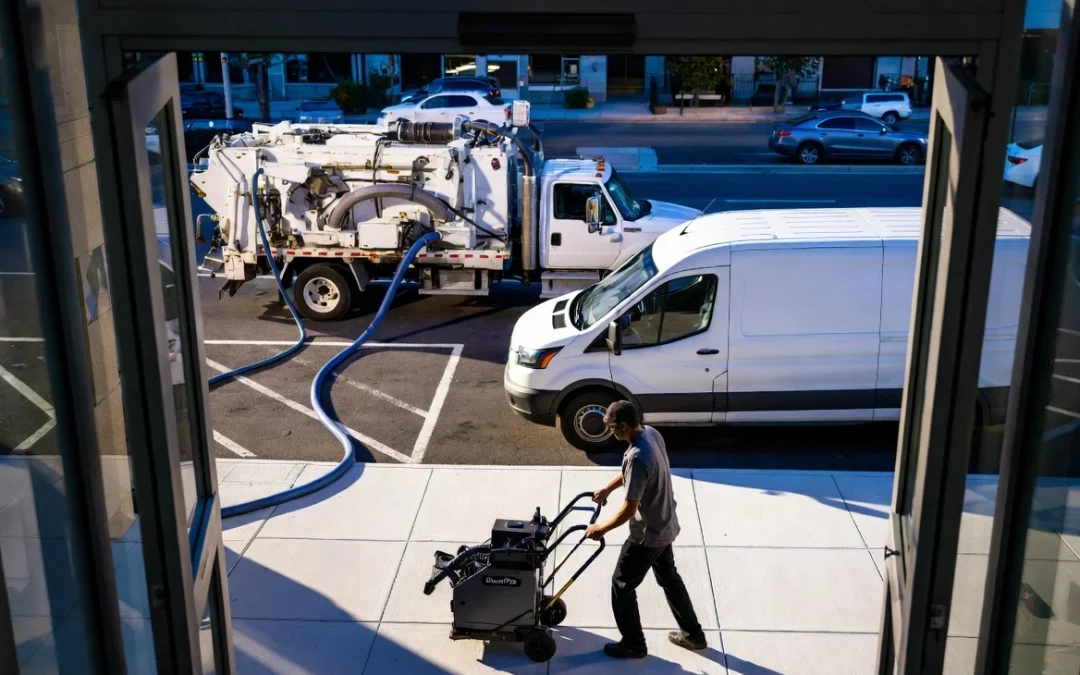
The truck-mount vs. portable debate in the duct cleaning industry is framed incorrectly by most contractors evaluating the decision. The question is not which system produces more CFM at the motor. It is which system delivers more verified airflow at the trunk line on the specific job inventory you actually run.
Those are different questions with different answers, and the answer to the second one is not always “truck mount.”
This framework covers the capital cost differential, the physics of friction loss in long hose runs, the operational risk profile of single-motor versus multi-motor architecture, and the market access gap that portable units exploit and truck mounts cannot close. Make the decision based on the full financial and operational picture, not on raw power ratings that never appear intact at the point of extraction.
The Performance Paradox: Why More Power Does Not Always Mean More Extraction
Truck-mounted duct cleaning systems generate high CFM figures at the motor. The engineering is sound: a large continuous-duty motor or gas engine driving a centrifugal blower can produce 8,000 to 12,000 CFM of free-air capacity. That number appears prominently in the marketing materials.
What the marketing materials do not show is the friction loss calculation for the hose run between the truck and the duct access point.
The Physics of Friction Loss in Extended Hose Runs
Every foot of collection hose introduces resistance to airflow, measured in inches of water column (WC) per 100 feet of hose at a given flow rate. For standard 8-inch diameter collection hose, friction loss varies with airflow, hose construction, length, and condition. As the hose ages and the interior surface accumulates debris coating, friction loss can increase.
A truck-mount setup on a commercial job requiring the vehicle to park at street level and run hose through a building entrance, down a corridor, and to the HVAC access point on the second floor commonly deploys 100 to 200 feet of collection hose. At 150 feet of 8-inch hose at operating flow:
Friction loss: 150 x (1.0 inch WC / 100 feet) = 1.5 inches WC of resistance introduced by the hose run alone.
A truck-mount motor rated at 10,000 CFM free-air with a 6-inch WC static pressure capacity loses 1.5 inches WC to hose friction before encountering any resistance from the duct system itself. The duct system adds another 1.5 to 2.5 inches WC of system resistance under working conditions. Total system resistance: 3.0 to 4.0 inches WC.
At that resistance point, the motor’s operating point on its performance curve shifts below the free-air CFM rating. The airflow delivered at the duct connection can be substantially lower than the free-air rating, depending on hose length, hose diameter, duct resistance, filtration, and the equipment’s performance curve.
A portable system connected with a 15 to 25-foot hose run to the same duct access point can experience substantially less hose friction than a truck-mounted system using a much longer hose run. Working-load performance should be evaluated under actual resistance conditions, taking into account hose length, hose diameter, duct resistance, filtration, and the equipment’s performance curve.
The performance paradox is that a truck-mounted system with a high free-air CFM rating can deliver substantially less airflow at the trunk line once hose and system resistance are introduced, while a portable system with a lower rated airflow and a shorter hose run can preserve more of its available airflow at the point of extraction.
For the full technical breakdown of how working-load CFM ratings are derived and why free-air ratings are operationally misleading, see our reference on high CFM duct cleaning vacuum performance metrics.
The “CFM at the Trunk” Measurement Standard
The only performance measurement with operational relevance is CFM delivered at the duct connection point under actual working conditions. Contractors evaluating either platform should require working-load CFM data measured at the hose inlet with standard hose length and partial filter load, not free-air motor ratings from manufacturer test stands.
Any vendor that cannot or will not provide working-load CFM data is selling free-air numbers. Any contractor making a capital decision based on free-air numbers is not making an informed purchase.
Financial Architecture: CapEx, OpEx, and the Path to Profitability
The capital expenditure differential between truck-mount and high-CFM portable systems is the most straightforward component of the comparison. The operating cost differential is where the full economic picture diverges significantly from the initial sticker price comparison.
Capital Expenditure Comparison
Truck-mount system (complete setup):
- Service vehicle (1-ton van or truck, cargo-configured): $45,000 to $65,000 new, $25,000 to $40,000 quality used
- Truck-mount vacuum unit and installation: $18,000 to $30,000
- Hose inventory (150 to 200 feet of 8-inch collection hose): $3,000 to $5,000
- Agitation tool package: $2,000 to $4,000
- Total new truck-mount entry cost: $68,000 to $104,000
- Total quality used truck-mount entry cost: $48,000 to $79,000
High-CFM portable system (complete setup):
- Cargo van or sprinter (standard configuration, no modification required): $35,000 to $50,000 new, $18,000 to $28,000 quality used
- DuctPro complete portable system including vacuum unit, agitation tools, and BioClean sprayer: $15,000 to $22,000
- Hose inventory (25 to 50 feet of standard collection hose): $500 to $1,200
- Total new portable entry cost: $50,000 to $72,000
- Total quality used portable entry cost: $33,000 to $50,000
The CapEx differential between platforms: $18,000 to $32,000 comparing new systems. On used equipment, the differential narrows but remains $15,000 to $29,000 in favor of the portable configuration.
Time to ROI: The Job Count Calculation
At commercial job rates of $1,500 to $2,500 per job, the CapEx differential of $25,000 (midpoint) is recovered in 10 to 17 additional commercial jobs that the portable system generates margin on before the truck-mount investment reaches breakeven relative to the portable entry point.
At residential rates of $400 to $600 per job, the differential recovers in 42 to 63 additional residential jobs. At a production rate of 4 residential jobs per day, that represents 10 to 16 additional production days before the truck-mount system begins generating margin above what the portable investment would have generated.
These numbers assume equivalent revenue-generating capability across both platforms. They do not account for the market segments the truck-mount cannot access, which adds additional opportunity cost on top of the CapEx differential.
Operating Cost Differential
The ongoing operating cost comparison compounds the CapEx differential over the equipment lifecycle.
Truck-mount operating costs:
- Fuel consumption: truck-mount vehicles with large engines and heavy equipment loads average 10 to 14 MPG. At 150 miles per day of route driving and $3.50/gallon fuel, fuel cost runs $37 to $52 per day
- Specialized maintenance: truck-mount blower units require service from mechanics familiar with commercial continuous-duty motors. Standard automotive service centers cannot work on truck-mount vacuum systems. Specialized service calls average $150 to $250 per hour plus parts
- Vehicle depreciation: a purpose-built truck-mount vehicle depreciates faster than a standard cargo van due to the structural modifications and specialized equipment load
- Annual insurance premium for a commercial truck-mount rig: typically $4,000 to $7,000 per year depending on market and coverage levels
Portable van operating costs:
- Fuel consumption: a standard cargo van or sprinter with a portable vacuum system averages 16 to 22 MPG. Same 150-mile day at $3.50/gallon: $24 to $33 per day. Annual fuel savings over a truck-mount: $3,000 to $5,000
- Maintenance: standard cargo van maintenance uses any commercial fleet service center. No specialized mechanics required
- Annual insurance premium for a cargo van with equipment: typically $2,500 to $4,000 per year
Five-year operating cost differential (fuel and maintenance only): $18,000 to $35,000 in favor of the portable van configuration, before accounting for the CapEx differential already captured above.
Total 5-year ownership cost advantage of the portable platform: $36,000 to $67,000 against a comparable truck-mount setup.
The Accessibility Moat: Reaching Markets Where Trucks Cannot Park
The financial comparison above assumes both platforms can access the same jobs. They cannot. The accessibility gap between truck-mounted and portable systems is the most operationally consequential differentiator and the least discussed in vendor marketing materials.
High-Rise Residential: The Truck-Mount Dead Zone
High-rise residential buildings – condominiums and apartments above the third floor – represent a premium market segment in any major metro area. These properties have HVAC systems that have never been professionally cleaned in many cases, owners who pay for premium services, and no ability to receive truck-mount service because the hose run from a street-level vehicle to a 12th-floor unit exceeds any truck-mount system’s operational range.
150 feet of hose gets a truck-mount system to approximately the third floor of a standard commercial building with a first-floor equipment entry point. Beyond that, the friction loss calculation described above collapses extraction performance to below useful levels.
A portable system rides the freight elevator to the 12th floor. The hose run from the unit to the duct access point is 15 to 25 feet. Full working-load CFM is delivered at the trunk. The job that was physically inaccessible to the truck becomes a standard production job for the portable platform.
Commercial Buildings: The Logistics Reality
The logistics of commercial duct cleaning were covered in detail in the commercial process documentation. The summary relevant to the platform decision: commercial buildings above two stories require freight elevator access. Truck-mount hose runs through service corridors and elevator shafts introduce the friction losses calculated above and, beyond a building depth of approximately 100 feet from the truck parking position, make it impractical to deliver adequate extraction CFM at upper-floor HVAC access points.
Class A office building managers with properties above four stories actively prefer portable service providers because they do not require street-lane permits, do not block building service entrances for extended periods, and can access every floor without hose-run constraints.
For the full operational case for portable equipment in commercial and high-rise access scenarios, see our reference on the portable duct cleaning system architecture and job-type fit matrix.
Market Size Implication
In dense urban markets, high-rise residential properties and multi-story commercial buildings can create significant access requirements for duct-cleaning contractors. The proportion of these properties varies considerably by market, building stock, and service area, so contractors should evaluate local demand and building access conditions when assessing the opportunity.
A truck-mount operator in those markets is structurally excluded from serving a large portion of the available work. A portable operator with the same air duct cleaning equipment capability can bid every segment.
Risk Management: Redundancy vs. Single-Point Failure
Every commercial job carries operational risk. The question is whether the equipment architecture creates a single point of failure or distributes that risk across redundant systems.
The Truck-Mount Single-Point Failure Model
A truck-mount duct cleaning system is built around one primary motor or engine. If that motor fails during a job, the job stops. There is no fallback operating mode, no reduced-capacity continuation option, and no field repair protocol for a major motor failure in a commercial mechanical room at 2:00 AM.
The operational consequences of a mid-job motor failure on a commercial job:
- Duct system left open with agitated debris suspended or partially settled in the trunk lines
- Occupied building with disrupted HVAC system pending equipment repair or replacement
- Contract breach exposure if the job is time-critical (pre-occupancy cleaning, post-remediation clearance)
- Emergency equipment rental cost if a substitute unit can even be sourced on short notice
The probability of motor failure on any individual job is low. The consequence when it occurs is high. The truck-mount architecture provides no mitigation for the consequence.
The Tri-Motor Redundancy Model
The DuctPro Tri-Motor Duct Vacuum operates three independent motors. Each motor is a fully functional independent unit with its own thermal protection, its own electrical circuit connection, and its own maintenance cycle.
If one motor requires maintenance or trips its thermal protection circuit during a job, the remaining two motors can continue operating. The system continues extracting at reduced capacity, allowing the contractor to continue working while the affected motor is serviced. Actual airflow with two motors depends on operating conditions and system configuration, so contractors should use the manufacturer’s published performance data rather than assume a fixed CFM figure.
The risk profile is categorically different. A truck-mount motor failure is a binary event: full capacity or zero. A tri-motor portable motor fault is a degraded event: reduced capacity but continued operation. The probability of all three independent motors failing simultaneously is orders of magnitude lower than the probability of a single motor failure.
For contractors running off-hours commercial schedules where emergency equipment sourcing is not realistic, this redundancy architecture is not a feature. It is a risk management requirement.
Maintenance Scheduling and Thermal Management
The tri-motor architecture also changes the maintenance scheduling model. Three motors running at distributed load operate below their individual thermal ceilings, extending motor service life compared to a single motor running at sustained high load.
When a motor does require service, it can be removed from the portable unit, serviced, and reinstalled without taking the entire system offline. The remaining two motors continue handling production jobs during the service interval. A truck-mount motor service requiring the vehicle to be out of rotation takes the entire revenue-generating asset offline until the repair is complete.
Conclusion: Why the Van-Based Portable Model is the Future of the Trade
The truck-mount system is not technically inferior. In the specific application for which it was designed – high-volume suburban residential work with consistent driveway access and short hose runs – it performs well and the capital investment can be justified.
That application profile describes a smaller and smaller percentage of the available market. Dense urban residential, high-rise condominiums, multi-story commercial buildings, and healthcare facilities represent the growth segments in the duct cleaning market. Every one of those segments favors or requires portable equipment.
The financial analysis adds the capital cost differential. The performance physics of friction loss in extended hose runs add the CFM-at-the-trunk argument. The tri-motor redundancy architecture adds the risk management argument. Together, these factors make the case for evaluating a van-based portable platform according to its verified working-load performance, access requirements, hose configuration, equipment architecture, and suitability for the commercial and high-rise market.
The contractor who starts with the truck-mount invests $68,000 to $104,000 in an asset that serves part of the market and cannot access the highest-margin segments.
The contractor who starts with a high-CFM portable system invests $50,000 to $72,000 in a platform that serves the full market, delivers verified working-load extraction performance, and carries redundancy architecture that protects commercial contracts from single-point failure events.
The decision is not about which system is more powerful. It is about which system builds a more defensible business.
That answer has been the same for several years and is becoming more obvious as urban density and commercial building complexity continue to increase. The portable platform with verified working-load CFM is the trade’s direction.