
A 2023 EPA report found that children spend approximately 90% of their time indoors, and the majority of that indoor time occurs in school buildings. A child in a K-12 classroom breathes an estimated 15,000 liters of air per day in that environment. If the HVAC ductwork feeding that classroom has not been cleaned in three years, that air is carrying a documented bio-load of mold spores, skin cell debris, clothing fibers, and outdoor allergens that no portable air cleaner can remediate. The source is the duct system. The solution is the duct system.
The air duct cleaning equipment specification for an educational facility is not a commercial cleaning job. It is a public health protocol with legally binding procurement standards, narrow operational windows, and student population exposure liability that compounds with every deferred cycle.
This article is written for the Superintendent, University Plant Director, or Public Works Procurement Officer who is building or auditing a school district HVAC maintenance program. The technical and regulatory standards are current as of 2024.
The Regulatory and Public Health Mandate for Educational Facility HVAC
EPA IAQ Tools for Schools: The Governing Framework
The EPA’s IAQ Tools for Schools Action Kit is the definitive federal framework for managing indoor air quality in K-12 buildings. It is not a mandate in the regulatory sense, but it establishes the standard of care that governs procurement decisions, liability exposure, and state-level grant eligibility. Deviation from its protocols is defensible only if you have a documented, peer-reviewed alternative.
The Action Kit’s core operational requirements relevant to duct maintenance:
- Maintain HVAC systems per manufacturer specifications, including periodic duct inspection and cleaning based on measured contamination levels.
- Document all HVAC maintenance actions, filter replacement schedules, and IAQ complaint investigations in a School IAQ Management Plan.
- Designate an IAQ Coordinator at the district level responsible for maintaining records and coordinating with facility staff.
- Conduct post-remediation verification before re-occupying any space where HVAC contamination has been identified.
The Action Kit’s guidance aligns directly with ASHRAE Standard 62.1 (Ventilation for Acceptable Indoor Air Quality), which sets minimum ventilation rates and system cleanliness requirements for occupied educational spaces.
ASHRAE 62.1 and the Ventilation Rate Floor
ASHRAE Standard 62.1-2022 sets minimum outdoor air ventilation rates for educational occupancies at 0.15 CFM per square foot of classroom area plus 7.5 CFM per person for standard classroom occupancy loads. These rates are calculated assuming a clean, unobstructed air delivery system.
When duct surfaces are coated with bio-load accumulation, two things happen simultaneously. First, the effective cross-section of the duct decreases, reducing delivered CFM below the 62.1 minimum. Second, the contaminated surface sheds particulate into the airstream, elevating indoor PM2.5 concentrations regardless of outdoor air quality on any given day.
A school district operating below ASHRAE 62.1 ventilation minimums due to duct restriction is in a documentable compliance deficiency. In states where 62.1 is adopted by reference into building codes, that deficiency is a code violation.
State-Level Legislation: The Shifting Compliance Landscape
Several states have moved beyond the federal IAQ Tools framework into enforceable legislation:
- Connecticut Public Act 03-220: Requires school districts to adopt and implement an IAQ program, including HVAC maintenance protocols. Mandates annual inspections and documentation.
- New York Education Law Section 409-d: Requires school districts to develop and implement a comprehensive school building health and safety plan that includes air quality protocols.
- California AB 841 (2020): Allocated funding tied to IAQ upgrades in K-12 schools, with compliance conditions attached to grant disbursement.
Procurement officers in states with active school IAQ legislation should confirm whether duct cleaning frequency and documentation requirements are codified at the state level before setting a maintenance interval.
The Educational Facility Bio-Load: What Accumulates in School Ductwork
High-Density Occupancy: The Core Variable
A standard commercial office occupancy runs approximately 150-200 square feet per person. A K-12 classroom runs 20-30 square feet per student at full occupancy. That density difference is not incremental. It represents a bio-load generation rate 5-7x higher per square foot than the commercial baseline used to set standard commercial cleaning intervals.
Every student in that classroom is a continuous source of:
- Skin cell debris (dander): Human shedding rate averages 1.5 million cells per hour per person. In a 30-student classroom, that is 45 million cells per hour entering the return air stream.
- Clothing fiber particulate: Synthetic fibers from polyester and nylon garments shed continuously. These fibers carry surface-adsorbed allergens, including pollen, pet dander, and mold spores brought in from outdoor environments.
- Footwear-transferred outdoor particulate: Studies from Lawrence Berkeley National Laboratory have shown that outdoor allergens, pesticides, and heavy metal particulate (primarily lead and cadmium from legacy soil contamination near older urban schools) are tracked indoors and become airborne through HVAC circulation.
Mold Spore Loading in Educational Buildings
Older school buildings, particularly those constructed before 1990, have a higher incidence of building envelope moisture intrusion due to aging caulking, roof membranes, and window seals. Moisture events that do not cause visible surface mold can deposit moisture in ductwork insulation liners, creating growth substrates.
Aspergillus/Penicillium species are the most common duct-interior mold genera identified in school settings. Cladosporium is frequently found in return ducts serving classrooms with exterior window exposure. Stachybotrys chartarum (black mold) requires sustained moisture and is less common in active ductwork but has been identified in abandoned or low-use wing systems where condensation accumulates.
At airborne concentrations above 200-500 colony forming units per cubic meter (CFU/m3), mold exposure triggers respiratory symptoms in sensitized individuals. Children have higher respiratory sensitivity than adults and represent a disproportionately affected population at exposures that would not affect typical office occupants.
Allergen Concentrations and the Asthma Burden
CDC data places asthma prevalence among school-age children (5-17 years) at approximately 8.4%. In urban school districts, that rate is frequently higher due to compounding environmental exposures. For a 500-student elementary school, that is a baseline of 42 students with clinically diagnosed asthma, each with measurable sensitivity to HVAC-borne allergens.
The primary duct-borne allergen categories affecting this population:
- Cat and dog dander (Fel d 1, Can f 1): Carried on clothing into classrooms, deposited on return filter media, and recirculated when filter loading exceeds capacity.
- Dust mite allergen (Der p 1, Der f 1): Accumulates in horizontal duct surfaces at high-humidity periods. Der p 1 concentrations above 2 micrograms per gram of dust are associated with allergic sensitization in children. Above 10 micrograms per gram, the threshold for acute asthma exacerbation is reached.
- Cockroach allergen (Bla g 2): Documented in ductwork serving cafeterias and food preparation areas in older urban school buildings.
- Outdoor pollen (grass, tree, ragweed): Enters through fresh air intakes without pre-filtration, deposits on duct surfaces, and releases during system cycling.
For institutions managing student health data and tracking asthma-related absences, duct cleaning logs should be correlated with absence records. The EPA IAQ Tools for Schools framework includes this tracking methodology.
The Academic Operational Window: Scheduling for Zero Student Exposure
Why the Calendar Is a Hard Constraint
There is no industrial equivalent to the school facility scheduling problem. A manufacturing plant can schedule HVAC work during a planned production shutdown. A hospital can isolate wings. A commercial office building can clean after hours over a standard weekend.
A school campus with 800 students cannot be partially occupied during duct cleaning operations. The mechanical agitation phase – deploying high-velocity air whips and skipper balls through duct sections – temporarily elevates localized particulate concentrations in the work zone before extraction normalizes the air. That is an acceptable condition in an unoccupied building. It is not acceptable with students 50 feet away in an adjacent classroom.
The three compliant operational windows for K-12 school duct cleaning:
Summer Recess (Primary Window)
- Duration: Typically 60-90 days depending on district calendar.
- Advantages: Maximum time, full building access, no schedule conflicts with other trades.
- Critical coordination: Summer recess frequently coincides with painting, flooring, and HVAC equipment replacement projects. The duct cleaning contractor must be sequenced before any HVAC coil replacement or filter system upgrade to avoid contaminating new components with legacy debris.
Winter Break (Secondary Window)
- Duration: Typically 10-14 days.
- Constraint: Sufficient for a single-building campus or a targeted wing, not a multi-building district-wide program.
- Heating system coordination: Cleaning in heating season requires the mechanical team to manage system de-energization without allowing freeze conditions in water-based heating coils in cold climates.
Spring Break (Tertiary Window)
- Duration: Typically 5-7 days.
- Constraint: Tight. Suitable only for targeted remediation of identified problem areas, not comprehensive campus programs.
- Timing advantage: Post-winter, pre-allergy season cleaning reduces spring pollen accumulation before outdoor allergen loads peak.
Calculating the Required Operational Duration
Estimating cleaning duration before mobilizing is a procurement requirement, not an optional pre-job courtesy. The formula:
Estimated hours = Total duct square footage / Average production rate per crew
For a DuctPro Tri-Motor system with a trained two-person crew, production rates in standard rectangular ductwork depend on duct accessibility, contamination levels, system configuration, and the cleaning methods used.
A typical 100,000 square foot elementary school campus may have 8,000-12,000 linear feet of supply and return ductwork. Procurement officers scheduling summer work need that number before the vendor selection process, not after mobilization.
Containment and Extraction Protocols in Active Educational Environments
Containment Setup: Protecting Adjacent Occupied Spaces
When cleaning must occur adjacent to recently vacated or partially occupied areas (particularly during a tight winter break with custodial or administrative staff present), containment is mandatory. The commercial air duct cleaning process protocols provide the baseline containment specification: negative pressure isolation of the work zone using 6-mil poly sheeting, sealed to floor, walls, and ceiling with fire-rated tape.
In educational environments, containment considerations include:
- Classroom furniture and materials: Student desks, books, and stored materials must be covered or removed before work begins in any classroom served by an active cleaning zone.
- Computer and AV equipment: Electronic equipment in technology labs and media centers requires dust covers rated for PM2.5 penetration resistance. Standard cloth covers are not adequate in a duct cleaning environment.
- Library collections: Special collections and library stacks within the air distribution zone of cleaning operations require consultation with library staff and, in archives, with a conservator.
The Filtration Standard for Student Populations
Review the duct cleaning indoor air quality metrics for the particle size data behind this requirement.
Comparing Educational to Clinical Standards
For reference scale: hospital hvac duct cleaning protocols under FGI Guidelines and ASHRAE Standard 170 operate at HEPA filtration with continuous air sampling, negative pressure rooms at -0.01 inches water column, and infection control risk assessment (ICRA) documentation for every work zone.
The Portable Equipment Advantage in Multi-Wing School Layouts
The Access Problem No Truck-Mount Solves
A truck-mounted vacuum system delivers high raw CFM, but it is anchored to a parking lot. The hose run from the truck to the interior ductwork introduces friction loss that compounds with every 10-foot increment. In a standard two-story, multi-wing school building, a truck-mount parked at the loading dock may be 300-400 feet of hose run from the third-floor classroom wing. At that distance, effective CFM at the duct face drops below the transport velocity threshold for the particulate load being extracted.
More critically, many urban school campuses have zero viable truck parking adjacent to the building. Legacy urban schools were built to the street line. The service entrance may be a single corridor-width loading dock with a standard freight elevator. A truck-mount system cannot operate from a freight elevator.
Our portable cabinet system is engineered for exactly this access constraint:
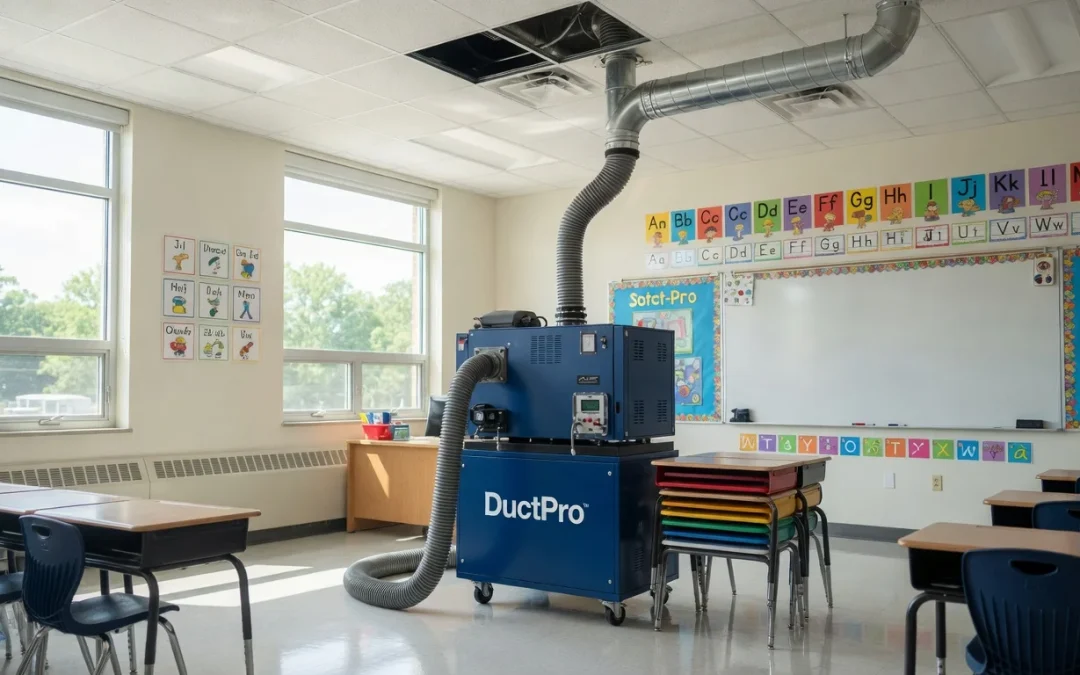
- The DuctPro Tri-Motor system provides 330 CFM of rated airflow at the equipment, giving contractors a portable extraction solution for cleaning applications where equipment access and hose routing are important considerations.
The contractor working a four-story urban high school with restricted street access does not have a truck-mount option that maintains extraction integrity on the top floor. Portable is not a compromise. It is the only specification that works.
Project Verification and District-Level Closeout Documentation
What the Procurement Officer Needs to Accept the Work
A school district accepting an HVAC duct cleaning project completion is accepting a public health representation. The closeout documentation package should include:
- Pre-cleaning photographic log: Timestamped borescope images at a minimum of one access point per duct section cleaned, documented against the building floor plan.
- Extraction unit filter log: Record of filter differential pressure readings at 2-hour intervals during operation. Rapid pressure rise indicates high bio-load and confirms the cleaning was warranted.
- Post-cleaning photographic log: Matching images confirming visual cleanliness at the same access points. NADCA ACR 2021 visual cleanliness standard is the applicable specification.
- Filter disposal documentation: In facilities with documented mold contamination, spent filters may require disposal as regulated waste under applicable state environmental rules.
- HVAC system restart record: Confirmation that all access panels are sealed, filters are replaced (not reinstalled), and the system has completed a full operational cycle before the building is re-occupied.
- IAQ coordinator sign-off: The district’s designated EPA IAQ Tools for Schools coordinator should countersign the closeout package. This creates the documented chain of accountability required if a parent or regulatory agency requests proof of compliance.
Post-Cleaning Air Quality Verification
For districts with active asthma management programs or documented mold remediation history, post-cleaning air sampling is the defensible standard. ACGIH and AIHA published guidelines support settled dust sampling or air cassette sampling in representative rooms 24-48 hours after system restart as the verification method.
If your district carries liability from a prior IAQ complaint or parental inquiry, the air sampling report is the document that closes that file. Without it, the cleaning log is a maintenance record. With it, it is a health and safety certification.
Scheduling Your District’s HVAC Cleaning Program
Educational facility HVAC maintenance is a repeating capital obligation, not a one-time remediation project. EPA IAQ Tools for Schools guidance and ASHRAE 62.1 do not specify a universal cleaning interval because the correct interval is a function of measured contamination rate, which varies by building age, filtration specification, occupancy density, and outdoor air quality index.
What the data supports: High-density K-12 buildings with pre-2000 duct systems and MERV-8 or lower filtration typically reach NADCA-threshold contamination levels in 3-5 years. Buildings with upgraded MERV-13 filtration and modern air handling units may extend to 5-7 years between full duct cleaning cycles. No educational facility should be operating on a greater than 7-year interval without documented inspection showing the duct interior is below contamination threshold.
Review the complete professional-grade HVAC cleaning equipment specifications and contact our team with your district’s building inventory, construction dates, and current filtration specification. We will map a program interval and mobilization sequence that fits your academic calendar and capital budget cycle.
The 42 students with asthma in that 500-student school are not an abstract statistic. They are present in the building, breathing the air your HVAC system delivers. The cleaning protocol you specify is the direct mechanical link between your procurement decision and their respiratory health on any given school day.
That is the decision this article is designed to inform.