
CFM is one of the first specifications contractors look at when choosing a duct-cleaning vacuum. It is also one of the easiest specifications to misunderstand.
There is no single CFM number that automatically makes a vacuum suitable for every professional duct-cleaning job. The airflow needed in an actual cleaning setup depends on the duct dimensions, duct geometry, hose configuration, fittings, bends, access openings, filtration, debris loading, system resistance, extraction arrangement, and the operating conditions of the equipment.
CFM still matters. It simply has to be considered as part of the complete extraction system rather than treated as a standalone measure of cleaning capability.
For contractors comparing a professional duct cleaning vacuum, the useful question is not only how much CFM the manufacturer publishes. It is also what that published number represents, how it was measured, and how the equipment will be connected to the duct system on the job.
What Does CFM Mean in Duct Cleaning?
CFM means cubic feet per minute. It describes volumetric airflow, or the volume of air moving through a system over a given period.
In duct cleaning, airflow provides the moving airstream that transports loosened material toward the extraction equipment. Agitation tools can dislodge dust and debris from interior duct surfaces, but the material still needs a controlled path out of the duct system.
That makes airflow an important part of source removal.
A vacuum’s published CFM, however, is an equipment specification. It should not automatically be interpreted as the exact airflow available at the point where a technician is cleaning. Once a vacuum is connected to hoses, fittings, ductwork, filters, access points, and other components, the airflow path has resistance.
The operating conditions can therefore differ from the conditions under which the manufacturer’s CFM specification was established.
This distinction is particularly important when comparing different duct cleaning vacuums. Two published CFM figures are only directly useful for comparison when the measurement conditions and definitions are reasonably comparable.
Why CFM Matters During Duct Cleaning
Professional duct cleaning involves two related processes: agitation and extraction.
Agitation loosens material from the interior surfaces of the ductwork. Extraction creates the airflow needed to carry that material toward the collection equipment.
The extraction system therefore needs enough airflow to establish a useful path through the portion of ductwork being cleaned. If the airflow path is poorly configured, simply having a larger published CFM figure does not automatically solve the problem.
The location of the extraction connection matters. So do the access openings and the way the system is isolated.
A well-configured extraction system directs replacement air through the section being cleaned and toward the vacuum. That creates a controlled route for loosened material to follow.
This is closely related to the principles discussed in how negative pressure works in duct cleaning. Negative pressure creates a pressure difference that establishes the preferred direction of airflow. The vacuum does not simply pull every particle directly from a duct surface. Agitation releases the material, while the moving airstream transports it toward collection.
CFM, Air Velocity, and Duct Size
CFM and air velocity are related, but they are not the same measurement.
Air velocity describes how quickly air moves through a particular cross-sectional area. CFM describes the volume of air moving through that area.
The basic relationship can be expressed as:
Velocity = Volumetric Flow Rate ÷ Cross-Sectional Area
This means the same CFM can produce different air velocities depending on the size of the passage through which the air is moving.
For example, a given airflow passing through a relatively small hose will have a different velocity than the same airflow distributed through a much larger duct cross-section. The relationship is mathematical, not a universal duct-cleaning standard.
That distinction matters when someone tries to convert a vacuum’s CFM rating into a specific cleaning velocity and then treat that velocity as a required industry threshold. The calculation can describe a particular airflow condition, but it does not establish a universal professional duct-cleaning requirement.
Duct size therefore matters when evaluating airflow, but it is only one part of the calculation. Duct shape, transitions, branches, openings, restrictions, and the extraction configuration also influence the actual airflow conditions.
Why There Is No Single CFM Requirement for Every Duct Cleaning Job
A residential air handler, a large commercial HVAC system, and a complicated multi-branch duct network do not present the same extraction conditions.
The physical dimensions of the ductwork are different. The number and arrangement of branches can be different. Access conditions can vary substantially. Hose routing may also change from one job to another.
Several factors can affect the airflow available during cleaning:
- Duct dimensions
- Duct geometry
- Hose diameter
- Hose length
- Fittings
- Bends
- Access openings
- Filtration
- Debris loading
- System resistance
- Extraction configuration
- Equipment operating conditions
- Cleaning method
Because these variables interact, a universal CFM requirement would be misleading.
The correct approach is to evaluate the vacuum in the context of the duct system and the complete extraction path.
A contractor should also distinguish between the equipment’s published rating and the airflow actually present during a particular cleaning operation. The former is a specification. The latter is an operating condition affected by the connected system.
How Hose and System Resistance Affect Available Airflow
The airflow path between the duct and the vacuum can contain considerable resistance.
Hose length is one factor. Diameter is another. Every bend and fitting changes the path. Restrictions, transitions, access arrangements, filtration, and debris can also affect the conditions under which the vacuum operates.
This is why a published machine CFM figure should not automatically be interpreted as airflow at the cleaning point.
Consider two jobs using the same vacuum. On one job, the extraction path may be relatively direct, with appropriate hose routing and controlled access. On another, the hose may be longer and include additional bends, fittings, or restrictions. The vacuum has not changed, but the airflow conditions have.
The same principle applies to the duct system itself. Complex geometry can create different resistance throughout the system, and uncontrolled openings can provide easier paths for air to enter than the section the technician intends to clean.
Contractors evaluating vacuum suction power should therefore consider CFM together with the conditions under which the equipment will actually be used.
CFM vs. Water Lift vs. Static Pressure
CFM, water lift, and static pressure are related to vacuum and airflow performance, but they describe different things.
CFM describes volumetric airflow. It tells you how much air is moving under a specified measurement condition.
Water lift is a vacuum specification that provides information about pressure capability. It is commonly used to describe how much suction pressure a vacuum can develop under a specified test condition.
Static pressure describes pressure within an airflow system and helps explain the resistance encountered as air moves through the connected path.
These measurements should not be treated as interchangeable.
A higher water-lift specification does not mean the equipment has an equivalent CFM rating. Likewise, a CFM number does not tell you the water-lift capability of the machine.
The distinction becomes particularly useful when troubleshooting airflow problems. If a vacuum is connected to a restrictive extraction path, the contractor needs to consider the complete relationship between airflow, pressure, and resistance rather than focusing on one number.
HVAC static pressure analysis provides another way to understand what happens between the vacuum inlet and the section of duct being cleaned.
What Contractors Should Ask When Comparing Duct Cleaning Vacuums
A CFM number is useful, but it should be the beginning of the equipment evaluation rather than the end.
Before comparing professional duct cleaning equipment, contractors should ask:
What CFM does the manufacturer publish?
Start with the manufacturer’s current specification. Avoid relying on numbers copied from older articles, third-party listings, or equipment discussions when the manufacturer has a current specification available.
Under what measurement conditions was the CFM obtained?
A published airflow figure has meaning only in the context of its measurement conditions. Contractors should be cautious about comparing numbers that were obtained or described using different methods.
Are the specifications being compared on an equivalent basis?
A responsible comparison requires more than placing two CFM numbers side by side. The specifications need to describe comparable measurements.
What hose configuration will be used?
Hose diameter, length, routing, bends, and fittings can all influence the extraction path.
What duct size and configuration are involved?
The duct cross-sectional area affects the relationship between volumetric airflow and air velocity. Branches, transitions, dampers, and other geometry also influence the airflow path.
What restrictions exist in the extraction path?
Every restriction can affect system resistance. The contractor should consider the complete path from the cleaning area to the collection equipment.
What type of material is being removed?
The material being removed and the cleaning method affect how extraction is performed. Loose dry debris is not necessarily handled under the same conditions as heavier or more difficult material.
How does filtration affect resistance?
Filtration is part of the airflow path. Contractors should understand the filtration configuration of the equipment they are evaluating and account for the resistance it may introduce.
How will the complete extraction system operate?
The vacuum, hose, access arrangement, duct configuration, filtration, agitation method, and debris collection process should be considered together.
This approach gives a more useful picture of equipment suitability than selecting a machine based solely on its highest advertised CFM.
DuctPro Tri-Motor Vacuum Specifications
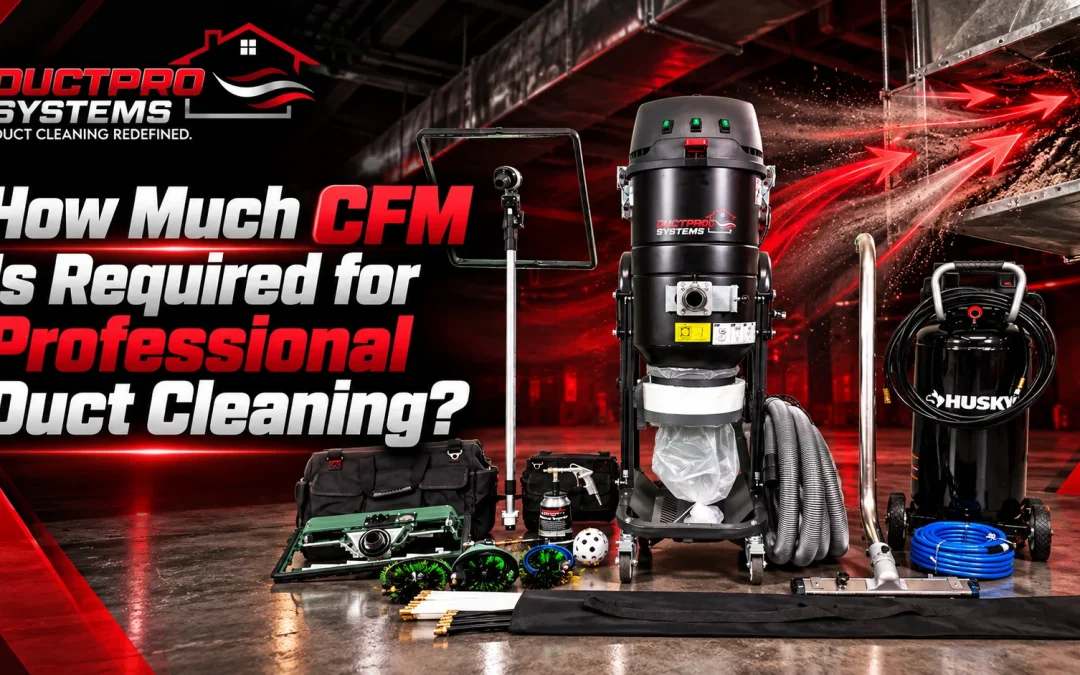
The DuctPro Tri-Motor Vacuum has a published airflow specification of 330 CFM. Its other confirmed specifications are:
| Specification | DuctPro Tri-Motor Vacuum |
| Airflow | 330 CFM |
| Air Watts | 900 Air Watts |
| Water Lift | 220 inches |
| Motor configuration | Three independent vacuum motors |
| Debris capacity | 12 gallons |
| Operating voltage | 120 Volts |
These specifications describe the DuctPro Tri-Motor Vacuum and provide contractors with key information for evaluating the equipment alongside the requirements of a specific cleaning application.
In particular, 330 CFM is not a minimum CFM requirement for every duct-cleaning job, nor does it represent an ideal airflow figure for every duct system. The published specification should be evaluated alongside the complete extraction configuration and the conditions of the job.
The three independent vacuum motors describe the motor configuration. They should not be used to calculate or assume an unverified combined airflow figure.
Similarly, the 220-inch water-lift specification should not be treated as another way of expressing the 330 CFM airflow rating. The two specifications describe different aspects of vacuum performance.
For contractors evaluating the DuctPro Tri-Motor Vacuum, the useful comparison is between the equipment’s confirmed specifications and the requirements of the actual work.
Why the Complete Extraction System Matters
The vacuum is only one component of a professional duct-cleaning extraction system.
A typical airflow path may involve the duct section being cleaned, access openings, the extraction connection, hose, fittings, filtration, debris collection, and the vacuum itself.
Each component can influence the operating conditions.
Access points determine how the technician connects to and isolates the system. Hose routing affects the path between the ductwork and vacuum. Duct geometry determines how air can travel through the system. Filtration can add resistance. Debris loading can change the conditions within the collection path.
Agitation also matters because extraction cannot transport material that has not been adequately released from the duct surface.
This is why equipment selection and job setup should be considered together. A vacuum with a published CFM specification is not operating in isolation once it is connected to a real HVAC system.
The objective is to establish a controlled airflow path through the portion of the ductwork being cleaned.
For contractors evaluating air duct cleaning equipment, that complete-system perspective is more useful than looking for a single number that supposedly works for every application.
Frequently Asked Questions
How much CFM is needed for professional duct cleaning?
There is no single universal CFM requirement that applies to every professional duct-cleaning job. The appropriate airflow depends on duct dimensions, duct configuration, hose arrangement, resistance, access, filtration, debris, extraction configuration, and equipment operating conditions.
A contractor should evaluate the manufacturer’s published CFM specification in relation to the complete extraction system rather than selecting equipment from a universal minimum number.
Does higher CFM always mean better duct cleaning?
No. CFM is an important airflow specification, but it does not describe every aspect of vacuum performance.
Water lift, system resistance, hose configuration, duct geometry, filtration, access, and the extraction arrangement also affect actual operating conditions. A higher published CFM figure by itself does not establish that a machine will perform better in every duct-cleaning application.
Does duct size affect CFM requirements?
Duct size affects the relationship between airflow and velocity because velocity depends on both volumetric airflow and cross-sectional area.
However, duct size alone does not determine the appropriate equipment specification. Duct geometry, hose configuration, restrictions, access openings, filtration, and the complete extraction path also matter.
What is the difference between CFM and water lift?
CFM measures volumetric airflow, while water lift provides information about vacuum pressure capability.
They are different specifications and should not be treated as equivalent. Evaluating a duct-cleaning vacuum properly requires understanding what each specification describes.
Does hose length affect available airflow?
Hose length can affect the resistance of the extraction path and therefore the airflow conditions under which the equipment operates.
Hose diameter, bends, fittings, restrictions, and the rest of the connected system also matter. This is why the manufacturer’s published CFM should not automatically be assumed to be the airflow available at the cleaning point.
What should contractors compare when choosing a duct-cleaning vacuum?
Contractors should compare the manufacturer’s published specifications, the measurement conditions behind those specifications, hose configuration, duct size and geometry, system resistance, access requirements, filtration, debris characteristics, and the complete extraction configuration.
CFM should be considered as part of that evaluation rather than as a standalone measure of cleaning capability.
Conclusion
CFM is an important specification when evaluating a professional duct-cleaning vacuum, but there is no universal CFM number that determines whether equipment is appropriate for every job.
The practical question is how the published airflow specification relates to the complete extraction system. Duct dimensions, hose diameter and length, fittings, bends, access openings, filtration, debris, system resistance, and equipment operating conditions all influence the airflow available during an actual cleaning operation.
Contractors should therefore compare equipment specifications carefully, understand the conditions behind published numbers, and evaluate the vacuum together with the duct system and extraction configuration.
The DuctPro Tri-Motor Vacuum’s published specifications should be evaluated alongside the requirements of the actual cleaning application rather than treated as universal duct-cleaning requirements. Those figures describe the product. They do not establish universal duct-cleaning requirements.
The most reliable equipment decision comes from matching the complete extraction system to the work rather than selecting a vacuum based on CFM alone.