
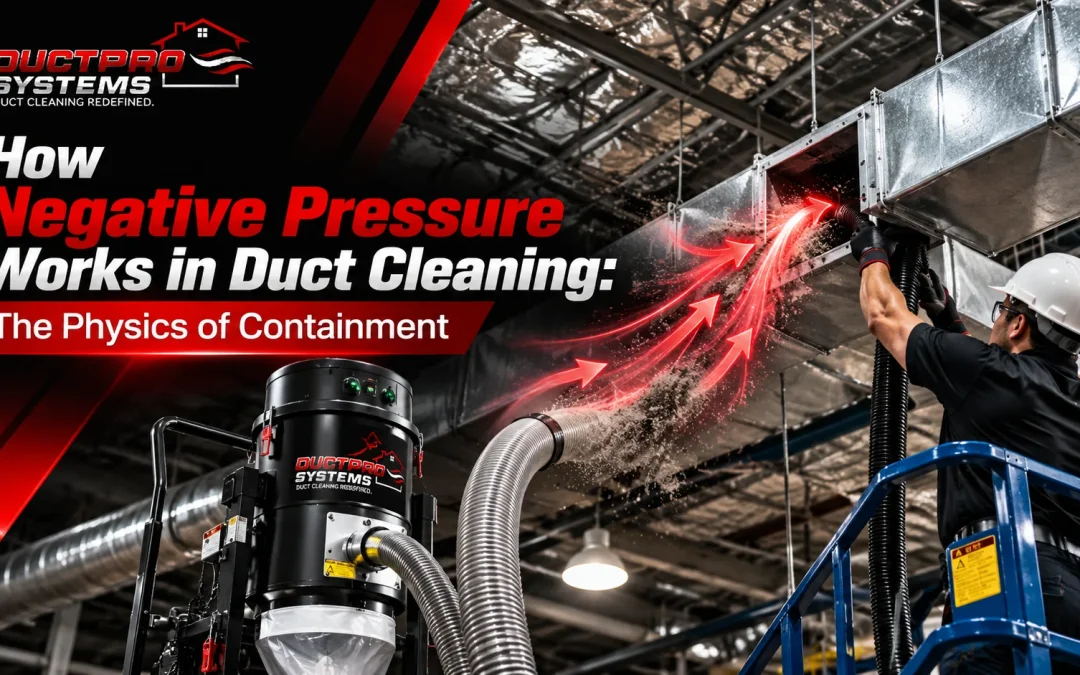
Negative pressure is the basic control principle behind source removal in professional duct cleaning. The vacuum does more than pull debris through a hose. When the system is configured correctly, it creates a pressure difference that establishes airflow toward the collection equipment and helps keep loosened contaminants from escaping into the surrounding space.
That distinction matters. A duct system is not a sealed laboratory chamber. It contains branches, fittings, registers, access openings, leaks, filters, dampers, and other paths through which air can move. The cleaning equipment has to create a controlled airflow path through that system while the agitation tools release material from interior surfaces.
Understanding the physics makes it easier to understand why vacuum capacity, hose configuration, system setup, and containment all matter during a cleaning job.
What Negative Pressure Means in a Duct System
Negative pressure simply means that the pressure inside the section being cleaned is lower than the pressure outside it.
A vacuum collector creates this pressure difference by removing air from the duct system. Air then moves from areas of higher pressure toward the lower-pressure region. In a duct-cleaning application, that movement gives the loosened dust and debris a direction to travel.
The vacuum does not pull every particle directly from the duct surface by itself. Instead, it establishes the airflow needed to transport material once agitation has separated it from the surface.
This is why professional duct cleaning normally combines two functions:
- Agitation, which breaks dust and debris loose from interior surfaces.
- Airflow and extraction, which carry that material out of the duct system and into the collection equipment.
Without adequate extraction, loosened material can remain suspended in the duct, settle elsewhere, or move toward areas that were not intended to receive the debris.
Pressure Difference Creates the Airflow Path
The useful part of negative pressure is the pressure difference, not the word “vacuum” by itself.
Consider a duct section connected to a vacuum collection system. Once the vacuum begins removing air, pressure inside the connected duct falls relative to the surrounding space. If there is an opening or controlled access point, surrounding air can enter the system and move toward the vacuum.
That moving air becomes the carrier for loosened material.
The basic relationship can be expressed conceptually as:
Higher pressure → lower pressure
The larger and better controlled the pressure difference, the stronger the driving force for airflow through available paths. Actual airflow, however, depends on the resistance of those paths. Duct dimensions, hose diameter, bends, restrictions, filters, fittings, access openings, and the condition of the system all affect how much air can move.
This is why a vacuum’s published airflow figure should not be treated as a guarantee of identical airflow at every point in an actual duct-cleaning setup.
Negative Pressure Is About Containment, Not Just Suction
The term “containment” describes an important practical consequence of negative pressure.
During cleaning, debris is deliberately disturbed. Brushes, air tools, whips, and other agitation methods can put fine material back into the airstream. If the section being cleaned is maintained under negative pressure relative to the surrounding area, the preferred direction of air movement is into the duct and toward the extraction equipment.
That helps prevent the cleaning process from becoming a source of uncontrolled dust release.
The objective is not to create a perfect vacuum throughout an entire building. The objective is to establish a controlled pressure and airflow relationship around the portion of the HVAC system being cleaned.
This distinction becomes particularly important when technicians isolate sections of a system or work through access openings. The extraction point and the openings being used for cleaning have to work together.
Why the Vacuum Connection Location Matters
Where the vacuum is connected affects the airflow path through the duct system.
A connection positioned so that airflow travels through the section being cleaned can draw loosened material toward the collection equipment. A poorly chosen connection can create a much shorter path for the air, allowing it to bypass portions of the system.
The air will follow the path of least resistance.
That principle is easy to overlook when looking only at the vacuum itself. A powerful collector connected to the wrong location cannot compensate for an ineffective airflow path.
Technicians therefore need to consider the layout of the duct system before deciding where to establish the extraction point. The location of branches, access points, dampers, and other openings can influence how air moves through the system.
For larger or more complicated systems, the cleaning process may require sectional isolation so that the vacuum is working on a defined portion of the ductwork rather than trying to draw air through every available path simultaneously.
Why Openings and Leaks Matter
Negative pressure only works as intended when the airflow path is controlled.
A duct system contains intentional openings, such as registers and access points, as well as unintentional leakage. Every opening can influence the pressure distribution within the system.
An uncontrolled opening can allow air to enter without passing through the section the technician is trying to clean. That can reduce the effectiveness of the desired airflow path.
This is one reason containment and isolation are closely related to extraction. The goal is not simply to make the vacuum run. The goal is to control where replacement air enters and where extracted air leaves.
When access openings are properly positioned and the system is configured around them, the technician can create a more predictable movement of air and debris.
Negative Pressure and Airflow Are Related, But They Are Not the Same
Understanding the relationship between airflow, pressure, and system resistance is essential when selecting professional air duct cleaning equipment. The equipment is only one part of the extraction system; hose routing, access points, duct configuration, and other restrictions all influence how effectively air moves through the section being cleaned.
CFM and pressure are different performance characteristics.
CFM describes airflow volume. It tells you how much air the equipment can move under a specified condition.
Pressure describes the pressure difference the system can develop. In vacuum equipment, this is often discussed using a water-lift or static-pressure measurement.
Both characteristics matter because duct cleaning involves moving air through a resistance-filled system.
A vacuum can have a strong pressure capability but still move less air when the connected hose, ductwork, filter, or other components impose significant resistance. Conversely, a high airflow figure by itself does not tell you how the equipment will behave when the system presents substantial resistance.
The practical question is therefore not simply, “How many CFM does the vacuum have?”
It is, “How does the extraction system perform through the actual airflow path being used?”
The DuctPro Tri-Motor Vacuum
The DuctPro Tri-Motor Vacuum has a 330 CFM airflow specification, along with 900 Air Watts, 220 inches of water lift, three independent vacuum motors, a 12-gallon debris tank, and 120-Volt operation. These specifications describe the equipment itself and should not be interpreted as the exact airflow that will exist at every point in a connected duct system.
Actual system performance depends on the complete path between the ductwork and the collection equipment. Hose routing, restrictions, fittings, filters, access configuration, and the duct system itself all influence the resulting airflow.
That is an important distinction when evaluating extraction equipment. The vacuum is one component of the system. The complete airflow path determines what happens at the cleaning location.
What Happens When the System Is Properly Under Negative Pressure
Once the extraction system is operating and the duct section is configured correctly, several things happen together.
First, the vacuum removes air from the system.
Second, the pressure in the connected section falls relative to the surrounding environment.
Third, replacement air moves toward the lower-pressure region through the available controlled openings.
Fourth, agitation releases dust and debris from duct surfaces.
Finally, the moving airstream transports that material toward the vacuum collection system.
The process is continuous. As the vacuum removes air, more air enters the system, creating the flow needed to carry loosened material.
This is why extraction and agitation cannot be considered completely separate operations. Agitation determines how effectively material is released. Extraction determines how effectively that released material is transported away.
What Negative Pressure Cannot Do
Negative pressure is not a substitute for proper cleaning technique.
It does not automatically remove material that remains firmly attached to a duct surface. It does not guarantee that every branch of a complex system receives the same airflow. It does not eliminate the effects of restrictions or uncontrolled openings.
A technician still has to determine how the system should be accessed, isolated, and cleaned.
The same principle applies to equipment selection. A vacuum should be matched to the work and the duct system rather than selected from one specification in isolation.
Why System Configuration Often Matters More Than the Vacuum Rating
A duct-cleaning vacuum can only operate within the conditions created by the connected system.
Imagine two jobs using the same extraction equipment. One has a short, relatively direct connection with controlled access and few restrictions. The other has a long hose run, several bends, restricted access, and multiple paths through which air can enter.
The equipment is identical, but the airflow conditions are not.
This is why professional extraction requires attention to hose routing, access locations, system isolation, and restrictions. The objective is to preserve a useful airflow path between the area being cleaned and the collection equipment.
The vacuum creates the pressure difference. The system configuration determines how effectively that pressure difference produces the desired airflow.
Negative Pressure and Cross-Contamination Control
Containment is particularly important when cleaning systems in occupied buildings.
If loosened material is allowed to escape from access openings or migrate into adjacent areas, the cleaning process can create a secondary contamination problem. Maintaining the appropriate negative-pressure relationship helps direct air toward the extraction system rather than allowing uncontrolled outward movement.
That does not mean negative pressure alone provides complete containment. Openings still need to be managed, and the equipment and cleaning method must be appropriate for the application.
The principle is straightforward: material that has been intentionally disturbed should have a controlled path out of the system.
The Physics in Practical Terms
For a technician, the physics can be reduced to a few practical ideas.
Air moves because of a pressure difference.
Airflow encounters resistance.
The path with less resistance tends to carry more of the airflow.
Agitation releases material that extraction then transports.
Openings and leaks change the pressure and airflow distribution.
The extraction connection should be positioned to produce the desired airflow through the section being cleaned.
These principles explain why professional duct cleaning is more than connecting a vacuum to a duct and turning it on.
Negative Pressure Is the Control Mechanism
The central purpose of negative pressure in duct cleaning is directional control.
The vacuum establishes a lower-pressure region. The resulting pressure difference drives air toward the extraction point. Properly configured, that airflow carries loosened contaminants away from the work area and into the collection equipment.
The quality of that process depends on the entire system. Vacuum capacity matters, but so do pressure capability, hose configuration, access points, restrictions, isolation, and the way the technician moves through the duct system.
Understanding that relationship makes equipment specifications easier to interpret. CFM is not the entire story, and suction strength is not the entire story either. Effective extraction comes from creating and maintaining a controlled airflow path through the section being cleaned.
That is the practical physics behind negative-pressure duct cleaning.