
The wrong equipment purchase does not just cost you money upfront. It costs you jobs you cannot reach, hours lost to callbacks, and revenue capped by the physics of an underpowered system. This guide is not a product comparison. It is a capital investment framework built around the mechanical variables that determine whether your equipment makes you money or limits you.
Every decision here starts with one question: what does this machine actually deliver at the point of extraction, under real job-site conditions?
When evaluating air duct cleaning equipment, the contractors who make durable purchasing decisions are the ones who stop reading spec sheets at face value and start asking about working performance under load.
Identifying the Metrics that Matter: Why CFM Is Only Half the Story
CFM is the metric every manufacturer leads with. It is also the metric most commonly misrepresented.
Here is the problem. Free-air CFM is measured with no restriction on the inlet. No hose. No connection collar. No duct resistance. It is a laboratory number that does not exist on any job site you will ever work. The moment you attach a hose, connect to a trunk line, and begin extracting through a real duct network, that rated CFM drops. How far it drops depends on the machine’s working static pressure, measured in water column inches (WC).
Static pressure is the force the machine generates to overcome resistance in the extraction path. A unit with high free-air CFM but low static pressure will see its effective airflow collapse as soon as the system encounters duct resistance. At that point, air velocity inside the trunk line drops below the threshold required to entrain debris. Particulate settles back onto the duct floor. You have moved debris. You have not extracted it.
For a detailed breakdown of how to calculate the CFM your specific job configuration actually requires, see our post on CFM required for professional duct cleaning.
The minimum thresholds that matter in practice:
| Metric | Minimum Viable | DuctPro Tri-Motor | Why It Matters |
| Free-Air CFM | 2,000 CFM | 5,000 CFM | Sets ceiling for working performance |
| Working Static Pressure | 4 inches WC | High-static design | Maintains velocity through resistance |
| Filtration Final Stage | HEPA capable | HEPA at 0.3 microns (99.97%) | Determines IAQ compliance |
| Motor Configuration | Single | Tri-Motor (3 independent) | Redundancy and load distribution |
Do not buy a machine on free-air CFM alone. Ask for the performance curve: CFM plotted against static pressure at the operating point your hose configuration will create. If the manufacturer cannot provide that curve, treat it as a disqualifying data point.
The 5,000 CFM working figure our Tri-Motor system is engineered around is the number that matters at the trunk connection, not at the machine outlet in a controlled lab setting.
The Portability Factor: Reaching the “Unreachable” Job Site
Truck-mount systems have one irreversible constraint: the hose has to reach the work area. In a single-story residential job with a driveway near the utility room, that works. In a high-rise residential building, a multi-tenant commercial property, or a luxury condo where parking access is restricted, the truck stays on the street and the job goes to a competitor with a portable unit.
That is not a theoretical scenario. It is a structural revenue ceiling you build into your business the day you commit to truck-mount-only equipment.
The objection contractors raise is power. Truck mounts deliver high CFM because they run off the vehicle engine or a dedicated power unit with no electrical constraints. The assumption is that portable equals underpowered.
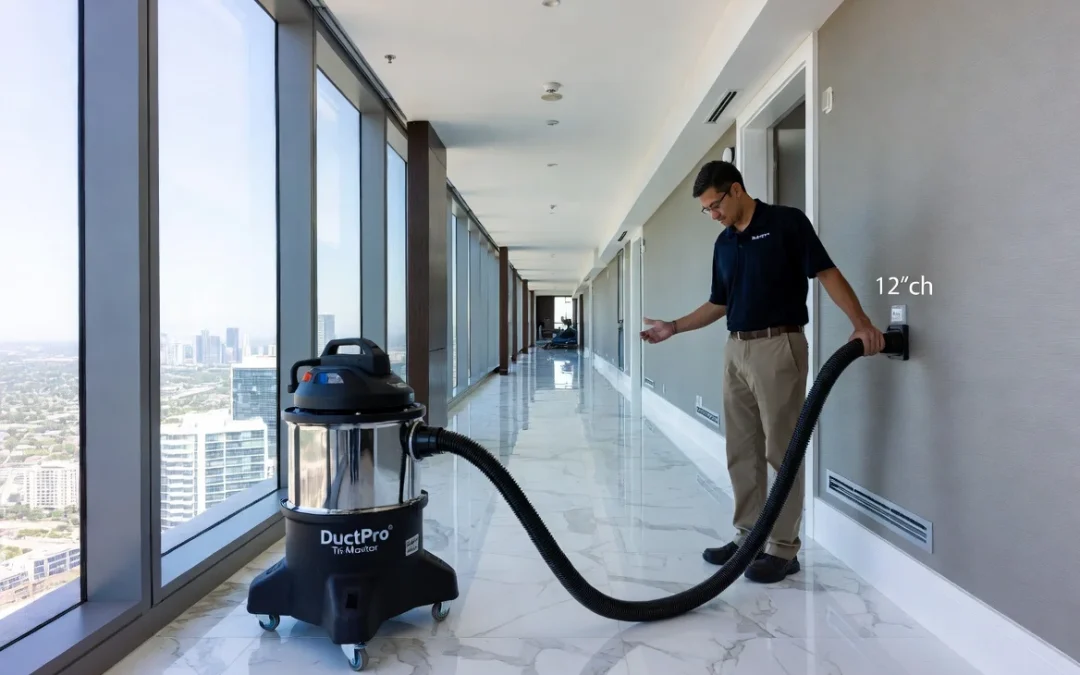
Our Tri-Motor Duct Vacuum is engineered specifically to close that gap. Three high-efficiency motors operating in parallel deliver 5,000 CFM in a cabinet designed for van or truck transport. The system moves to any floor of any building. The hose runs from the machine to the trunk, not from the street.
Where a high-power portable system outperforms truck-mount:
- High-rise residential and commercial: No hose-length limitation. The machine positions at the optimal point inside the building.
- Restricted-access properties: No parking, no problem. The unit rolls in with the crew.
- Multi-zone jobs: Repositioning the machine between zones takes minutes. Repositioning a truck-mount configuration takes significantly longer.
- Mixed residential and commercial book: One portable system covers both markets. A truck-mount optimized for one market underperforms on the other.
Portability does not mean compromise when the underlying performance spec matches or exceeds the stationary alternative. The business case is straightforward: more job types accessible with the same capital outlay.
Analyzing Total Cost of Ownership (TCO): Filter Efficiency and Motor Life
Sticker price is the least useful number in this purchase decision. The number that determines actual cost is total cost of ownership over a 3-to-5 year operating window.
TCO in this category breaks into three components: filter consumable cost, motor replacement risk, and downtime cost per event.
Filter Cost and IAQ Compliance
Our 3-stage filtration architecture stages the debris load before it reaches the final filter. Stage 1 handles bulk debris collection. Stage 2 is a polyester secondary filter that captures mid-range particulate. Stage 3 is the HEPA final filter, rated at 99.97% efficiency at 0.3 microns.
The practical implication: because stages 1 and 2 are pre-loading the debris before it reaches the HEPA media, the HEPA filter lasts longer between replacement cycles. A single-stage system that passes all particulate directly to the HEPA media will require more frequent filter changes at higher cost. Over a 12-month operating period on a full job schedule, that differential is material.
Motor Redundancy and Downtime Economics
A single-motor system that fails mid-job has one outcome: the job stops. You are now looking at a callback, a rescheduled customer, and a day of lost revenue.
The Tri-Motor architecture changes that math. Three independent motors mean that if one motor requires maintenance, the system continues to operate on two. You complete the job at reduced capacity rather than shutting down entirely. Then you service the motor on your own schedule, not the customer’s.
Calculate this simply. If your average job revenue is $350 and a motor failure costs you two days of scheduling disruption, the downtime cost of a single event exceeds $700 in lost revenue. A Tri-Motor system that prevents one downtime event per year has paid for a meaningful portion of the purchase price premium over a single-motor competitor unit.
The BioClean Duct Sanitizing Sprayeras a revenue extension: Chemical integration compatibility is a TCO factor, not just a feature. Equipment that supports post-extraction antimicrobial treatment allows you to upsell a service that costs minutes to add and commands a significant per-job premium. Evaluate this integration capability before you purchase.
Circuit Management: The Hidden Operational Cost of Underpowered Units
This section does not appear in most buying guides. It should be the first thing you verify before any equipment purchase.
Underpowered single-motor units in the 1,500 to 2,000 CFM range are often marketed as “easy to run” because they draw low amperage. That low amperage is precisely the problem. Low amperage means low motor power, which means low static pressure under load. You are not buying simplicity. You are buying insufficient extraction performance.
High-power systems require proper circuit management. Mismanaged electrical draw is the most common source of mid-job failures in portable extraction systems, and it is entirely preventable.
Our Tri-Motor system is engineered for residential 15-amp and 20-amp circuits. The built-in circuit locator allows you to identify independent breakers and distribute the motor load before you power up. Specific steps for executing this protocol on arrival at any job site are covered in our air duct cleaning equipment setup guide.
The circuit management protocol in brief:
- Use the circuit locator to identify a minimum of two independent breakers within extension cord range of your planned machine position.
- Assign each motor leg to a separate circuit. Document the assignment before startup.
- Verify both circuits are genuinely independent by checking the panel. Two outlets on the same wall often share a single breaker.
- Confirm each circuit is unloaded before startup. Refrigerators, HVAC air handlers, and electric water heaters sharing your circuit will push you into trip territory under full motor load.
A mid-job breaker trip in a sealed duct system causes an immediate pressure collapse. The extraction airstream stops. Debris that was entrained in the moving air column drops back into the duct. You are not starting from where you left off. You are re-agitating debris that has re-settled. That costs you time, which costs you money.
Proper circuit management is not an operational nicety. It is a direct line item in your per-job labor cost.
Conclusion: Selecting a System that Scales with Your Business
The equipment decision you make today sets the ceiling on the jobs you can quote tomorrow.
A 2,000 CFM single-motor unit limits you to standard residential work. You cannot quote high-rise contracts. You cannot guarantee IAQ compliance on multi-zone commercial jobs. And when that single motor fails, you are off the schedule.
A 5,000 CFM Tri-Motor system with 3-stage HEPA filtration, built-in circuit management, and a portable footprint does not cap your market. It opens the residential tier, the luxury residential tier, and the light commercial tier simultaneously. The capital cost is higher. The revenue ceiling is structurally higher.
Evaluate equipment purchases on these four criteria, in this order:
- Working static pressure performance curve, not free-air CFM ratings.
- Portability and access range: can this machine reach every job type you want to quote?
- Motor redundancy: what is the operational cost of a single downtime event with this system?
- Filtration architecture: what are the filter consumable costs over a 36-month operating window?
To review the complete DuctPro equipment lineup against these criteria, visit the shop or request the operation manual for detailed performance specifications. If you are evaluating the full system configuration, the complete air duct cleaning equipment system page covers the integrated package in full.