
Most clients cannot see the problem. They cannot see a 0.3-micron mold spore suspended in recirculated air. They cannot see the dust mite allergen fragments that have settled into the duct lining over five years of HVAC operation. What they experience are symptoms: chronic congestion, elevated allergy response, unexplained respiratory irritation. They call you because something is wrong in the air, not because they understand the physics of what is making it wrong.
Your job is to fix the air. The equipment you bring to the job site determines whether you actually accomplish that, or whether you disturb a contained contamination problem and make it worse.
The selection and operation of air duct cleaning equipment is an IAQ intervention, not a maintenance service. The distinction matters in how you price the job, how you explain the process to the client, and what you can guarantee when you leave.
The Filtration Standard: Why HEPA 99.97% Is the Only Acceptable Baseline for IAQ
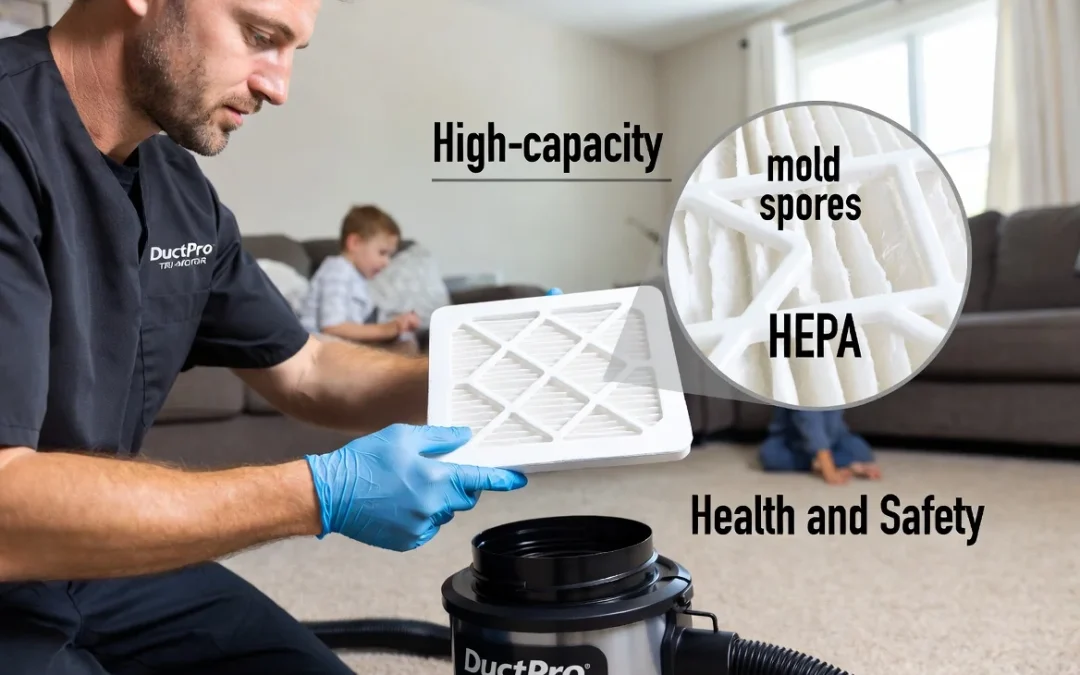
HEPA stands for High Efficiency Particulate Air. The standard is not a marketing designation. It is a defined performance specification: a true HEPA filter must capture 99.97% of airborne particles at 0.3 microns in diameter. That specific size, 0.3 microns, is selected because it represents the Most Penetrating Particle Size (MPPS): the particle size most likely to pass through filter media due to the competing aerodynamic forces acting on it. Particles larger or smaller than 0.3 microns are actually easier to capture. The HEPA rating is the worst-case performance floor.
Here is why that number matters in a duct cleaning context.
The biological contaminants driving the majority of IAQ complaints are all concentrated in the sub-micron to low-micron size range:
| Contaminant | Particle Size | Health Relevance |
| Mold spores | 1 to 20 microns | Respiratory irritant, allergenic, potentially toxic |
| Dust mite allergen (Der p 1) | 1 to 10 microns | Primary driver of perennial allergic rhinitis |
| Pet dander (Fel d 1) | 2 to 10 microns | Persistent airborne allergen |
| Bacteria | 0.3 to 10 microns | Infection risk in immunocompromised occupants |
| Combustion particulate (PM2.5) | Under 2.5 microns | Cardiovascular and pulmonary disease risk |
Any extraction system not equipped with a HEPA final stage is not capturing the contaminants at the top of this table. It is capturing visible debris and recirculating the rest. In practical terms: a non-HEPA extraction system runs contaminated air through its filter media, fails to capture sub-micron particulate, and exhausts that particulate back into the occupied space. You have not cleaned the air. You have run the HVAC system with extra turbulence.
Our 3-stage filtration architecture addresses this problem at scale. Stage 1 captures bulk debris: accumulated dust, insulation fragments, large particulate that would otherwise rapidly load the fine media downstream. Stage 2, the polyester secondary filter, captures mid-range particulate and protects the final stage from premature saturation. Stage 3 is the HEPA final filter at 99.97% efficiency at 0.3 microns: the only stage that addresses the biological contaminants driving the client’s symptoms.
The sequential staging matters operationally. A system that passes the full debris load directly to the HEPA media saturates the filter faster, increases resistance across the filter stack, and reduces working CFM delivery. Our pre-loading architecture extends HEPA filter life and maintains airflow performance across the full duration of the job. That is not a convenience feature. It is a performance variable that determines whether your 5,000 CFM rated system is still performing at adequate extraction velocity at hour three of a four-hour job.
Cross-Contamination Risks: How Negative Pressure Protects the Occupied Space
The filtration stage handles what the machine exhausts. Negative pressure containment handles what happens inside the duct network during agitation.
Mechanical agitation, whether air whips, skipper balls, or rotary brush, dislodges debris from duct surfaces and suspends it in the airstream. That is the correct mechanical process. The risk variable is where that suspended debris goes. In a properly sealed, negatively pressurized system, the answer is: directly toward the extraction point, and into the machine.
In an unsealed or partially sealed system, the answer is different. Agitation-induced turbulence inside the duct network creates pressure spikes that push contaminated air through unsealed registers, past loose boot connections, and into the occupied space. Mold spores, dust mite allergen, and pet dander that were contained inside the duct system are now airborne in the room. They will settle on soft furnishings, carpets, and bedding. The client’s air quality has measurably worsened as a direct result of the cleaning process.
For a detailed explanation of how negative pressure propagates through a branched duct network and the physics of containment maintenance, see our post on how negative pressure works in duct cleaning.
The containment protocol requirements for IAQ-compliant work:
- All supply registers except the primary access point must be sealed before agitation begins. Not mostly sealed. Sealed. A gap at the corner of a foam register cover is a contamination pathway.
- The negative pressure envelope must be verified before mechanical agitation begins. If your system is equipped with a manometer connection point, measure the pressure differential between the duct interior and the room before you run the first air whip. A verified negative pressure reading is the confirmation that containment is active.
- Agitation sequencing should move from the furthest register toward the extraction point. This keeps the contaminated debris wave moving consistently toward the machine and prevents re-suspension behind the agitation tool.
- If you detect a pressure loss during agitation, stop the agitation tool. A pressure drop mid-job indicates a seal failure or a previously undetected duct breach. Continuing agitation under those conditions disperses debris into the occupied space.
The relationship between adequate CFM delivery and effective containment is direct: you need sufficient extraction airflow to maintain negative pressure across the entire duct network volume while simultaneously entraining agitated debris. Undersized systems lose containment integrity under agitation load because the extraction airflow cannot compensate for the turbulence the agitation tools introduce. For the CFM thresholds required to maintain containment across different duct network sizes, see our post on CFM required for professional duct cleaning.
Beyond Dust: Addressing Biological Growth with BioClean Integration
Mechanical extraction removes what is loose. It does not address what is adhered.
Mold colonies, bacterial biofilm, and microbial growth inside duct systems establish on the duct surface itself. They are not suspended in the airstream waiting to be captured. They are structurally attached to the substrate: metal duct walls, flex duct liner, insulated surfaces, and boot interiors. Mechanical agitation can dislodge surface-level growth. It cannot penetrate the hyphal network of an established mold colony, and it cannot neutralize the mycotoxin residue that remains on the surface after physical removal.
This is the mechanical limitation of duct cleaning as a standalone service. Extraction removes particulate. It does not decontaminate biological growth.
Antimicrobial treatment addresses that gap. The BioClean Duct Sanitizing Sprayer is engineered for integration with our extraction system as a post-cleaning treatment step. After mechanical extraction and before the system is re-pressurized, the BioClean sprayer introduces an antimicrobial fog into the duct network. The fog penetrates areas that mechanical agitation tools cannot physically reach: elbow interiors, flex duct corrugations, boot cavities behind register faces.
The biological targets of antimicrobial fogging:
- Active mold colonies on duct surfaces: neutralized at the hyphal structure before the system returns to normal operation and begins circulating air across that surface again.
- Bacterial biofilm in condensate-contacted areas: particularly relevant in humid climates where the evaporator coil section and nearby ductwork accumulate biological growth between cleaning cycles.
- Residual allergen protein: antimicrobial chemistry denatures the protein structure of allergens like Der p 1 (dust mite) and Fel d 1 (cat dander) that have adhered to duct surfaces, reducing their allergenic potential even after re-aerosolization.
Position the antimicrobial treatment step as a mandatory final protocol, not an optional upsell. A duct system with extracted particulate but untreated biological growth will reload contamination faster than a system where the biological substrate has been addressed. The client will call back in 18 months with the same symptoms. The BioClean step is how you prevent that callback and justify the service interval you recommend.
Technical Documentation: Using Equipment Specs as a Client Sales Tool
IAQ is invisible. You cannot show a client a clean air column the way you can show them a clean duct interior on a camera inspection. What you can show them is the objective measurement of the process: the equipment specifications and field readings that confirm the extraction system performed to IAQ standards.
This is where your equipment specification converts from a purchasing decision into a client communication tool.
The documentation framework for IAQ-compliant jobs:
Pre-job documentation:
- Record the static pressure reading at the trunk connection before sealing. This establishes the baseline duct system leakage rate.
- Photograph the condition of the primary access point, register covers, and any visible contamination before agitation begins. This protects you from post-job claims and establishes the remediation baseline for the client record.
In-process documentation:
- If equipped with a manometer, record the negative pressure differential reading after sealing and before agitation. A reading in the 0.02 to 0.05 inches WC range across the register face confirms active negative pressure containment. Show this number to the client. It is objective proof that the contaminated airstream is contained inside the system during the cleaning process, not migrating into the occupied space.
- Note the CFM delivery at operating conditions. A 5,000 CFM system operating at verified high static pressure in a sealed duct network is a quantifiable performance statement.
Post-job documentation:
- Record the filter stage condition at job completion. A loaded primary stage confirms that significant particulate mass was extracted. This is tangible evidence of extraction volume.
- Document the antimicrobial treatment application: product, dilution ratio, application coverage area, and dwell time. This converts the BioClean step from a verbal claim into a documented decontamination record.
- Provide the HEPA filter specification to the client in writing: 99.97% efficiency at 0.3 microns, with the filter’s rated performance standard. A client holding a document that references a hospital-grade filtration standard understands the service differently than a client who received a verbal description of “high-quality filters.”
The contractors who hold and lose IAQ-focused accounts are separated by one variable: documentation. A client who has a physical record of manometer readings, HEPA certification specs, and antimicrobial treatment logs has objective evidence that the service was performed to a clinical standard. That document is your renewal conversation at the 12-month mark.
Conclusion: Elevating Duct Cleaning from Maintenance to Healthcare
The services priced at $89 are cleaning services. The services priced at $400 to $600 are IAQ interventions. The difference is not the truck or the labor time. It is the equipment specification and the documentation protocol that converts that specification into a verifiable health outcome for the client.
HEPA 99.97% at 0.3 microns. Verified negative pressure containment. Antimicrobial biological decontamination. Documented pre-and post-job performance readings. These are not premium add-ons. They are the technical baseline for a service that can be legitimately described as improving indoor air quality rather than simply moving debris from one location to another.
Your equipment is your argument. When a client asks why your quote is higher than the competitor, the answer is not “we do better work.” The answer is a filter specification, a CFM rating, and a containment protocol that the competitor cannot match.
Build that case from the equipment outward. Start with the complete air duct cleaning equipment system and work backward to the service tiers it enables. The IAQ market is not won on price. It is won on the ability to prove, in writing, that the air in that building is measurably safer after you leave than it was before you arrived.