
There is a persistent assumption in this industry that portable means underpowered. That assumption is costing contractors revenue on every job they decline because their truck cannot park close enough, their hose cannot reach the mechanical room, or their system cannot get past the lobby of a restricted-access building.
The assumption is also mechanically wrong.
A properly engineered air duct cleaning equipment system in a portable cabinet does not sacrifice performance. It repositions the performance. And in most real-world job configurations, that repositioning results in higher effective CFM at the trunk line than a truck-mount running the same rated output from the street.
This article addresses the physics, the logistics, and the operational economics of high-performance portable duct cleaning systems for professional contractors.
The Physics of Proximity: Why Portable Systems Often Deliver Higher Effective CFM
Rated CFM is a machine specification. Effective CFM is a job-site reality. The gap between those two numbers is determined by one primary variable: the total resistance in the extraction path between the machine and the trunk line connection.
Every foot of hose adds friction resistance. Every 90-degree bend creates turbulent flow conditions that reduce the cross-sectional area available for laminar airflow. A truck-mount system running a 150-foot hose from the street to the mechanical room on the second floor of a residential property may be rated at 5,000 CFM at the machine outlet. By the time that airstream has navigated the hose run, the bends around the building exterior, and the connection at the trunk, effective CFM at the point of extraction can be reduced by 20 to 35 percent depending on hose diameter, bend count, and elevation change.
That same 5,000 CFM system in a portable cabinet positioned 10 to 15 feet from the trunk connection delivers a materially different effective CFM number. The friction loss across a 15-foot hose run with a single 90-degree connection bend is a fraction of the loss across a 150-foot run with six bends and a vertical elevation change.
The portable system does not match truck-mount performance at the machine. It exceeds truck-mount performance at the trunk line, which is the only location where the CFM number actually matters.
The effective CFM comparison at the trunk connection point:
| Configuration | Rated CFM | Hose Run | Estimated Bends | Approximate Effective CFM at Trunk |
| Truck-mount, street parking | 5,000 CFM | 150 feet | 6 to 8 | 3,250 to 4,000 CFM |
| Truck-mount, driveway access | 5,000 CFM | 60 feet | 3 to 4 | 4,200 to 4,600 CFM |
| Portable, positioned indoors | 5,000 CFM | 10 to 15 feet | 1 | 4,750 to 4,900 CFM |
The physics argument for portability is not theoretical. It is geometry. Shorter path, fewer bends, higher effective delivery. For contractors evaluating this investment against a truck-mount configuration, the full TCO and performance comparison framework is covered in our contractors duct cleaning equipment buying guide.
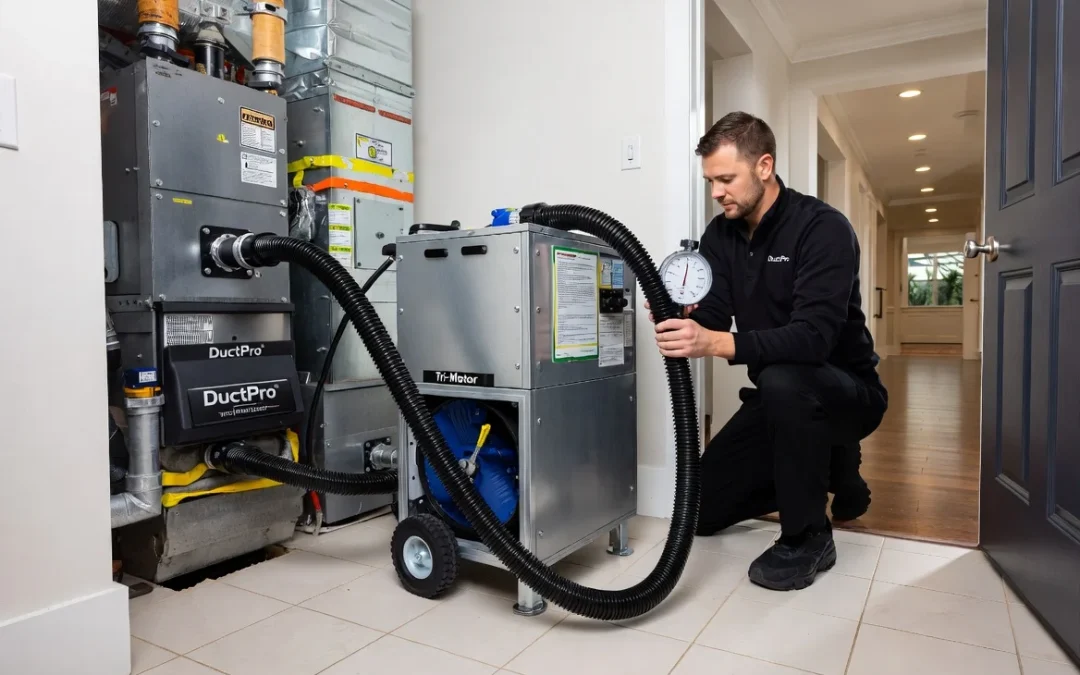
The static pressure advantage compounds this further. Our Tri-Motor system is engineered around high-static pressure physics: the system is designed to maintain extraction velocity under resistance, not just to move a high volume of air in free-air conditions. At a 15-foot hose run, the system is operating well within its resistance tolerance, which means static pressure at the trunk connection is near the machine’s rated maximum. That static pressure is what lifts debris off the duct floor and maintains it in the airstream long enough to reach the extraction point. Lower static pressure moves debris. Higher static pressure extracts it.
Expanding Your Service Radius: Accessing High-Rise and Restricted-Parking Jobs
A truck-mount system has a fixed operational constraint: the truck must park within hose distance of the duct access point. In a suburban single-family home with driveway access and a mechanical room near an exterior wall, that constraint is invisible. In every other job type, it becomes a revenue limiter.
Consider the job categories that are structurally inaccessible to a truck-mount-only operation:
High-rise residential buildings: Elevator access required. The machine goes in through the service entrance, up the elevator, and positions outside the unit door or inside the mechanical closet. A truck-mount hose cannot reach floor 12. A portable system can be on floor 12 in under 10 minutes.
Urban condominium buildings: No driveway. Street parking may be 50 to 100 feet from the building entrance before the hose run inside even begins. Doorman buildings may prohibit exterior hose routing through lobby areas. A portable system eliminates the exterior hose run entirely.
Gated communities and restricted-access properties: Contractor vehicle access is controlled at the entrance. A van with a portable system clears the gate. A truck-mount with external equipment may not. This is not a hypothetical: it is a consistent operational barrier reported by contractors in high-density metro markets.
Multi-unit commercial properties: A portable system can be repositioned between units on the same job. The machine moves to each mechanical room. A truck-mount serves one access point per setup, requiring significant hose reconfiguration between units.
Luxury residential accounts: High-value clients in premium buildings are not going to accept exterior hose runs routed through the front entrance or across landscaping. The portable system is the only option that meets the access and aesthetic requirements of that client tier.
The revenue in these job categories does not require different skills. It requires different equipment. A contractor running a portable 5,000 CFM system quotes every one of those job types. A contractor running truck-mount-only equipment declines them or refers them out.
Quantify this simply: if your market has even three to five high-rise or restricted-access jobs per month at an average revenue of $450 to $700 per job, the annual revenue gap between a portable-capable operation and a truck-mount-only operation is $16,000 to $42,000. That number dwarfs the price differential between equipment configurations.
Operational Efficiency: Reducing Setup Time and Hose Management Labor
Setup time is unbillable labor. Every minute your crew spends running hose from the truck, routing it around obstacles, and securing it against trip hazards is time that produces no revenue and consumes crew capacity.
The typical truck-mount setup sequence for a standard residential job with street parking and a mechanical room on the opposite side of the house:
- Unload hose reels from the truck.
- Run primary hose from truck to building entry point: 40 to 60 feet minimum.
- Route hose through entry, down hallway, and to mechanical room: additional 30 to 50 feet.
- Secure hose against door frames and floor transitions to prevent trip hazards.
- Connect to trunk and verify seal.
Total hose deployed: 70 to 110 feet minimum. Total setup time for this sequence, including connection and seal verification: 20 to 35 minutes for an experienced two-person crew.
The portable system setup sequence for the same job:
- Load the cabinet onto a hand truck or wheeled cart.
- Move through building entry to mechanical room position.
- Connect 10 to 15 feet of hose to the trunk.
- Verify seal.
Total setup time: 8 to 12 minutes. For the full connection and seal verification protocol that maximizes setup efficiency on a portable system, see our air duct cleaning equipment setup guide.
The time differential per job is 12 to 23 minutes. On a four-job day, that is 48 to 92 minutes of recovered crew time. Applied across a 250-day working year, that recovered time represents the equivalent of 200 to 380 additional job-hours annually. At a blended crew cost of $45 per hour, the labor efficiency of portable setup generates $9,000 to $17,100 per year in recovered crew capacity relative to truck-mount setup workflows.
That recovered capacity is either additional jobs per day or reduced crew overtime on the same job volume. Both outcomes directly improve margin.
Hose management labor cost by configuration:
| Configuration | Hose Run | Setup Time | Teardown Time | Total Non-Billable Time Per Job |
| Truck-mount, street parking | 100 to 150 feet | 25 to 35 min | 20 to 30 min | 45 to 65 min |
| Truck-mount, driveway access | 60 to 80 feet | 15 to 22 min | 12 to 18 min | 27 to 40 min |
| Portable, indoor position | 10 to 15 feet | 8 to 12 min | 6 to 10 min | 14 to 22 min |
The teardown differential is equally significant. Coiling and reloading 150 feet of vacuum hose is a two-person, 20-minute task. Disconnecting and stowing a 15-foot hose run takes one person under 8 minutes.
Conclusion: Why the Future of Duct Cleaning is High-Performance Portability
The truck-mount model was built for an era when the average duct cleaning job was a single-family home with a driveway and a mechanical room near the exterior wall. That job type still exists. But it represents a shrinking percentage of the available market in high-density metro areas, high-rise residential development corridors, and multi-unit commercial properties where growth in the duct cleaning market is concentrated.
The contractors scaling in those markets are not running hose from the street. They are running portable systems that position at the trunk, deliver near-rated CFM at the point of extraction, and set up in under 15 minutes per job. Their equipment does not cap their market. It opens it.
Our Tri-Motor Duct Vacuum is the extraction core of the portable system: 5,000 CFM rated airflow, three independent motors for circuit-distributed power management on residential 15-amp and 20-amp breakers, and a 3-stage HEPA filtration stack in a cabinet engineered for transport in a standard service van.
The complete portable system configuration, including agitation hardware and BioClean sanitization integration, is detailed on the complete air duct cleaning equipment system page. Individual components are available through the shop.
If you are running a truck-mount-only operation and declining high-rise or restricted-access jobs, the equipment decision is the only variable that needs to change.