
Containment failure is the single most common reason a duct cleaning job generates an immediate callback. Debris that escapes the work zone during high-velocity mechanical agitation does not disappear; it resettles in return air paths, redistributes into occupied spaces, or fouls downstream mechanical equipment that was never part of the original remediation scope.
Contractors who consistently avoid this outcome do not rely on luck or excessive poly sheeting. They deploy air duct cleaning equipment capable of sustaining the massive airflow volume and static pressure required to keep liberated particulate moving in a single direction: out of the building envelope, not around it.
Maintaining a true environmental boundary during active remediation is a dynamic fluid mechanics problem. Airflow capacity, rather than static suction strength alone, determines whether a containment zone stays negative under load or collapses the moment an access door or a return grille cycles open.
Why Containment Fails at Low CFM
Containment is a function of transport velocity, not just vacuum presence. A system can register minor negative pressure at the connection point and still completely fail to maintain containment if it cannot sustain particulate transport velocity across the entire length of the main trunk line.
Shop-vac class units operating at 150 to 300 CFM are the primary source of containment failure on commercial jobs. When a low-CFM source is connected to a large duct system, the mechanical physics of air distribution work against the operator:
- Particulate requires a specific minimum transport velocity to remain fully entrained in the air stream.
- As duct length increases and cross-sectional area expands, a fixed low-CFM source loses velocity faster than the debris settles.
- Once velocity drops below the entrainment threshold, particulate falls out of suspension mid-duct instead of reaching the collection collector.
This settled debris becomes secondary background contamination that gets stirred back into the airstream the next time the building HVAC system boots up, often days after the remediation crew has left the site.
True 5,000 CFM airflow changes this equation completely. Compared to the industry-standard equipment ceiling of roughly 2,000 CFM, a properly configured Tri-Motor system maintains constant transport velocity across extended horizontal runs and large-diameter trunk lines, eliminating the mid-line drop-off that causes particulate drop-out.
Establishing Negative Pressure Before Agitation Begins
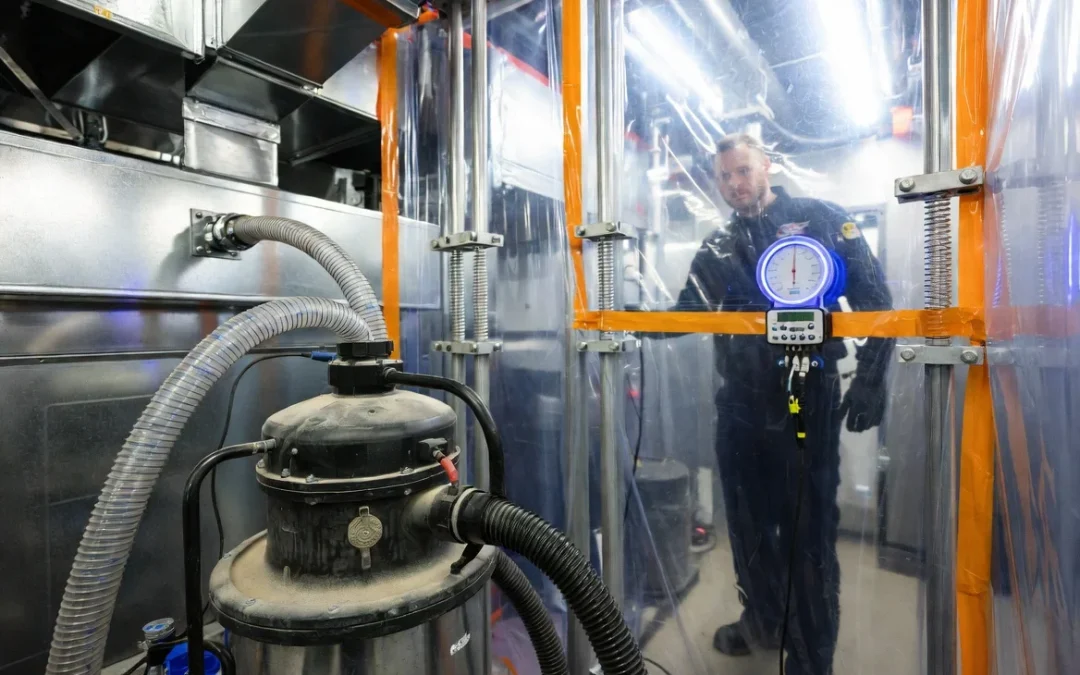
Containment mechanics must be verified before any mechanical whip or skipper ball touches the interior duct walls. The work zone must exist under a continuous negative pressure gradient relative to the surrounding occupied space, ensuring that any escaped micro-particulate is drawn back into the system rather than pushing outward through microscopic tears in the barrier.
Contractors must follow verified field protocols to establish negative pressure duct cleaning zones before starting the mechanical remediation sequence. The targeted differential range measured at the containment perimeter must read:
$$\Delta P = -0.02 \text{ to } -0.05 \text{ in. w.c.}$$
Measurements shallower than -0.02 inches of water column provide insufficient atmospheric pull to reliably contain fine particulate during high-pressure air blasting. Measurements deeper than -0.05 inches of water column typically indicate that the vacuum system is fighting excessive static resistance within the isolation setup, usually caused by an under-sized access point or an improperly sized service opening.
Zone Isolation as a Containment Control
Negative pressure gradients alone cannot solve containment challenges on complex, multi-zone commercial air distribution networks. If adjacent branch lines remain open to the section under active remediation, the vacuum pressure differential dissolves across the broader system instead of concentrating where the physical agitation is occurring.
For this reason, engineers must execute a strict hvac zone isolation strategy before introducing any compressed air tools into the system. This structural control requires a definitive sequence:
- Sealing supply and return boundaries completely at the zone perimeter using 6-mil poly sheeting.
- Confirming that mechanical dampers or temporary internal blocking plates hold under the targeted static pressure, not just at rest.
- Verifying structural isolation integrity before agitation tools are energized, ensuring debris is never permitted to drift into uncleaned zones.
Airflow Capacity and Air Changes Per Hour
Containment during active agitation is a highly dynamic variable. Every cycle of a pneumatic whip or forward-skipper ball introduces a massive burst of particulate into the local airstream; the extraction equipment must possess enough structural volumetric capacity to clear that concentration spike before the next cleaning cycle begins.
This is the phase where Air Changes Per Hour (ACH) becomes the critical engineering metric rather than static open-air CFM ratings. The relationship is governed by the standard volumetric calculation:
$$ACH = \frac{CFM \times 60}{V_{zone}}$$
Where $V_{zone}$ represents the enclosed space volume in cubic feet. For active structural remediation work, the target metric is 4 to 6 ACH. Below 4 ACH, particulate concentration climbs faster than the system can extract it, and containment boundaries degrade even if the initial pressure differential appeared correct at setup.
A true 5,000 CFM Tri-Motor configuration reaches this target range across standard commercial zone volumes without requiring multi-stage, segmented passes. A standard 2,000 CFM unit cannot, which forces crews into slow, highly segmented agitation schedules to prevent particulate saturation within the containment enclosure.
Power Management Without Mid-Job Breaker Trips
Containment strategy completely collapses the moment a vacuum unit shuts down during active extraction. A tripped circuit breaker does not merely pause the workflow; it instantly drops the negative pressure differential across the isolated zone, causing any particulate suspended in the airstream at that exact second to settle immediately into the ductwork or leak past the unpressurized poly barriers.
The specialized Tri-Motor System architecture eliminates this single point of failure. Three independent high-efficiency motors, backed by built-in circuit locators, distribute electrical load across separate paths to run safely on standard 15-amp or 20-amp circuits without risk of overloading electrical panels mid-extraction.
Furthermore, this setup provides true mechanical redundancy. If one motor requires on-site maintenance mid-extraction, the remaining two motors continue running, allowing the zone to maintain its negative pressure gradient rather than losing environmental containment entirely.
Filtration as the Final Containment Layer
Airflow capacity and pressure gradients control what stays contained inside the physical duct network. Filtration quality controls what happens to that air once the vacuum unit exhausts it back into the facility environment.
A 3-Stage Advanced Filtration system, terminating in a HEPA final stage rated at 99.97% efficiency at 0.3 microns, is mandatory to protect indoor air quality (IAQ) on commercial remediations. Stage 1 captures the bulk high-volume debris. Stage 2 utilizes a polyester secondary filter to arrest mid-range particulate. Stage 3 is the certified HEPA stage, which guarantees the vacuum exhaust stream does not become its own contamination source inside the mechanical room.
Down-grading or bypassing this final filtration stage means a contractor can execute flawless negative pressure and perfect zone isolation, yet still fail the containment objective by redistributing fine respirable particulate back into the building via the machine’s exhaust air path.
Verifying Airflow Performance and Dismantling Sequences
None of these containment metrics hold up if field teams fail to verify actual vacuum airflow performance against real-world static pressure conditions on-site, rather than relying on faceplate manufacturer-rated CFM. Factory-rated CFM is measured under open-air conditions; real-world delivered airflow drops significantly once flex hose friction, multiple elbow fittings, and heavy filter loading are introduced to the circuit.
Before starting pneumatic tools on any containment-critical commercial project, operators must confirm delivered airflow at the point of extraction, ensuring the system is actively delivering the velocity needed to sustain the pressure envelope from start to finish.
Once extraction finishes, containment must be struck using an identical engineering sequence to prevent recontamination. The drawdown protocol dictates running a continuous ten-minute vacuum purge post-agitation before any physical barriers are moved. For critical environments that demand strict verification parameters, contractors should mirror established hospital hvac duct cleaning decontamination protocols by deploying digital particle counters to log air compliance metrics before the multi-stage pressure locks are completely unsealed.