
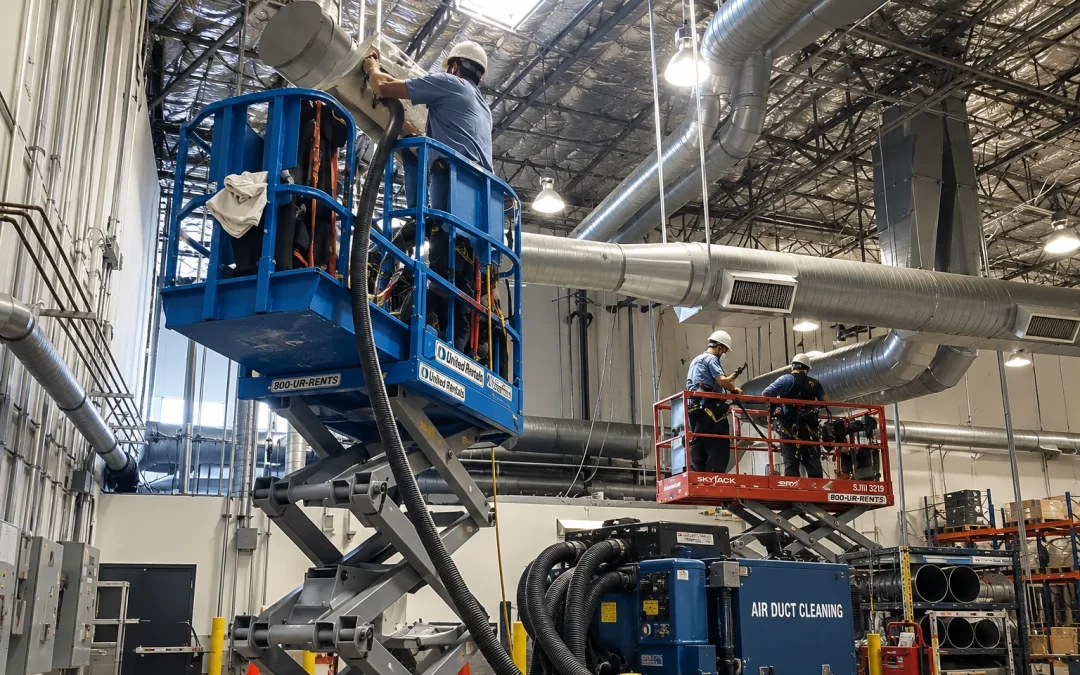
Commercial air duct cleaning is not simply a matter of inserting a vacuum into a duct and removing visible debris. A professional project requires a controlled process that accounts for the building, HVAC system configuration, access, contamination, airflow control, agitation, extraction, inspection, and documentation.
The objective is source removal. Debris and contaminants are loosened from system surfaces and directed toward an appropriate collection point while the work area and surrounding building are kept under control. The exact approach depends on the HVAC system and the conditions found during the inspection.
For contractors, facility managers, and procurement teams, understanding the process makes it easier to define the scope of work, evaluate cleaning proposals, and determine whether the contractor has planned the job around the actual system rather than a generic procedure.
1. Initial Assessment and Scope Definition
Every commercial air duct cleaning project should begin with an assessment of the building and the HVAC systems involved.
The contractor needs to understand what areas are included in the project and how those areas are served. A commercial building may contain multiple air-handling systems, supply and return networks, branches, equipment rooms, and areas with different access or operating requirements.
The initial assessment should consider:
- Building type and use
- HVAC system configuration
- Areas included in the cleaning scope
- Condition of accessible ductwork
- Visible debris or contamination concerns
- Existing access points
- Areas where additional access may be necessary
- Occupancy and operating schedules
- Equipment or furnishings that require protection
- Restrictions imposed by the building or facility
This information affects virtually every later decision. A contractor cannot select an effective cleaning method without first understanding what needs to be cleaned and how the system can be accessed.
The scope should also distinguish between ductwork and other HVAC components. Not every component necessarily requires cleaning during every project. The final scope should reflect the condition and accessibility of the system.
2. HVAC System Inspection and Planning
After the initial scope is established, the contractor should inspect the HVAC system and develop a practical cleaning plan.
The inspection should identify the relationship between supply and return paths, main trunks, branches, air-handling equipment, dampers, grilles, registers, and available access points.
The contractor also needs to determine where the system can be divided into workable sections. Sectioning is particularly useful in commercial systems because it allows the cleaning crew to control the airflow path and concentrate extraction on the area being cleaned.
Planning should account for the physical construction of the ductwork as well as the type and location of debris. A method suitable for one section may not be appropriate for another if duct construction, surface condition, accessibility, or contamination differs.
A good plan answers practical questions before cleaning begins:
- Where will the extraction equipment connect?
- Which sections will be isolated?
- Where will technicians gain access to the duct interior?
- How will debris be agitated?
- How will loosened material be transported toward the collection system?
- Which HVAC components are included in the scope?
- How will occupied areas and building operations be protected?
The answers should be based on the actual system rather than an assumed layout.
3. Establishing Proper Containment and Negative Pressure
Source removal depends on controlling the movement of loosened material.
The extraction system creates a controlled airflow path that helps move debris from the duct section being cleaned toward the collection equipment. Maintaining appropriate negative pressure at the working section is part of that process.
The objective is not simply to operate the largest vacuum available. The extraction arrangement needs to work with the duct configuration, isolation points, access locations, hose arrangement, and cleaning method being used.
Commercial systems can vary substantially in size and configuration, so there is no single CFM or pressure value that should be presented as a universal requirement for every cleaning project.
The contractor should instead establish an extraction arrangement that is appropriate for the specific system and the section being cleaned.
Containment is also important. Work areas should be managed so that loosened debris is directed into the intended collection path rather than being allowed to migrate into occupied spaces or other parts of the HVAC system.
4. Creating or Using Appropriate Access Openings
Adequate access is essential for effective duct cleaning.
Technicians need sufficient access to inspect the interior surface, position cleaning tools, agitate accumulated material, and direct loosened debris toward the extraction point. Existing access openings can sometimes provide what is needed. In other situations, additional access may be necessary.
Access requirements depend on the duct configuration, construction, dimensions, internal obstructions, and cleaning method.
A small opening that allows a hose to enter does not automatically provide adequate access for the entire cleaning procedure. Technicians need to be able to reach the surfaces that require cleaning and use the selected agitation tools effectively.
New access openings should be planned carefully and positioned where they support the cleaning method. They should also be properly closed after the work is completed.
The practical requirement is adequate access for inspection, agitation, extraction, and verification.
5. Sectioning and Zone Isolation
Commercial HVAC systems are commonly approached in manageable sections rather than treated as one unrestricted airflow path.
The contractor can isolate portions of the system so that extraction is concentrated on the section being cleaned. This helps establish a predictable airflow path from the work area toward the collection equipment.
Sectioning can involve the use of dampers, temporary isolation methods, access points, or other system-specific controls. The appropriate method depends on the HVAC design.
The purpose is to control where air and loosened debris move during cleaning. Isolation also allows technicians to work systematically through the system instead of attempting to clean multiple areas without controlling the extraction path.
The sequence should be planned around the actual duct layout. Main trunks, branches, supply sections, return sections, and equipment connections may require different approaches.
6. Agitation and Debris Loosening
Vacuum extraction alone does not necessarily remove material that is adhered to duct surfaces. Agitation is used to loosen accumulated debris so that the extraction system can transport it toward the collection equipment.
Depending on the duct construction and condition, contractors may use tools such as:
- Air whips
- Mechanical brushes
- Skipper balls
- Other suitable agitation tools
The correct method depends on the surface being cleaned, the type of contamination, the construction of the duct, and the accessibility of the area.
Technicians should use enough agitation to loosen the material without treating every duct surface in the same way. Different materials and construction types can require different cleaning techniques.
Agitation and extraction work together. The agitation tool loosens material, while the controlled airflow path provides a route for that material to leave the duct system.
7. Negative-Pressure Extraction
Once debris has been loosened, the extraction system captures and transports it toward the collection equipment.
The effectiveness of this stage depends on the complete airflow path. The vacuum is only one part of the system. Hose arrangement, access, isolation, duct configuration, and the location of the extraction connection all affect how the cleaning process is performed.
DuctPro’s Tri-Motor Vacuum is one example of equipment used for professional duct cleaning applications. Its confirmed specifications are:
| Specification | DuctPro Tri-Motor Vacuum |
| Airflow | 330 CFM |
| Air Watts | 900 Air Watts |
| Water Lift | 220 inches |
| Motor configuration | Three independent vacuum motors |
| Voltage | 120 Volts |
| Debris capacity | 12 gallons |
The DuctPro Tri-Motor Vacuum is rated at 330 CFM airflow. This product rating should not be treated as a universal extraction requirement for commercial duct cleaning or used to project performance for an entire commercial HVAC system. It should not be treated as a universal extraction requirement for commercial duct cleaning or used to project performance for an entire commercial HVAC system.
Contractors selecting air duct cleaning equipment should evaluate the equipment in the context of the complete cleaning system, including the duct configuration, access, isolation, hose arrangement, agitation method, and collection requirements.
8. Filtration and Debris Collection
Loosened material needs to be collected in a controlled manner.
The extraction equipment should be configured with appropriate filtration and debris collection for the application. The purpose is to prevent collected material from being redistributed into the surrounding environment.
Collection procedures also matter during cleanup. The crew should manage accumulated debris, filters, hoses, access openings, and other work materials so that the completed area is left in an appropriate condition.
Specific filtration performance should not be assumed unless it has been verified for the particular equipment and configuration. The appropriate approach is to use the manufacturer’s confirmed equipment information and the contractor’s established procedures for the particular application.
9. Cleaning Supply, Return, and HVAC Components
Commercial air duct cleaning can involve several parts of the HVAC system, depending on the project scope and the condition discovered during inspection.
Relevant areas may include:
Supply ducts
Supply ductwork distributes conditioned air from the air-handling equipment to occupied areas. Cleaning may involve main supply trunks, branches, and accessible sections leading toward registers or diffusers.
Return ducts
Return ductwork carries air back toward the air-handling equipment. Return paths can also accumulate debris and may be included in the cleaning scope.
Grilles and registers
Accessible grilles, registers, and related components can accumulate dust and debris. Cleaning these components can form part of the overall project where included in the scope.
Air-handling units
Air-handling equipment may contain accessible components that require attention based on their condition and the project requirements. The contractor should identify which components are included rather than assuming that every part of the equipment will be cleaned.
Other accessible HVAC components
Additional components may be addressed when they are part of the defined scope and can be safely and appropriately accessed.
The important distinction is that commercial duct cleaning is not automatically a complete cleaning of every HVAC component. The scope should identify what will actually be inspected and cleaned.
10. Inspection and Verification
Inspection should occur throughout the project, not only after the equipment has been turned off.
Initial inspection helps establish the condition of the system and identify areas requiring attention. During cleaning, technicians can use available access points to evaluate whether debris is being removed and whether the selected cleaning method is working as intended.
After cleaning, accessible areas should be inspected again.
Visual verification can help determine whether the targeted surfaces have been adequately addressed. Before-and-after photographs can also provide useful documentation where appropriate.
Verification should reflect the actual scope and conditions of the project. A contractor should not rely on a universal pass/fail measurement when the applicable project requirements do not establish one.
If inaccessible areas remain, those limitations should be documented rather than represented as fully cleaned.
11. Documentation and Closeout
Commercial projects benefit from clear documentation.
A useful closeout record can identify:
- Areas included in the cleaning
- Areas actually cleaned
- Access points used or created
- Significant observations
- Before-and-after documentation where appropriate
- Problems discovered during the work
- Areas that could not be accessed
- Other limitations affecting the scope
Documentation gives facility and property managers a record of what was actually performed.
It can also help future contractors understand the system. Access locations, observations, and documented limitations can be useful when subsequent inspection or maintenance work is required.
For procurement teams, documentation is particularly useful because it creates a clearer distinction between a contractor that performed a defined source-removal process and one that simply reports that a vacuum was used.
12. Commercial vs. Residential Duct Cleaning
Commercial and residential duct cleaning share the same basic source-removal principle, but commercial projects can require substantially more planning and coordination.
Commercial HVAC systems may contain multiple air-handling units, larger networks of trunks and branches, more complicated access conditions, and areas with different operational requirements.
The building may also remain partially occupied during the work. That can introduce scheduling, containment, isolation, and coordination requirements that do not exist in the same way on a small residential project.
Commercial cleaning therefore requires the contractor to understand the HVAC system as a complete working system rather than approaching every project with the same sequence and equipment setup.
13. Choosing Equipment for Commercial Duct Cleaning
Equipment selection should follow the cleaning requirements, not the other way around.
The contractor should consider:
- HVAC system configuration
- Duct dimensions and construction
- Type and condition of contamination
- Available access
- Isolation requirements
- Agitation method
- Extraction arrangement
- Debris collection
- Project conditions and operating constraints
Vacuum specifications such as CFM and water lift can be useful when evaluating extraction equipment, but they should not be considered in isolation.
The complete airflow path matters. A contractor also needs appropriate hoses, access, agitation tools, isolation methods, filtration, and collection procedures for the particular job.
DuctPro’s Tri-Motor Vacuum provides a confirmed 330 CFM airflow specification, 900 Air Watts, 220 inches of water lift, three independent vacuum motors, 120 Volt operation, and a 12-gallon debris capacity. These are product specifications, not universal requirements for commercial duct cleaning.
The equipment should be matched to the system and the planned cleaning procedure rather than selected on the basis of a single airflow number.
14. Conclusion
A professional commercial air duct cleaning process is a controlled source-removal operation.
The work begins with assessment and scope definition, followed by inspection and planning. The contractor then establishes appropriate access, isolates workable sections, controls the extraction path, loosens accumulated debris with suitable agitation methods, and transports the material into a controlled collection system.
The process continues with inspection and verification of the cleaned areas, followed by documentation of the work and any limitations encountered.
The central principle is straightforward: effective commercial duct cleaning is not simply about running a high-CFM vacuum. Results depend on how the entire cleaning process is planned and executed, including access, airflow control, agitation, extraction, containment, inspection, and documentation.