

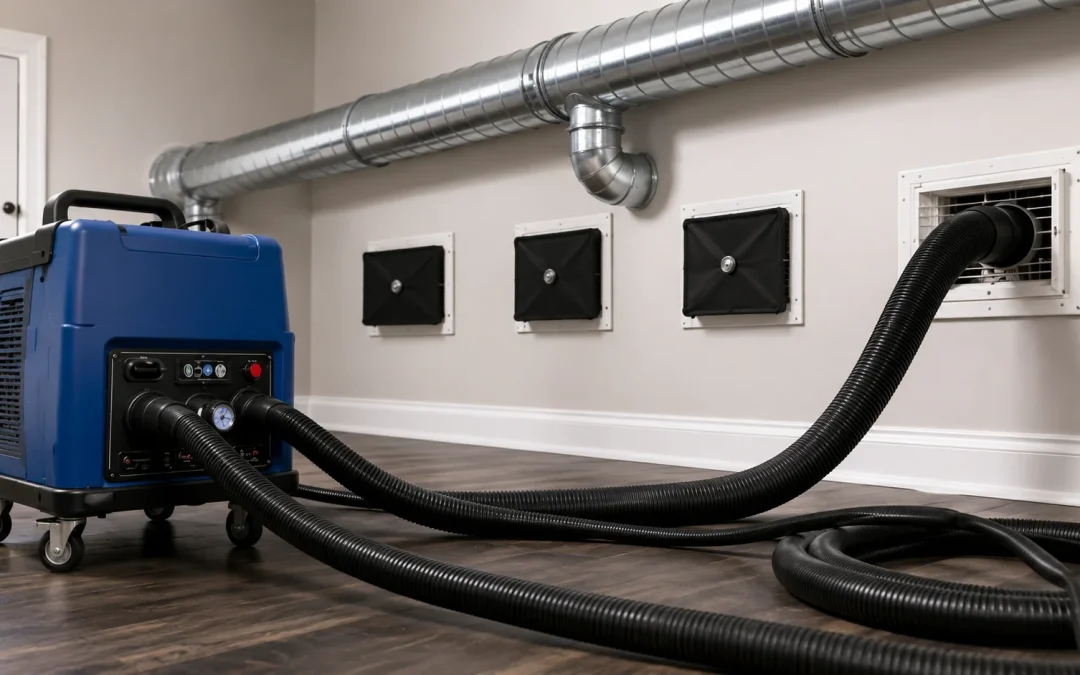
A contractor who blocks every register except the one nearest the vacuum connection is not maximizing suction. In most systems, that contractor is starving the fan curve, spiking static pressure past the point where the motor delivers useful airflow, and pulling debris past the collection point instead of into it. Register blocking looks like a simple mechanical task. It is actually a pressure management problem, and treating it as anything less is where most extraction failures begin.
This article explains how register blocking actually redistributes pressure and velocity through a duct system, why the same technique behaves differently in residential and commercial layouts, and where contractors consistently get it wrong. Where it strengthens the explanation, we reference DuctPro’s air duct cleaning equipment and the engineering resources built around it.
Why Blocking a Register Changes the Entire System, Not Just That Branch
A duct system under negative pressure behaves as a network of parallel resistances feeding a single source of suction. Airflow, pressure differential, and resistance are related the same way they are in any fluid network:
Q = ΔP ÷ R
Airflow (Q) equals pressure difference (ΔP) divided by resistance (R).
When a register is blocked, the resistance of that branch does not become irrelevant. It approaches infinity. Since the vacuum source is still generating the same pressure differential, the air that would have traveled through the closed branch has to go somewhere. It redistributes across the remaining open branches, based on their relative resistance.
This is the part contractors miss most often. Closing a register does not remove airflow from the system. It reroutes it. If the remaining open branches are undersized, poorly connected, or already running near their resistance limit, the redistributed air does not simply flow faster through them in a predictable way. The whole system’s operating point shifts, and the vacuum unit’s fan curve determines what actually happens next.
Fan Curve Behavior Under Increased System Resistance
Every vacuum unit has a performance curve that plots airflow against static pressure. As you close registers, you increase total system resistance, which moves the unit’s operating point up the curve toward lower CFM and higher static pressure.
This is where register blocking becomes a genuine engineering decision rather than a housekeeping step. Blocking two or three registers on a large commercial system with a single-motor unit can push static pressure high enough that airflow collapses across the board, including in the branches you intentionally left open. This is one of the reasons independently configured multi-motor systems, like the DuctPro Tri-Motor Vacuum System, are relevant here. A tri-motor configuration lets a contractor manage static pressure and airflow delivery independently across zones instead of accepting whatever operating point a single fan curve dictates once resistance climbs.
Understanding this relationship in more depth is worth the time before running a job. The mechanics of how suction power responds to changing system resistance are covered in detail in our guide on vacuum suction power.
Transport Velocity Is the Real Target, Not Suction Alone
Register blocking exists to concentrate airflow, and airflow concentration exists to achieve adequate transport velocity. Debris does not move because a system has strong suction in the abstract. It moves because air is traveling through a specific branch fast enough to keep particulate entrained rather than allowing it to settle back into the duct.
Industry guidance commonly cites transport velocities in the range of 3,000 to 4,000 feet per minute as the threshold needed to keep typical duct debris airborne during extraction, with higher velocities generally required in vertical runs than horizontal ones. Confirm current thresholds against NADCA’s published standards rather than treating any single number as fixed, since acceptable ranges vary by debris type and duct geometry.
Blocking registers is one of the only tools a contractor has to raise velocity in a specific branch without buying a bigger vacuum unit. By closing off competing paths, you force a larger share of the available CFM through the branch you are actively cleaning. This only works, however, if the branch you leave open has enough cross-sectional capacity to accept that concentrated airflow without itself becoming the new bottleneck.
Airflow capacity planning for a job like this should account for total required CFM across the system, not just the branch in front of you. Our breakdown of CFM required for professional duct cleaning walks through how to size that requirement correctly before you start closing registers.
Leakage Effects at the Register Boundary
A blocked register is only as effective as its seal. Foam plugs, register covers, and tape all fail differently, and the failure mode matters. A poor seal at a register does not just waste some suction. It creates a secondary, uncontrolled inlet that competes with the branch you are actually trying to clean.
Because this leakage path is short and direct, often just a few inches from open room air to the duct interior, it draws disproportionately relative to its size. Even a small gap can pull enough ambient air to meaningfully reduce the pressure differential available to the branch under active cleaning. This is why experienced contractors treat register sealing as a precision task rather than a formality, particularly on branches close to the vacuum connection point where pressure differential is already highest and leakage is most tempting for air to exploit.
Residential Versus Commercial Blocking Strategy
Residential systems typically run off a single air handler with a shared trunk line, which makes register blocking relatively linear. Closing registers in unrelated rooms concentrates flow predictably because there are fewer competing pressure zones to account for.
Commercial systems change this considerably. Multiple air handlers, VAV boxes, and independently zoned trunk lines mean that closing a register in one zone may have no meaningful effect on airflow in a different zone entirely, because the two zones are not sharing the same resistance network. Contractors who apply residential blocking logic to a commercial system often end up chasing airflow that was never going to redistribute the way they expected.
On commercial jobs, blocking strategy has to be planned zone by zone, informed by the mechanical drawings where available, rather than applied uniformly across the building.
Relationship With Zone Isolation
Register blocking and zone isolation solve related but distinct problems. Zone isolation controls which section of the building’s duct network is under active negative pressure at all. Register blocking then fine-tunes airflow distribution within that isolated zone.
Attempting register blocking without proper zone isolation upstream often produces confusing results, because air is still being pulled from unisolated sections of the building through paths the contractor never accounted for. Getting the isolation boundary right first makes register blocking behave predictably. Our detailed walkthrough of zone isolation strategy covers how to establish that boundary before fine airflow control becomes relevant.
Relationship With Vacuum Connection Location
Where the vacuum unit connects to the system changes which branches experience the steepest pressure gradient, and that in turn changes which registers are worth blocking. Branches physically closer to the connection point naturally see higher velocity for a given resistance, while distant branches may already be starved regardless of blocking strategy.
A contractor who blocks registers based purely on which rooms are being cleaned, without accounting for connection location, can end up working against the system’s natural pressure gradient rather than with it. Establishing the connection point and the resulting pressure profile is covered in our guide on how contractors establish negative pressure before extraction begins.
Containment Considerations
Register blocking also functions as a containment control. A properly sealed, blocked register prevents debris from being pushed backward into occupied space during pressure transients, which can happen briefly when a vacuum unit starts up or when airflow shifts suddenly as other registers are opened or closed mid-job.
This is a secondary but genuine benefit of disciplined blocking practice. Containment failures at register boundaries are rarely dramatic. They tend to show up as fine dust settling near vents days after a job, long after the crew has left, which is part of why sloppy sealing is such an easy mistake to overlook in the moment.
Common Contractor Mistakes
The most frequent error is blocking registers based on room-by-room convenience rather than system resistance. A second common mistake is over-blocking on a single-motor system, which drives static pressure high enough to collapse airflow system-wide rather than concentrating it usefully.
A third mistake is inconsistent sealing quality, treating register blocking as interchangeable regardless of material or fit. A fourth is failing to reassess blocking configuration as the job progresses from branch to branch, leaving earlier seals in place after they’ve stopped serving a clear purpose and are now just adding unnecessary resistance to the system.
Engineering Recommendations
Plan register blocking as a system-level decision, not a room-level one. Understand your vacuum unit’s fan curve well enough to know how much added resistance it can absorb before airflow degrades. Seal registers with the same care you would apply to sealing the extraction connection itself. Sequence blocking changes deliberately as you move through the job rather than accumulating closures without reassessing their purpose.
Register blocking done well is quiet and unremarkable. The job simply moves faster, transport velocity holds where it needs to, and containment stays intact. That is the actual signature of correct pressure management, not a dramatic increase in perceived suction at any single register.