
Most residential HVAC contractors leave $3,000 to $5,000 per month on the table. Not because they lack the skills. Because they have not structured their service menu around high-velocity, low-labor add-ons.
Full-system duct remediation jobs are profitable, but they are also time-intensive and logistically heavy. You cannot run six of them in a single day. Professional dryer vent cleaning tools give your crew a weapon that does the opposite: a 20-to-30-minute billable service that converts at high margins, requires no additional headcount, and closes on-site without a second sales conversation. That is not upselling. That is engineering your revenue per truck.
The Economics of Dryer Vent Services
Here is the math that matters.
A standard residential dryer vent cleaning job takes an experienced technician 20 to 30 minutes of active labor. National billing rates for this service range from $150 to $250 per ticket, with higher-end markets regularly commanding $275 to $300 when antimicrobial post-treatment is included.
The cost basis is almost entirely labor. The consumables, compressed air, and rotary brush wear are negligible per job. That puts gross margins consistently above 70% on every ticket.
Time-to-Profit Breakdown: Dryer Vent vs. Full Duct System
| Metric | Full Duct System Cleaning | Dryer Vent Add-On |
| Average Labor Time | 3 to 5 hours | 20 to 30 minutes |
| Average Billable Rate | $400 to $900 | $150 to $275 |
| Gross Margin (Est.) | 45% to 60% | 68% to 80% |
| Jobs Per Truck Per Day | 1 to 2 | 6 to 10 (as standalone) |
| Additional Crew Required | Sometimes | No |
The arithmetic is straightforward. A technician who completes four dryer vent cleans per day at $200 average ticket generates $800 in daily revenue from a service that consumes less than two hours of total labor. Across a 20-workday month, that is $16,000 gross from a single technician without touching their full-system schedule.
Why Dryer Vent Jobs Close Without Friction
Dryer vent blockages are not discretionary maintenance. They are a documented fire hazard.
The U.S. Fire Administration attributes approximately 2,900 residential fires per year to clothes dryer failures, with lint accumulation identified as the leading cause. When you frame a dryer vent cleaning to a homeowner using that data, you are not selling a service. You are closing a safety conversation. The objection rate collapses.
Your technician is already inside the home. The equipment is on the truck. The marginal cost of the conversation is zero. This is the structural advantage of the “while-we-are-here” model.
Sanitization and Microbial Control: The Upsell Inside the Upsell
Standard dryer vent cleaning removes mechanical blockage. Post-cleaning antimicrobial treatment removes biological risk and substantially increases perceived value.
A lint-clogged vent line is a warm, dark, humid environment. It is ideal for mold propagation and bacterial colonization, particularly in homes with pets or high-moisture laundry loads. After mechanical extraction, a fogging pass with an EPA-registered antimicrobial agent eliminates residual biological matter and delivers a result the homeowner can verify by smell and feel.
This matters for three operational reasons:
- Invoice differentiation: Antimicrobial treatment allows you to bill a two-tiered service: standard clean versus premium biocidal finish. The premium tier commands a $40 to $75 uplift per ticket with near-zero additional material cost.
- Callback elimination: Odor recurrence is the primary driver of post-service complaints. Chemical remediation cuts that failure mode before it starts.
- Referral rate: Homeowners talk about surprising sensory results. A vent line that smells sterile after service is a low-effort word-of-mouth trigger.
The DuctPro BioClean Duct Sanitizing Sprayer is engineered for exactly this application: fine-mist antimicrobial delivery into confined duct and vent passages with controlled droplet dispersion to prevent over-saturation of liner material.
Client Spotlight: Scaling Residential Margins
“We started offering dryer vent sweeps as a ‘while we’re here’ special. By investing in professional-grade dryer vent cleaning tools that integrate with our existing compressors, we added over $4,000 in pure monthly profit without hiring a single new technician. Beyond the hardware, DuctPro Systems’ business services and customer service teams consistently show highly developed interpersonal and communication skills: they always solve my issues with marketing, technical setups, and ordering seamlessly.”
Louis Adams, Founder of Denver Air Duct Cleaning
Tool Integration and Operational Efficiency
The critical selection criterion for dryer vent tooling is integration compatibility, not standalone performance.
A dryer vent cleaning kit that requires its own dedicated compressor or vacuum unit adds setup time, truck space, and crew cognitive load. None of those costs appear on an invoice. They come directly out of margin.
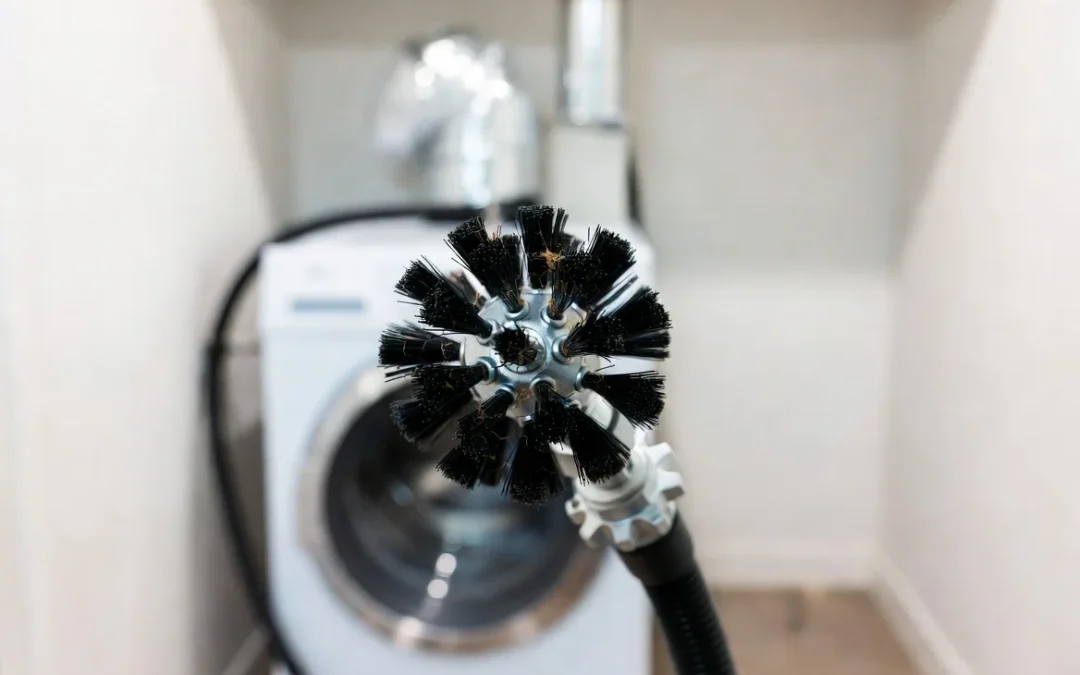
The correct engineering decision is a toolset that runs off your existing pneumatic infrastructure: the same air supply line feeding your rotary agitation tools and your blow-out guns. Flexible rotary brush systems sized for 4-inch to 6-inch vent diameter attach directly to standard air compressor fittings. A reverse-jet blow-out nozzle paired with your existing vacuum creates negative pressure at the termination point, pulling dislodged lint toward extraction rather than redistributing it.
This is the same physics that governs full-system duct cleaning. High static pressure, not high volume, is what moves consolidated debris through a confined passage. A shop-vac generating 150 to 300 CFM at low water column pressure cannot reliably extract compacted lint plugs from a 20-foot flex duct run. Professional pneumatic tooling operating at 90 to 120 PSI delivers the static pressure differential to dislodge and move material in a single pass.
Your core air duct cleaning equipment platform should be the operational hub. Dryer vent tools are an attachment layer, not a separate system. When you select tooling on that basis, every new revenue line you add requires zero additional truck configuration.
For a full technical breakdown of how vacuum performance specifications translate to real-world extraction on residential duct and vent systems, our internal guide on CFM requirements for professional duct cleaning covers the volumetric flow and static pressure physics in depth.
Building the “While-We-Are-Here” Service Stack
Dryer vent cleaning does not exist in isolation. It is one node in a structured add-on menu that your crew can move through systematically on every residential job.
Recommended same-visit add-on sequence:
- Dryer vent cleaning (20 to 30 min / $150 to $250)
- Antimicrobial fogging (5 to 10 min / $40 to $75 uplift)
- Exhaust fan duct inspection and clean (15 to 20 min / $75 to $125)
- HEPA filter replacement recommendation (2 to 5 min / variable materials markup)
A technician who executes steps 1 through 3 on a visit where they were booked only for step 1 has just increased the job’s average order value by 60% to 90% without scheduling a return visit.
That is the margin architecture. Not more trucks. Not more technicians. Structured tooling and a sequential add-on protocol that your existing crew runs on every job.
The DuctPro Complete Air Duct Cleaning Equipment System is built to anchor this stack: a single platform your technicians load once, drive anywhere, and expand into every service tier on your menu.