
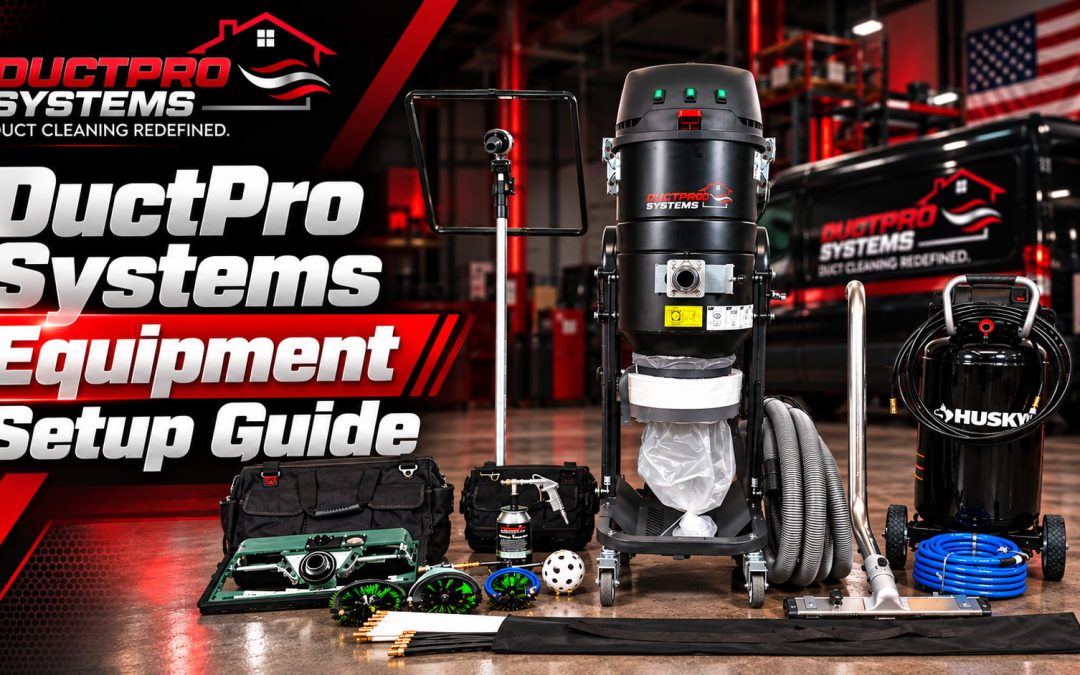
Professional duct cleaning depends on more than selecting a vacuum and connecting a hose. The way the extraction system is positioned, routed, connected, and checked before operation affects how effectively the equipment can perform under the conditions of the job.
A consistent setup process also makes it easier to identify avoidable problems before cleaning begins. Contractors can use the same basic sequence on each project while adapting the connection point, access locations, hose route, and duct configuration to the building.
This guide focuses on the practical setup of professional duct-cleaning equipment, with particular attention to the extraction system and the DuctPro Tri-Motor Vacuum.
Start With the Job-Site Assessment
Before positioning the vacuum, inspect the work area and determine how the extraction system will be configured.
Identify the following:
- The most appropriate access location
- The main trunk or other suitable connection point
- Available workspace around the equipment
- The practical route for the extraction hose
- The configuration of the duct system
- Available registers and access locations
- Where extracted debris will be collected
The goal is to establish the extraction path before equipment is connected. A setup that looks convenient from the equipment location may not be practical once the hose reaches the duct connection.
Access should also be considered in relation to the work being performed. Contractors need enough room to connect equipment, inspect connections, operate the vacuum, and manage the debris collection area without creating unnecessary obstacles.
Position the Vacuum for the Extraction Connection
Place the vacuum where it can serve the selected extraction point without creating an unnecessarily complicated hose route.
A reasonably direct extraction path can make the setup easier to manage. At the same time, equipment positioning should allow safe access to the machine and its connections.
Avoid placing the vacuum where the hose must pass through unnecessary obstacles, sharp changes in direction, or areas where the connection could be disturbed during the job.
The best position is therefore not simply the closest available location. It is the location that provides a practical connection while leaving adequate working space around the equipment.
Plan the Extraction Hose Route
Once the vacuum location and duct connection have been identified, plan the hose route before making the final connection.
Hose routing matters because the extraction system is a complete airflow path. The vacuum specification describes the machine, but the conditions at the connection point also depend on the path between the vacuum and the duct system.
Pay attention to:
- Unnecessary bends
- Unnecessary restrictions
- Loose or poorly fitted connections
- Hose routing around equipment and obstacles
- Connection integrity
- The overall practicality of the extraction path
Keep the route as straightforward as the job allows. Avoid creating additional restrictions simply because the equipment was positioned without considering the connection point.
Connections should be secure enough that the extraction path remains intact during operation. Inspect the hose and fittings before starting, particularly where movement, equipment traffic, or other job-site activity could disturb them.
Contractors comparing professional air duct cleaning equipment can use this setup process as a practical framework for evaluating how equipment will be configured on the job.
Prepare the Duct System and Access Points
With the extraction route established, prepare the duct system for the intended cleaning method.
Use appropriate access points for the work being performed. Prepare registers and other openings as necessary, and use temporary blocking where appropriate to help direct extraction through the intended portion of the duct system.
The objective is to control the path of the extraction air rather than allowing unnecessary leakage through openings that are not part of the intended cleaning configuration.
Sealing unnecessary openings can help direct extraction through the intended duct path and reduce unwanted leakage. The appropriate approach depends on the duct configuration and cleaning procedure, so contractors should use access and blocking methods suited to the particular system.
Inspect the connection between the equipment and the duct system before operation. A connection that appears acceptable initially can become a problem if it is loose, poorly positioned, or vulnerable to movement.
Check the Equipment Before Operation
A short pre-operation inspection can identify problems before the vacuum is running.
Check:
- Overall equipment condition
- Hose and fitting connections
- Debris collection capacity
- Filter condition where applicable
- Electrical connection appropriate for the equipment being used
- Access and connection integrity
- Exhaust direction
- Workspace around the equipment
The electrical supply should be appropriate for the equipment being operated. The confirmed operating voltage for the DuctPro Tri-Motor Vacuum is 120 Volts. Contractors should verify that the available job-site power supply is suitable for the equipment being used.
The debris collection area should also be checked before starting. Beginning a cleaning job without considering available collection capacity can create an avoidable interruption later.
For DuctPro-specific operating guidance, contractors can refer to the DuctPro operation manual.
DuctPro Tri-Motor Vacuum Specifications
The DuctPro Tri-Motor Vacuum has the following confirmed specifications:
| Specification | DuctPro Tri-Motor Vacuum |
| Airflow | 330 CFM |
| Air Watts | 900 Air Watts |
| Water Lift | 220 inches |
| Motor configuration | Three independent vacuum motors |
| Debris capacity | 12 gallons |
| Operating voltage | 120 Volts |
These specifications describe the equipment itself. They should not be interpreted as a guarantee of a particular airflow condition at the duct connection or elsewhere in a completed extraction setup.
Airflow: The confirmed DuctPro specification is 330 CFM. This is a published equipment specification and should not be converted into an assumed field airflow value.
Air Watts: The 900 Air Watts specification describes the vacuum’s rated performance characteristic. Actual extraction conditions still depend on the complete system configuration.
Water Lift: The 220-inch water lift specification describes another measure of vacuum performance. It should be considered alongside the rest of the extraction setup rather than treated as a direct prediction of field airflow.
Motor configuration: The system uses three independent vacuum motors. This describes the motor arrangement and does not mean the motor count should be used to calculate a different total CFM figure.
Debris capacity: The debris tank capacity is 12 gallons. Contractors should account for the available collection capacity as part of normal equipment preparation.
Operating voltage: The confirmed operating voltage is 120 Volts. Job-site power should be checked for compatibility before operation.
How Setup Affects Actual Extraction Conditions
Published equipment specifications describe the machine. The actual extraction conditions are influenced by the complete path through which air moves during cleaning.
Factors can include:
- Hose routing
- Restrictions
- Duct configuration
- Access location
- Leakage
- Debris conditions
- Filtration
- Cleaning method
This is why a machine specification should not be treated as a prediction of exactly what will occur at every point in a duct system.
For example, a practical hose route with secure connections presents different conditions from a route containing unnecessary restrictions or poorly fitted connections. Likewise, the configuration of the duct system can affect how the extraction path is established.
Access also matters. The selected connection point needs to work with the actual duct layout and the cleaning procedure. A setup that does not account for the system configuration can make the extraction process more difficult to manage.
Filtration and debris conditions can also change as the work progresses. Contractors should therefore inspect the equipment and collection system as part of normal operation rather than relying only on the initial setup.
A Repeatable Pre-Operation Checklist
Before starting the vacuum, work through a consistent checklist:
Job site
- Is the selected access location appropriate?
- Is there adequate workspace around the equipment?
- Is the debris collection area ready?
- Is the equipment positioned where it can be operated and inspected?
Extraction path
- Is the hose route practical?
- Have unnecessary bends and restrictions been avoided?
- Are hose and fitting connections secure?
- Is the extraction connection appropriate for the duct configuration?
Duct preparation
- Are the required access points prepared?
- Have registers and other relevant openings been addressed?
- Has temporary blocking been used where appropriate?
- Have obvious unwanted leakage points been considered?
Equipment
- Is the vacuum in suitable operating condition?
- Is debris collection capacity available?
- Is the filter condition appropriate where applicable?
- Is the electrical connection appropriate for the equipment?
- Is the exhaust directed appropriately?
- Can the equipment be accessed during operation?
Final check
- Is the extraction path ready?
- Are connections secure?
- Is the workspace clear enough for operation?
- Is there any obvious setup problem that should be corrected before starting?
Common Equipment Setup Mistakes
Unnecessarily complicated hose routing
A complicated route can introduce avoidable bends, restrictions, and connection points. Plan the route before positioning the equipment.
Loose connections
A hose or fitting that is not properly secured can interfere with the intended extraction path. Check connections before operation and after any movement of the equipment.
Poor access planning
Choosing an access point without considering the complete duct configuration can make the cleaning setup unnecessarily difficult.
Ignoring obvious leakage
Unwanted openings can affect where extraction air moves. Address relevant openings and use temporary blocking where appropriate for the cleaning procedure.
Failing to inspect the equipment
Starting the vacuum without checking the machine, connections, collection area, and other basic conditions can create preventable problems during the job.
Allowing debris collection capacity to become a problem
The collection system should be considered before and during operation. Contractors should avoid allowing collection capacity to become an interruption to the planned workflow.
Positioning the exhaust poorly
The exhaust location should be considered during equipment placement. It should not create an avoidable problem in the working area.
Beginning work before the extraction setup is ready
The vacuum should not be treated as ready simply because the hose has been connected. The complete extraction path, duct access, equipment condition, and workspace should be checked first.
Why Consistent Setup Matters
A repeatable setup procedure gives contractors a structured way to prepare the extraction system before cleaning begins.
It helps separate the setup process into identifiable steps: assess the job, select the connection point, position the vacuum, route the hose, prepare the duct system, inspect the equipment, and perform the final check.
That consistency can also make setup problems easier to identify. If a connection is loose, the hose route is impractical, an access point has not been prepared, or the workspace is not ready, the problem can be addressed before the cleaning process begins.
The exact configuration will vary from one building to another. A repeatable process does not mean every job uses the same physical arrangement. It means the important setup decisions are checked systematically.
Frequently Asked Questions
How should a duct-cleaning vacuum be positioned?
Position the vacuum where it can connect to the selected extraction point through a practical hose route while leaving sufficient workspace for operation and inspection. Avoid unnecessary obstacles and complicated routing.
Why does hose routing matter during duct cleaning?
The hose is part of the complete extraction path. Bends, restrictions, connections, and routing conditions can influence the conditions under which the vacuum operates. Keeping the route practical helps avoid unnecessary complications in the extraction setup.
What should be checked before starting the vacuum?
Check the equipment condition, hose connections, debris collection capacity, filter condition where applicable, appropriate electrical connection, access and connection integrity, exhaust direction, and workspace. The duct access and extraction path should also be ready before operation.
Does duct configuration affect extraction conditions?
Yes. The duct layout, access locations, connection point, leakage conditions, and cleaning method can all influence the complete extraction setup. Equipment specifications alone do not describe every condition in a connected duct system.
Why should contractors inspect connections before operation?
Connections form part of the extraction path. A loose or poorly fitted connection can create an avoidable problem during operation. Inspecting connections before starting helps confirm that the intended extraction path is properly configured.
What DuctPro Tri-Motor Vacuum specifications should contractors know?
The confirmed specifications are 330 CFM airflow, 900 Air Watts, 220 inches of water lift, three independent vacuum motors, 12-gallon debris capacity, and 120 Volts operating voltage.
Conclusion
A professional duct-cleaning setup should begin with the job site, not the vacuum switch. Contractors need to understand the available access, duct configuration, extraction connection, hose route, workspace, and debris collection arrangement before operation begins.
The basic sequence is straightforward: assess the job, position the vacuum, plan the extraction route, prepare the duct system and access points, inspect the equipment, and complete a final check.
Using the same disciplined process on each job creates a consistent starting point while still allowing the physical setup to change according to the building and duct system. The DuctPro Tri-Motor Vacuum provides confirmed equipment specifications, but the actual extraction conditions depend on how the complete system is configured and operated.