
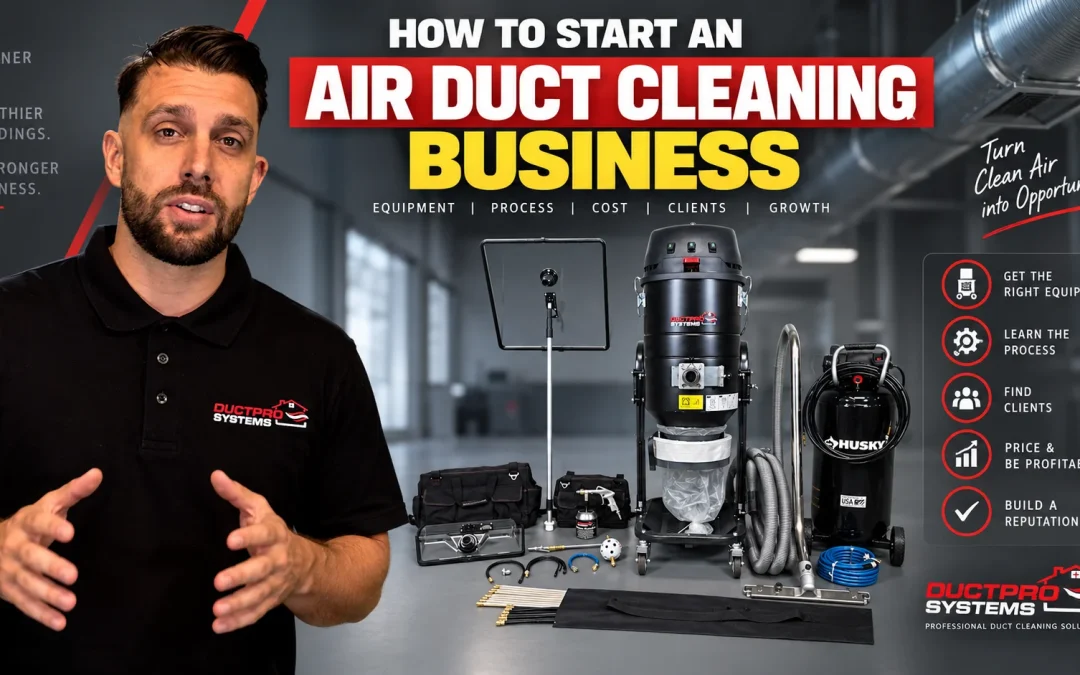
Starting an air duct cleaning business requires more than buying a vacuum and finding customers. You need to understand the work, choose the market you want to serve, meet applicable business and legal requirements, select equipment that fits the jobs you plan to perform, and build a repeatable cleaning process.
Equipment is one part of that decision. Choosing appropriate air duct cleaning equipment means considering the systems you expect to clean, the type of access available, the cleaning methods you intend to use, and whether your work will be residential, commercial, or both.
1. Understand the Air Duct Cleaning Business
Before investing in equipment or advertising, understand what an air duct cleaning contractor actually does.
Air duct cleaning can involve cleaning supply and return ductwork, air-handling components, registers, grilles, and other accessible parts of an HVAC system, depending on the scope of the job. The work can vary substantially from one building to another.
A professional contractor needs to evaluate the HVAC configuration before deciding how a system should be cleaned. Duct construction, access points, contamination, system layout, available working space, and the condition of the components can all affect the approach.
The business also involves work that happens before and after the physical cleaning. A contractor must communicate the scope with the customer, protect the work area, establish appropriate access, operate equipment correctly, inspect the system, and document the work when appropriate.
That means the business is built around a process, not simply a piece of equipment.
2. Decide Which Market to Serve
Your first major business decision is deciding which customers you want to serve.
Residential air duct cleaning
Residential work usually involves houses, apartments, or other smaller occupied spaces. The contractor needs to work around homeowners, furnishings, finished surfaces, and the existing HVAC configuration.
Residential customers may also need more explanation about what the service includes. A professional inspection and clear scope of work can help prevent misunderstandings about what will and will not be cleaned.
Commercial air duct cleaning
Commercial work can involve larger or more complicated HVAC systems and may require more detailed planning. Buildings can contain different duct configurations, equipment arrangements, access limitations, and operating requirements.
Commercial projects can also involve coordination with building owners, facility managers, maintenance personnel, or other contractors.
Before pursuing commercial work, understand the operational demands of the type of facilities you intend to serve. The commercial air duct cleaning process can help illustrate why commercial projects require careful planning rather than simply applying a residential workflow to a larger building.
A mixed market
A new company can also serve both residential and commercial customers. This can provide flexibility, but it also means your equipment, procedures, scheduling, pricing, and sales process need to accommodate different types of work.
Choose the market based on the work you can perform competently and the customers you can serve effectively, rather than assuming that one market is automatically more profitable.
3. Research Local Business and Legal Requirements
Business and licensing requirements vary by jurisdiction.
Before taking your first customer, determine which requirements apply to your location and the services you intend to provide. Depending on where you operate, you may need to investigate business registration, local permits, insurance, tax requirements, vehicle requirements, and other applicable regulations.
Check requirements at the state, county, city, and other relevant levels rather than assuming that requirements are the same everywhere.
If you plan to perform work in specialized facilities or pursue commercial contracts, identify any additional requirements specified by the customer or contract. Do not assume that a particular certification is universally required simply because it is recognized within the industry.
The same principle applies to insurance. Determine what coverage is appropriate for your business activities and discuss the risks associated with your specific operation with a qualified insurance professional.
4. Get Proper Training
Equipment can be learned, but professional cleaning requires an understanding of how the equipment fits into the entire process.
Training should help you understand HVAC system components, duct construction, contamination, access, cleaning methods, equipment operation, worker safety, customer communication, and documentation.
You should also learn how to recognize situations where the planned cleaning method may not be appropriate. A professional contractor should be able to identify limitations rather than promising that every system can be handled in exactly the same way.
Training can come from industry education, equipment instruction, experienced professionals, and practical field experience. The important point is to develop competence before taking on work that exceeds your current capabilities.
5. Choose Equipment and Tools
Equipment selection should follow your business model, not the other way around.
The equipment you need depends on the type of work you plan to perform, HVAC configuration, access conditions, contamination, cleaning method, and operating environment.
A professional setup may include several categories of equipment and tools.
Vacuum and extraction equipment
Vacuum equipment provides the negative-pressure extraction needed to collect loosened debris during appropriate cleaning procedures.
DuctPro’s Tri-Motor Vacuum has a capacity of 330 CFM, 900 Air Watts, and 220 inches of water lift. It uses three independent vacuum motors, operates at 120 Volts, and has a 12-gallon debris capacity.
The vacuum is only one component of the cleaning system. Airflow through the actual work area also depends on the complete setup, including the duct configuration, access, hoses, connections, and other conditions.
Agitation tools
Agitation tools help loosen debris from duct surfaces so it can be captured by the extraction system.
The appropriate tool depends on the duct configuration and cleaning method. A contractor should have more than one approach available when the work requires it.
Hoses
Hoses connect the extraction equipment to the HVAC system and influence how the equipment can be positioned and used.
Hose selection should account for the work environment, access, system configuration, and the equipment manufacturer’s specifications.
Access tools
Duct cleaning often requires appropriate access to portions of the HVAC system that cannot be reached effectively through existing openings.
A contractor should understand how to establish appropriate access without unnecessarily damaging the system or surrounding building components. Access planning should take place before the cleaning begins.
Inspection tools
Inspection tools allow the contractor to evaluate conditions before and after cleaning.
Visual inspection is particularly useful for determining the scope of work and checking accessible areas after the cleaning process. The goal is to verify the work rather than assume that operating the equipment automatically means the job was completed correctly.
Filtration and debris collection
The cleaning process needs a controlled way to capture and contain removed debris. The exact setup depends on the equipment and cleaning method being used.
Protective equipment
Personal protective equipment should be selected according to the hazards associated with the work environment and the procedures being performed.
Cleaning accessories
A complete working setup can also require brushes, whips, air tools, access supplies, protective materials, hand tools, and other accessories.
For contractors comparing different starting configurations, DuctPro provides both a Complete Air Duct Cleaning Equipment System and a Basic Air Duct Cleaning Equipment System. The appropriate configuration depends on the work the contractor intends to perform.
6. Set Up the Business for Operations
A duct cleaning company needs an operating system behind the field work.
Set up the administrative side of the business before you begin accepting jobs. This can include:
- Business registration
- Insurance
- Banking and payment processing
- Bookkeeping
- Customer records
- Scheduling
- Invoicing
- Quoting
- Vehicle organization
- Equipment maintenance records
- Consumables inventory
- Marketing
- Customer communication
- Software for scheduling, accounting, or other operational needs
You should also establish where equipment will be stored, how it will be transported, how tools will be inspected, and how equipment maintenance will be handled.
Startup expenses should be evaluated as categories rather than treated as a single universal figure. Business registration, insurance, a vehicle, equipment, tools, consumables, training, marketing, software, and operating cash reserves can all affect the amount of capital required.
There is no single startup budget that applies to every duct cleaning business.
7. Develop a Professional Cleaning Process
A repeatable process helps prevent important steps from being overlooked.
Start with an assessment
Before cleaning, inspect the HVAC system and understand its configuration.
Determine what the customer expects, what areas are included in the service, what components are accessible, and whether there are conditions that could affect the proposed work.
Define the scope
Clearly establish what will be cleaned.
A written scope can help distinguish included components from items that are outside the service. This is particularly important when a customer expects every part of an HVAC system to be cleaned regardless of accessibility.
Plan access
Determine where access is needed before beginning the cleaning.
Access planning should consider the physical configuration of the system, the location of components, the available working area, and how the cleaning equipment will be connected.
Establish isolation and containment
Prepare the system and work area so that the cleaning process can be performed in a controlled manner.
The exact procedure depends on the HVAC system and cleaning method. The objective is to control the movement of debris and protect areas that should not be exposed to the cleaning process.
Apply agitation
Agitation can loosen accumulated material from duct surfaces and components.
The contractor should select tools and methods appropriate for the construction and condition of the system. Excessive or inappropriate mechanical action can be unsuitable for some components, so the method needs to match the application.
Use negative-pressure extraction
Negative-pressure extraction provides a means of capturing loosened debris rather than simply disturbing it.
The vacuum should be connected and operated as part of the overall cleaning setup. Equipment specifications alone do not determine whether a particular HVAC system has been cleaned effectively.
Collect and contain debris
Removed material should be captured and handled in a controlled manner.
The contractor should also keep the work area orderly throughout the process. Good housekeeping is part of professional service, particularly when working inside occupied buildings.
Inspect the work
Inspection should not be treated as an optional final step.
After cleaning, inspect accessible areas to determine whether the intended scope has been addressed and whether additional work is necessary.
Verify and document
Where appropriate, document the work performed, areas addressed, limitations encountered, and observations made during the job.
Good documentation can help both the contractor and customer understand what was actually done.
8. Decide How to Price Your Services
There is no universal price for an air duct cleaning job.
A useful pricing process begins with the actual scope of work. Consider factors such as:
- Labor
- Equipment requirements
- Travel
- System configuration
- Accessibility
- Contamination
- Number and type of components included
- Project complexity
- Consumables
- Insurance and other overhead
- Administrative costs
- Local market conditions
Avoid quoting a job solely from the size of the building or by copying another contractor’s price.
Two systems in similarly sized buildings can require very different amounts of work because their configurations, access conditions, contamination, and scopes differ.
Your quote should make the scope clear enough that both you and the customer understand what the price covers.
9. Find Your First Customers
Once your operation is ready, focus on finding customers who actually need the service you can provide.
Potential customer acquisition channels include:
- A professional website
- Local search visibility
- Business directories
- Referrals
- Relationships with property professionals
- Direct outreach
- Commercial facility contacts
- Partnerships with complementary service providers
- Reviews from genuine customers
- Local networking
Your marketing should explain the service clearly instead of relying on exaggerated claims.
A prospective customer should be able to understand what you clean, how you approach the work, what affects the scope, and how to request an assessment or quote.
For commercial prospects, professional communication matters. Facility managers and property owners may want clear documentation, defined scopes, scheduling information, and evidence that the contractor understands the operational environment.
10. Build Trust and Professional Credibility
Trust is especially important when customers are allowing a contractor to work inside their home or facility.
Professional credibility comes from what you actually do, not from making the largest claims.
Useful trust signals include:
- Clear service descriptions
- Accurate quotes
- Professional communication
- Proper documentation
- Appropriate training
- Genuine customer reviews
- Consistent workmanship
- Well-maintained equipment
- Transparent explanations of limitations
Accurate information about your equipment and services is important when communicating with prospective customers. Avoid presenting specifications or capabilities that your equipment, training, staff, or procedures cannot support.
11. Expand Into Commercial Work
Commercial work should be approached as a separate operational challenge rather than simply a larger residential job.
Start by understanding the types of commercial systems you can competently service. Then develop procedures for assessment, access planning, scheduling, equipment placement, cleaning, inspection, documentation, and communication with facility personnel.
Commercial buildings can have complicated layouts and operating constraints. Your ability to plan the work can be just as important as your equipment selection.
If you intend to pursue larger projects, build your capabilities gradually. Take on work that matches your equipment, experience, staffing, and procedures rather than accepting a project simply because it is commercially attractive.
12. Common Mistakes New Duct Cleaning Businesses Make
Buying equipment before defining the business
Buying equipment first can leave you with a setup that does not match the work you eventually pursue.
Decide whether you are targeting residential, commercial, or mixed work first. Then select equipment around those requirements.
Treating vacuum specifications as the entire cleaning method
A vacuum is an important component, but cleaning effectiveness depends on the complete process.
Access, agitation, negative pressure, duct configuration, inspection, and debris collection all matter.
Quoting without inspecting the system
A quick quote based on limited information can create disputes when the actual system is more complicated than expected.
When practical, gather enough information to understand the scope before committing to a price.
Making unsupported claims
Avoid claims about guaranteed results, universal cleaning requirements, mandatory certifications, fixed industry pricing, or guaranteed profitability unless you have reliable support for the specific claim.
Failing to define the scope
Customers may have different ideas about what “duct cleaning” includes.
Put the scope in writing so expectations are clear before work begins.
Ignoring documentation
Without adequate records, it can be difficult to demonstrate what was inspected, what was cleaned, and what limitations were encountered.
Expanding too quickly
A growing customer base can expose weaknesses in scheduling, equipment maintenance, staffing, quality control, and customer service.
Build the operational foundation before increasing the workload beyond what the business can handle consistently.
13. Scale the Business
Scaling an air duct cleaning business is not simply a matter of buying more equipment.
As the company grows, evaluate the systems that support field operations.
You may eventually need clearer roles for technicians, standardized training, equipment maintenance procedures, quality-control checks, scheduling systems, customer relationship management, inventory control, and more formal documentation.
Monitor the types of jobs you are performing and identify which services fit your capabilities and operating model.
Growth should be based on the ability to maintain service quality while handling additional work. Adding jobs without improving the underlying operation can create problems with scheduling, equipment availability, workmanship, and customer communication.
14. Conclusion
Starting an air duct cleaning business involves building a complete service operation, not simply purchasing a vacuum.
Begin by choosing the market you want to serve and understanding the type of HVAC work that market requires. Research the legal and business requirements that apply to your location, obtain appropriate training, select equipment that fits your intended work, and establish a professional cleaning process.
From there, build a pricing method around actual scope and operating costs, develop reliable customer acquisition channels, document your work, and expand only as your capabilities and systems allow.
The strongest foundation is practical competence. Understand the systems you clean, use equipment appropriately, communicate the scope clearly, and make claims that your business can genuinely support.