
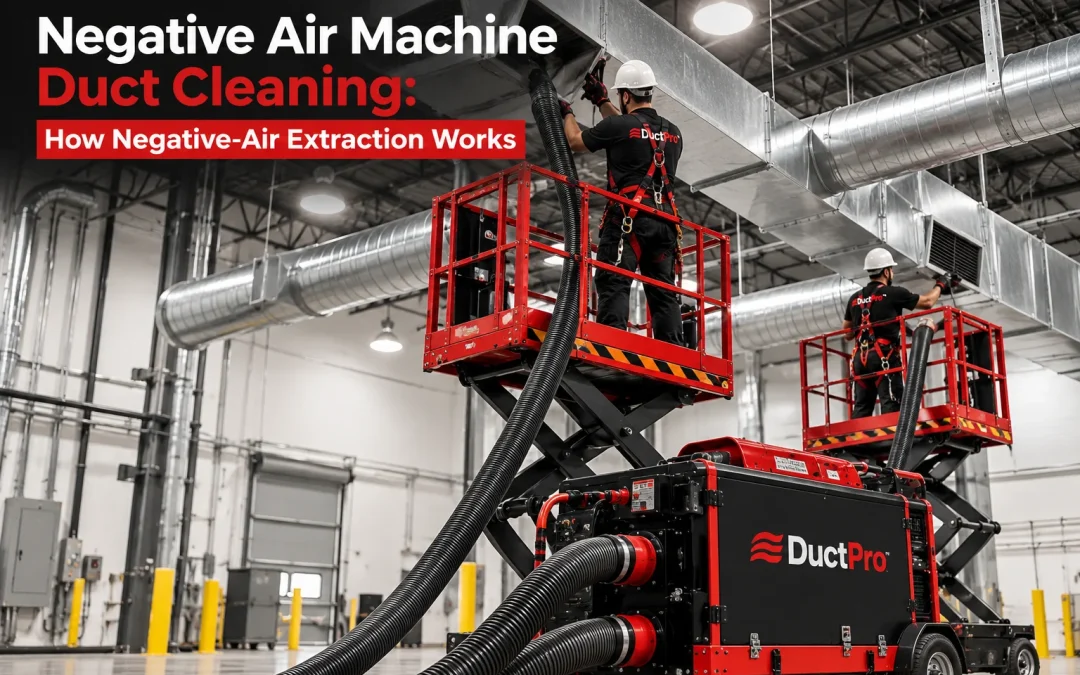
Negative air machine duct cleaning is based on a simple principle: control where air moves while debris is being loosened and removed from a duct system. Instead of allowing disturbed dust and debris to move freely through the surrounding work area, contractors can use vacuum extraction to create a pressure difference that encourages air to move toward the extraction equipment.
That principle becomes more important when duct cleaning involves contaminated sections, difficult access conditions, extensive debris, or work that requires greater control over air movement. A negative-air setup is not simply a matter of connecting a vacuum and turning it on. The actual result depends on the duct configuration, access openings, leakage, hose routing, agitation method, filtration, equipment configuration, and operating conditions.
For contractors, the goal is to understand how those factors interact and select extraction equipment that fits the actual job rather than relying on a single performance number.
What Is Negative-Air Duct Cleaning?
Negative-air duct cleaning uses a vacuum or extraction system to create lower air pressure within a controlled portion of the duct system or work area than in the surrounding area.
Air naturally moves in response to pressure differences. When the extraction equipment removes air from a duct or contained section, the pressure inside that section can become lower than the surrounding space. This pressure difference encourages air to move toward the extraction point.
In practical duct cleaning work, that controlled airflow can help direct loosened dust and debris toward the vacuum collection system rather than allowing disturbed material to move unpredictably through the building.
The concept is closely related to containment. If a section of ductwork is being cleaned, the contractor needs to consider how air enters the section, where the extraction equipment is connected, how other openings are controlled, and whether unintended leakage paths exist.
Negative air is therefore a method of controlling airflow. It is not, by itself, a complete duct cleaning procedure.
The extraction system, duct configuration, access points, agitation equipment, debris collection, and filtration all contribute to the overall process.
How Negative Pressure Helps Control Air Movement
Negative pressure is a relative condition. It means that the pressure in one area is lower than the pressure in another area.
During duct cleaning, the extraction equipment removes air from the controlled section. If the system is sufficiently controlled, air is encouraged to move from areas of higher pressure toward the extraction point.
This matters because cleaning often involves mechanical agitation. Brushing, air washing, or other cleaning methods can loosen material that was previously attached to interior duct surfaces. Without appropriate airflow control, that disturbed material can move in directions that are difficult to control.
A negative-air approach can help establish a preferred direction of movement.
However, negative pressure does not automatically mean that every opening is controlled or that containment is effective under every condition. A duct system can have multiple branches, gaps, access openings, disconnected sections, dampers, fittings, and other potential airflow paths.
Leakage is particularly important. If air enters through an unintended opening, some of the extraction capacity may be used to move air through that leakage path instead of producing the airflow conditions the contractor intended.
For that reason, contractors should evaluate the actual system configuration rather than assuming that connecting a vacuum automatically establishes effective containment.
What Can Affect Negative-Air Performance?
The conditions at the jobsite can be very different from the conditions represented by an equipment specification. Several factors can influence the actual extraction environment.
Leakage
Air can enter or escape through gaps, access openings, joints, disconnected components, or other pathways. The effect of leakage depends on the location and size of the opening and the configuration of the system.
A contractor should identify potential unintended airflow paths before relying on a negative-air setup for containment.
Duct Configuration
Duct systems are rarely just a single straight passage. Branches, transitions, elbows, dampers, fittings, flexible duct sections, and other components can change the way air moves through the system.
A vacuum connected at one location may therefore produce different conditions elsewhere in the system depending on how the ductwork is configured.
Access Openings
Cleaning access points are necessary for many duct cleaning procedures, but every opening changes the airflow path.
Contractors should consider which openings need to remain available for cleaning, which need to be controlled, and how the extraction connection interacts with those openings.
Hose Routing
The extraction hose is part of the airflow path. Its routing, fittings, bends, connections, and overall configuration can influence the conditions at the cleaning location.
This is one reason equipment specifications should not be interpreted as a guarantee of a particular airflow condition at the end of a hose or inside a specific duct section.
Fittings and Connections
Connections between the vacuum, hose, access equipment, and duct system should be properly configured for the job.
Unintended openings or poorly controlled connections can alter airflow and make the extraction conditions different from what the contractor expects.
Filtration
Filtration is an important part of any extraction setup because the vacuum is collecting material removed from the duct system.
The appropriate filtration approach depends on the work being performed and the type of material being handled. Contractors should evaluate the filtration requirements of the specific project rather than assuming that every vacuum configuration provides the same level of filtration or containment.
DuctPro’s published Tri-Motor Vacuum specifications do not establish a specific filtration architecture, filter material, HEPA efficiency rating, micron rating, or filtration testing result, so those characteristics should not be assumed.
Equipment Configuration
A negative-air system depends on more than the name of the machine. Contractors should consider the available airflow, pressure capability, motor configuration, debris capacity, connections, and the way the equipment will be used with the rest of the cleaning system.
Agitation
Extraction and agitation work together.
A vacuum can remove loosened material, but the material first has to be released from the duct surface. The appropriate agitation method depends on the duct material, construction, condition, access, and type of debris.
The objective is not simply to maximize suction. The cleaning method should produce controlled movement of loosened material toward the extraction system.
Why Airflow and Pressure Should Be Considered Together
Two commonly discussed vacuum specifications are CFM and water lift. They describe different aspects of equipment performance.
CFM, or cubic feet per minute, describes airflow. It indicates how much air the equipment is rated to move under the specified measurement conditions.
Water lift describes pressure capability. It is commonly used as a vacuum specification and indicates the equipment’s ability to develop suction pressure under a defined test method.
These specifications should not be treated as interchangeable.
A machine with a particular CFM rating does not necessarily produce that same airflow throughout an installed duct cleaning setup. Actual airflow can be affected by the hose, fittings, duct configuration, restrictions, leakage, debris loading, and other conditions.
Likewise, water lift should not be interpreted as a direct measurement of the airflow available at a particular cleaning point.
This distinction is important when evaluating a negative air machine for duct cleaning. Equipment specifications describe the machine. They do not replace measurement or evaluation of the complete airflow path.
Monitoring Negative Pressure During Duct Cleaning
When containment and pressure control are important to a project, contractors may use pressure measurement to verify the conditions they are actually achieving.
Measurement can provide useful information that cannot be obtained simply by looking at the vacuum’s published specifications.
The appropriate measurement method depends on the application and the requirements of the project. Contractors should establish what needs to be monitored, where measurements should be taken, and how the results should be interpreted before beginning work.
There is no single negative-pressure value that should be treated as a universal requirement for every duct cleaning project.
The appropriate condition depends on factors such as the containment design, building configuration, duct system, scope of work, and project-specific requirements.
Monitoring is valuable because it allows contractors to verify actual conditions rather than assuming that the equipment connection has produced the intended pressure relationship.
Choosing Equipment for Negative-Air Duct Cleaning
Selecting extraction equipment starts with the job requirements.
A contractor evaluating a negative-air vacuum should consider several characteristics together:
- Airflow specification
- Vacuum pressure or water lift specification
- Motor configuration
- Debris capacity
- Electrical requirements
- Hose and connection configuration
- Filtration requirements for the specific application
- Access limitations
- Duct configuration
- Expected debris conditions
- Agitation method
- Containment requirements
- Project-specific standards or procedures
The equipment should be matched to the actual work.
A higher number in one specification does not automatically make a machine appropriate for every application. Contractors need to consider how the equipment will function as part of the complete extraction path.
For professional duct cleaning operations, the air duct cleaning equipment used for extraction should be considered alongside the cleaning tools, access equipment, containment procedures, and debris-handling process.
DuctPro Tri-Motor Vacuum
The DuctPro Tri-Motor Vacuum is a professional extraction unit designed around three independent vacuum motors. Its current confirmed specifications are:
| Specification | DuctPro Tri-Motor Vacuum |
| Airflow | 330 CFM |
| Air Watts | 900 Air Watts |
| Water Lift | 220 inches |
| Motor configuration | Three independent vacuum motors |
| Debris capacity | 12 gallons |
| Operating voltage | 120 Volts |
These specifications describe the key performance and operating characteristics of the DuctPro Tri-Motor Vacuum.
330 CFM Airflow
The DuctPro Tri-Motor Vacuum is specified at 330 CFM.
That figure describes the published airflow specification for the equipment. It should not be interpreted as guaranteed airflow at a particular duct opening, through a particular hose arrangement, or under a particular load condition.
Actual extraction conditions depend on the complete system configuration.
900 Air Watts
The Tri-Motor Vacuum is specified at 900 Air Watts.
Air Watts are used as a vacuum equipment performance specification and should be considered alongside airflow and water lift rather than treated as a replacement for either measurement.
220 Inches of Water Lift
The DuctPro Tri-Motor Vacuum has a published water lift specification of 220 inches.
Water lift provides information about vacuum pressure capability. It is different from the machine’s CFM rating, so contractors should consider both specifications when evaluating extraction equipment.
Three Independent Vacuum Motors
The unit uses three independent vacuum motors.
Motor configuration is relevant when evaluating professional extraction equipment because it describes how the vacuum system is constructed. Contractors should still evaluate the equipment as a complete system and match it to the requirements of the particular duct cleaning application.
12-Gallon Debris Capacity
The Tri-Motor Vacuum has a 12-gallon debris capacity.
Debris capacity is a practical consideration for cleaning work because the amount and type of material removed can affect how often the collection container needs attention during a project.
120 Volts
The confirmed operating voltage for the DuctPro Tri-Motor Vacuum is 120 Volts.
No additional electrical requirements should be assumed from this specification alone. Contractors should verify the electrical requirements applicable to their specific installation and operating environment.
For current product information, contractors can review the DuctPro Tri-Motor Vacuum product page.
Negative-Air Extraction Is Part of a Complete Cleaning Process
A vacuum is only one component of a professional duct cleaning process.
Before extraction begins, the contractor needs to understand the duct layout and determine appropriate access points. The cleaning method then needs to address how material will be loosened from the interior surfaces.
Agitation and extraction should be coordinated. The agitation method should be appropriate for the duct construction and the material being removed, while the extraction setup should provide a controlled path for the loosened material.
Debris collection and filtration also matter. Material removed from the duct system needs to be captured and handled according to the requirements of the project.
Containment should be evaluated separately from equipment selection. A vacuum specification alone cannot establish that a particular building or work area meets a project’s containment requirements.
Where project conditions involve potentially hazardous materials or specialized remediation work, contractors should follow the applicable project procedures and verify any requirements that apply to the specific material, building, and scope of work.
DuctPro also provides other equipment for professional duct cleaning applications, including the Complete Air Duct Cleaning Equipment System. Contractors should evaluate the complete equipment configuration based on the work they perform rather than assuming that one machine or configuration fits every project.
Frequently Asked Questions
What is a negative air machine for duct cleaning?
A negative air machine for duct cleaning is an extraction system used to remove air from a controlled section of ductwork or work area. By lowering the pressure relative to surrounding areas, the system can encourage airflow toward the extraction point.
The effectiveness of the setup depends on the duct configuration, leakage, access openings, hose routing, filtration, equipment configuration, and operating conditions.
How does negative pressure work during duct cleaning?
Negative pressure occurs when the pressure in one area is lower than the pressure in another area. Removing air with an extraction system can create this pressure difference and encourage air to move toward the vacuum.
The contractor must still control unintended openings and evaluate the actual system configuration.
What CFM is needed for negative-air duct cleaning?
There is no single CFM value that should be treated as a universal requirement for every negative-air duct cleaning project.
The appropriate equipment depends on the duct system, containment arrangement, hose and connection configuration, cleaning method, and project requirements. Equipment CFM should be evaluated as a specification of the machine rather than as a guaranteed airflow at the duct opening.
What is water lift on a duct cleaning vacuum?
Water lift is a vacuum pressure specification. It provides information about the equipment’s ability to develop suction pressure under a defined measurement method.
Water lift and CFM describe different aspects of vacuum performance. Contractors should consider both when evaluating extraction equipment.
Does hose routing affect negative-air extraction?
Yes. Hose routing is part of the overall airflow path. Hose length, bends, fittings, connections, restrictions, and the way the hose interfaces with the duct system can affect actual extraction conditions.
For that reason, published equipment specifications should not be treated as a direct measurement of airflow at the end of a particular hose arrangement.
Does negative air replace agitation during duct cleaning?
No. Negative-air extraction and agitation serve different functions.
Agitation helps loosen material from duct surfaces, while extraction provides a path for moving loosened material toward the collection system. A professional cleaning process should coordinate the two methods according to the duct construction, debris, access conditions, and project requirements.
What should contractors monitor during negative-air duct cleaning?
Contractors should evaluate the pressure relationship and airflow conditions relevant to the containment arrangement. Where appropriate, pressure measurement can help verify actual conditions rather than relying solely on the vacuum’s published specifications.
The appropriate monitoring approach depends on the project and should not be based on an assumed universal pressure target.
Is the DuctPro Tri-Motor Vacuum suitable for every negative-air application?
No equipment specification should be interpreted as making a machine suitable for every application.
The DuctPro Tri-Motor Vacuum is specified at 330 CFM, 900 Air Watts, 220 inches of water lift, three independent vacuum motors, a 12-gallon debris capacity, and 120 Volts. Contractors should compare those specifications with the duct system, access conditions, containment requirements, cleaning method, and project requirements before selecting equipment.
Can a negative-air vacuum guarantee containment?
No. A vacuum cannot by itself guarantee containment.
Containment depends on the complete setup, including the duct configuration, openings, leakage paths, extraction connection, filtration, work practices, and project-specific requirements. Contractors should verify the actual conditions rather than assuming that connecting a particular vacuum automatically provides the required containment.
Conclusion
Negative-air duct cleaning is fundamentally about controlling air movement while material is being loosened and extracted. The vacuum creates the pressure relationship that encourages airflow toward the extraction point, but the effectiveness of that approach depends on the entire system.
Leakage, duct configuration, access openings, hose routing, fittings, filtration, agitation, equipment configuration, and operating conditions all influence the result. That is why contractors should evaluate the complete extraction setup instead of selecting equipment based on a single CFM or water lift number.
The DuctPro Tri-Motor Vacuum provides a defined set of professional extraction specifications, including 330 CFM airflow, 900 Air Watts, 220 inches of water lift, three independent vacuum motors, a 12-gallon debris capacity, and 120 Volts.
The appropriate equipment choice ultimately depends on the actual duct system and project. Contractors should match extraction equipment and containment procedures to the access conditions, cleaning method, duct configuration, and requirements of the work being performed.