
The biggest number on a truck-mount spec sheet is usually the least useful one.
Free-air CFM is measured at an open inlet with no hose, no fittings, and no resistance. That is a laboratory condition. A real job site is 140 feet of corrugated flex hose dragged across a front lawn, pinched through a storm door, and hauled up a stairwell to an attic air handler. By the time that airflow reaches the plenum, the headline figure no longer describes what the machine is doing. That gap is why contractors who explore DuctPro’s commercial air duct cleaning equipment systems start the evaluation with static lift instead of free-air volume.
This article follows vacuum performance from the truck bed to the trunk line. It shows why a high-static portable negative air system placed at the air handler often matches or beats the truck mount on extraction, and why it wins on logistics.
What a Portable Negative Air Duct Cleaning System Is
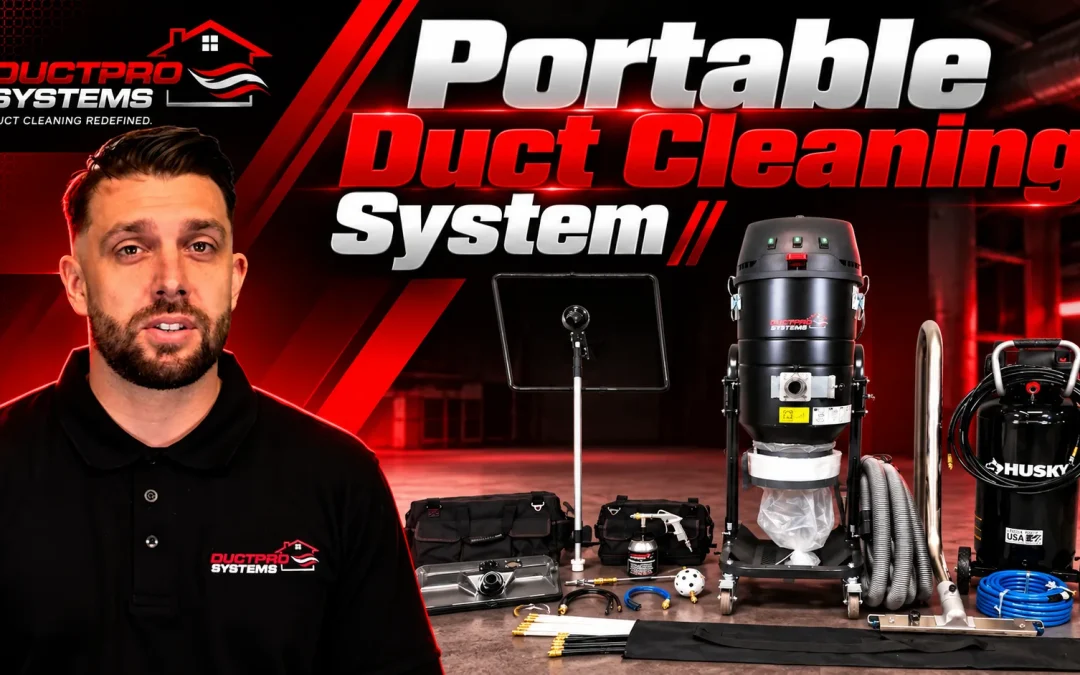
A portable negative air duct cleaning system is a self-contained, transportable vacuum collector that connects directly to an HVAC trunk line, plenum, or register opening and holds the duct system under continuous negative pressure during source-removal cleaning. Its three independent commercial-grade vacuum motors work together to pull a deep static vacuum on the ductwork, creating enough pressure differential to overcome friction from duct walls, fittings, and loaded filters while keeping dislodged debris moving toward collection. The DuctPro tri-motor system delivers 330 CFM of continuous operating airflow under static load, 220″ of static water lift, and 900 air watts of suction power.
That is the definition. The physics explains why those three numbers matter more than a free-air rating.
Free-Air CFM vs. CFM Under Static Load
What a Free-Air Rating Measures
Free-air CFM tells you how much air a vacuum source moves when nothing resists it, which only happens when the inlet is wide open and connected to nothing.
As soon as you attach a hose, resistance appears. Attach that hose to a duct system with dampers, turns, takeoffs, and a dirty coil, and resistance rises sharply.
The Fan Curve Problem
Every vacuum source operates along a performance curve:
- One end: maximum airflow at zero resistance (free air).
- Other end: maximum static pressure at zero airflow (sealed water lift).
- Real work: somewhere between those two points, depending on the total resistance between the motor and the debris.
More resistance means less airflow. Every time.
The useful question is not “How many CFM does it move?” It is “How many CFM does it move against the resistance of my job?” DuctPro specifies its 330 CFM as continuous operating airflow under load, which is the condition at the connection point rather than the condition in a brochure.
Air Watts: The Number That Combines Both
Airflow without suction is a fan. Suction without airflow is a sealed gauge. Neither cleans a duct alone.
Air watts measure actual work: airflow and suction combined at a real operating point. A 900 air-watt rating paired with 220″ of water lift gives the system a large pressure reserve to keep air moving as resistance increases. That reserve is what separates extraction from simple air movement.
Friction Loss: Where Truck-Mount CFM Disappears
Truck-mounted PTO and gas-driven systems produce real power at the vehicle. The problem is the distance between the vehicle and the work.
Hose Length Is a Linear Penalty
Under the Darcy–Weisbach relationship, pressure loss in a conduit rises in direct proportion to its length. Double the hose run and you roughly double the friction loss at a given velocity.
A 100–150+ foot run of 8″–10″ flex hose is a long section of resistance between the blower and the ductwork. The vacuum has to overcome all of it before any cleaning happens.
Velocity Is a Squared Penalty
Friction loss rises approximately with the square of air velocity.
This is the trap for volume-oriented systems. Pushing a large air volume through a long hose increases velocity, and higher velocity increases losses disproportionately. The machine spends much of its output fighting its own hose.
Flex Hose Is Not Smooth Pipe
Corrugated flex hose generates turbulence along every inch, so its effective resistance is meaningfully higher than smooth-wall duct of the same diameter.
Then add the routing:
- A sweep across the lawn or driveway.
- A tight bend through the entry door.
- A turn at the base of the stairs.
- A vertical lift up the stairwell.
- Another bend into the attic or mechanical closet.
Each turn adds equivalent length. Each coupling is a potential leak, and a leak at a splice lets the vacuum pull room air instead of duct air.
Transport Velocity and Vertical Lift
Debris moves only while air velocity stays high enough to keep it entrained. Fine dust stays suspended easily. Drywall fragments, construction debris, and compacted lint do not.
When velocity drops in a long horizontal run, heavier particulates settle in the low points of the hose. Vertical runs are worse because the airstream has to lift debris against gravity all the way back to the truck. Experienced techs know this as the hose that gets heavier as the day goes on.
Moving the Vacuum to the Debris
A portable negative air unit removes most of that hose from the equation. The machine stages beside the air handler or the register being cleaned, connected by a short, direct vacuum hose to the Vacuum Box through a 1.5″ or 2″ Dust Downer interface. Extended line friction is eliminated.
The Vacuum Box seals against the opening. Its integrated LED lighting lets the tech inspect the duct interior during the work. For larger trunk openings, the 24″ x 24″ Commercial Duct Cleaning Plate seals the connection. With the hose penalty minimized, most of the 220″ water lift goes to the ductwork itself instead of a transfer line.
The Dust Downer also controls fine particulate. It is a wet-down injection device that knocks down dust at the connection when conditions require it, which matters in occupied homes and sensitive facilities.
The principle is simple: put the pressure where the dirt is.
Agitation and Containment: How the System Cleans
Negative air does not scrub ductwork. It contains and carries.
Debris has to be dislodged first. That is the job of the pneumatic agitation system, operating within a verified range of 120–175 PSI. A 25-foot air hose runs from a red rubber supply hose through quick-connect fittings with an inline ball valve, so the technician controls air delivery at the tool.
The attachments are matched to airflow direction:
- Forward Blasting Air Ball: drives particulate forward. It is used in return air systems and for pushing dryer lint out of exhaust runs.
- Reverse Air Ball: pulls particulate backward toward the Vacuum Box. It is used in supply ducts.
- Air Gun & Cleaning Brushes: provide detailed agitation for HVAC coils, blower fans, and plenums.
The sequence matters. Agitation breaks material loose, and the negative pressure field immediately pulls it toward the 12-gallon recovery tank instead of letting it escape through registers into the occupied space. Source removal under containment is the approach NADCA’s ACR standard is built around.
Compressor Pressure Strategy
The agitation tools need a portable job-site compressor that maintains at least 120 PSI. That is the minimum operating pressure. Where you set it within the 120–175 PSI range changes how the tools perform.
| Compressor Setting | Initial Blast | Line Pressure Retention | Best Application |
| 150–175 PSI | Strongest initial impact | Drops below the 60–90 PSI working band faster | Breaking loose stubborn, compacted debris |
| 120–130 PSI | Moderate initial impact | Holds above the 60–90 PSI working band longer | Sustained cleaning across long trunk runs |
The compressor runs from a standard 15A or 20A, 120V outlet and refills its tank in roughly two minutes. No generator and no dedicated circuit are needed.
Field Data: Static Lift vs. Rotary Brushes
Contractors who moved from rotary-brush systems such as Rotobrush to high-lift negative air report a consistent result: fewer passes per trunk run.
The reason is mechanical. A rotary brush depends on repeated contact passes to loosen debris and then relies on whatever suction is available to carry it away. A system with deep static reserve keeps pulling during and between agitation passes, so less material settles back. Contractors report fewer repeat passes and significantly lower labor hours per job.
Dryer Vents and Long Aggressive Runs
Dryer exhaust lines in multi-unit commercial complexes often extend well past typical residential lengths, with multiple turns and long horizontal sections. Field validation in these buildings shows that forward/reverse air whips combined with high static lift achieve complete lint and debris extraction across those extended runs.
Long, lint-packed runs are where low-static equipment usually fails.
Labor Economics: The Two-Man Crew Problem
Truck mounts carry a staffing cost that rarely appears on the spec sheet.
One person manages the truck and the hose. Another works inside at the registers and air handler. Someone has to route, protect, and recoil long lengths of heavy hose. In practice, that means a two-person crew on every job, whether the job needs two people or not.
Single-Technician Deployment
Operational data confirms that the portable tri-motor package allows a single technician to complete the full negative air setup on residential and light-commercial jobs. One tech carries the unit in, seals the Vacuum Box, connects the agitation line, cleans, and tears down.
The accessories support solo work. The Extension Pole holds the Vacuum Box against ceiling registers without a second person. The Toe Kick Adapter Plate seals under-cabinet vent openings that would otherwise require improvised taping.
Run the math on your own operation:
Second tech’s loaded hourly cost × average hours per job × annual job count
That figure is the overhead a single-operator platform can remove or redirect into running a second crew.
Van-Based Deployment
The full system deploys from a standard service van, a pickup bed, or a small commercial vehicle. It does not need a dedicated PTO box truck or a vehicle built around the equipment. The Vacuum Box travels in its own protective transport case.
When the equipment is no longer tied to one truck, your existing fleet becomes your duct cleaning fleet.
Fleet Scalability for HVAC Mechanical Contractors
The common growth path for HVAC mechanical contractors is straightforward. They start with one pilot system, confirm the margin, and expand to 2–5 dedicated van packages. Duct cleaning becomes a high-margin add-on to existing preventative maintenance contracts, sold to customers who already trust the company with their equipment.
That expansion is much easier to justify when each new unit does not require a new truck.
Access: Jobs Truck Mounts Cannot Reach
High-Rise Condominiums
A truck mount’s reach ends where its hose ends. On the 14th floor of a condominium tower, that is not a workable option.
A portable unit fits in a service elevator, goes up with the technician, and connects at the unit’s air handler or registers. There is no parking-garage clearance problem, no hose hanging from a balcony, and no loading-dock negotiation.
Secure and Critical-Environment Facilities
Some facilities will not allow long hose runs through secured doors, corridors, or controlled zones. Others require equipment that meets strict containment standards.
DuctPro negative air equipment is deployed for critical-environment air quality maintenance at the NASA facility in Florida through Sani Effect Environmental. Facility engineers verified it against strict particulate containment and air-handling standards. In an aerospace environment, containment is what determines whether equipment is allowed on site.
Winter Climates
Running an 8″ or 10″ hose through a front door means the door stays open for the entire job.
In January, that means:
- Heated air escaping for hours.
- A cold house and an unhappy homeowner.
- Snow, slush, and ice tracked along the hose path.
A portable system operates indoors, and the door stays closed. In northern markets, that alone can win jobs.
Truck-Mounted PTO Systems vs. DuctPro Portable Tri-Motor: Side-by-Side
| Evaluation Factor | Truck-Mounted PTO/Gas Systems | DuctPro Portable Tri-Motor Negative Air |
| Effective Static Lift at the Trunk Line | High at the vehicle, but reduced by 100–150+ ft of flex hose friction, bends, couplings, and vertical lift before reaching the plenum | 220″ static water lift applied at the collection point through a short, direct vacuum hose to the Vacuum Box (1.5″ or 2″ Dust Downer interface); 330 CFM rated under load |
| Vehicle Requirements & Initial Capital Outlay | Dedicated box truck or trailer with PTO drive or auxiliary engine; vehicle and machine are one capital purchase | Rides in a standard service van, pickup bed, or small commercial vehicle; no dedicated truck required |
| Setup & Teardown Time (Labor Drag) | Long hose deployment, routing, protection, and recoil; typically requires a two-person crew | Carry-in, Vacuum Box seal, agitation hookup, and teardown handled by a single technician |
| High-Rise & Inclement Weather Access | Limited by hose reach and vehicle access; entry doors stay open for the duration of the job | Elevator-portable for upper floors; operates fully indoors with doors closed |
| Operational Fuel/Maintenance Costs | Engine run-hours, fuel burn while stationary, PTO and drivetrain wear | Electric vacuum motors with no fuel burn; inspect carbon motor brushes after 500 operating hours (average 3–5 year service interval); machine-washable cage filter |
| Power Sourcing & Amperage Management | Self-powered by the vehicle engine; no site circuits needed | Operates on standard nominal 120V grounded circuits; compressor runs on a standard 15A or 20A 120V outlet |
Where Truck Mounts Still Make Sense
Truck mounts are not obsolete. They still fit certain jobs: single-story commercial buildings with drive-up access, very large-diameter industrial trunks, and sites where the vehicle can park close to the air handler.
Those jobs are a small share of most contractors’ schedules. For the usual mix of two-story homes, condominiums, attic air handlers, multi-unit dryer vents, and winter service calls, much of the truck mount’s power advantage is lost to hose friction before it reaches the duct.
Build your equipment strategy around the jobs you actually run, not the exceptions.
How to Evaluate Your Next Equipment Platform
- Ask for CFM under load, not free air. A vendor who only provides free-air numbers is avoiding the figure that matters.
- Map your last 50 jobs. Record the distance from parking to the air handler, the number of floors, and whether the door had to stay open. That data shows how much hose loss you have been absorbing.
- Price the second technician honestly. Use loaded labor cost, not base wage.
- Audit your fleet. If your service vans can carry duct cleaning equipment, a dedicated truck may be unnecessary capital.
- Check site power. Confirm access to grounded 120V circuits for the vacuum and a standard 15A or 20A outlet for the compressor. Do not use adapters.
- Test it on a difficult job. Use a second-floor air handler, a packed dryer vent, or a January service call, not a shop demo.
The real test comes on the first job where a truck mount would have needed 150 feet of hose. Rated power only matters if it reaches the duct, and equipment that applies its full static lift at the plenum delivers what a truck-mount spec sheet promises.