

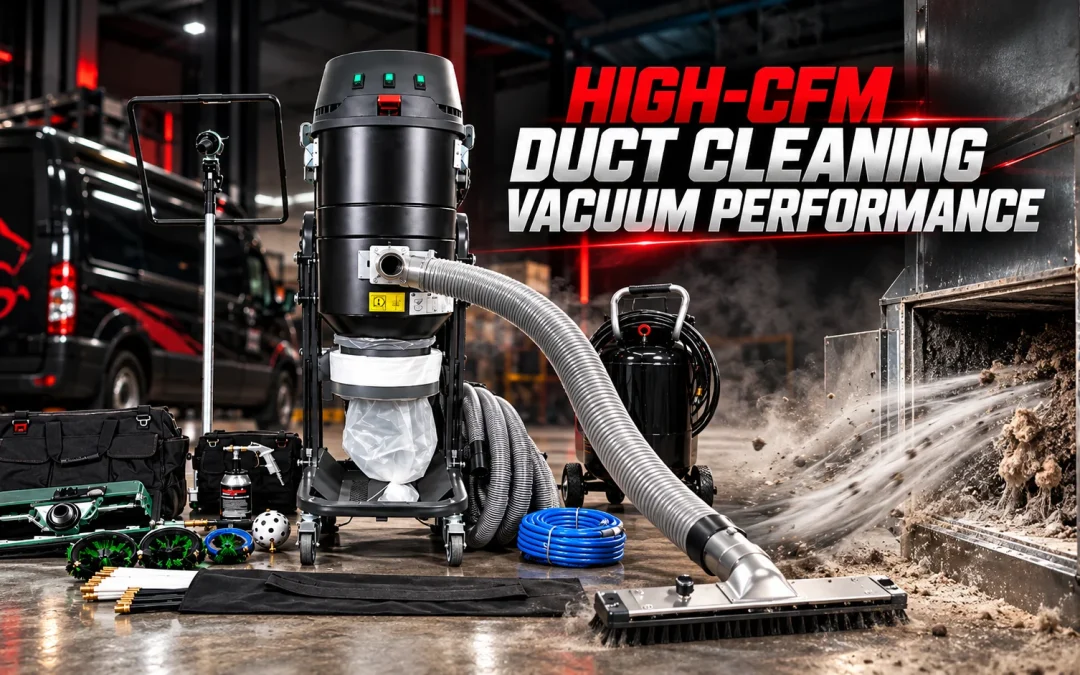
When contractors search for a high-CFM duct cleaning vacuum, the CFM rating is often the first specification they notice. That makes sense. CFM describes airflow, and airflow is an important part of moving loosened debris through a duct cleaning system.
But CFM by itself does not tell you how a vacuum will perform once it is connected to hoses, fittings, access points, filters, and ductwork.
The more useful way to evaluate a professional duct cleaning vacuum is to look at the complete performance picture. Airflow, water lift, motor configuration, debris capacity, electrical requirements, hose arrangement, and the actual HVAC system all have a role in equipment selection.
That distinction is especially important when comparing machines with very different advertised CFM figures. A larger number does not automatically mean better cleaning performance, and a published CFM figure should not be treated as the airflow a contractor will necessarily have at the duct opening.
DuctPro Systems takes this specification-first approach with its Tri-Motor Vacuum. The current confirmed specifications are 330 CFM, 900 Air Watts, 220 inches of water lift, three independent vacuum motors, a 12-gallon debris capacity, and 120 Volts.
What Does CFM Mean in a Duct Cleaning Vacuum?
CFM stands for cubic feet per minute. It describes the volume of air a vacuum is rated to move.
In duct cleaning, airflow matters because the vacuum forms part of the air-moving path used to transport loosened material toward the collection equipment. A contractor therefore needs enough airflow for the particular cleaning setup and application.
The important point is that CFM is a measurement of airflow volume, not a complete description of vacuum performance.
A vacuum does not operate independently of the rest of the system. Once hoses, fittings, filters, ductwork, and other restrictions are introduced, resistance affects the operating conditions.
This means contractors should be careful when comparing CFM specifications from different manufacturers. Unless the measurement conditions are known and comparable, two advertised CFM numbers may not provide a meaningful apples-to-apples comparison.
The same caution applies to interpreting a single machine’s published CFM. A manufacturer’s stated airflow should not automatically be described as airflow at the end of a particular hose or inside a particular duct unless that specific operating condition has been documented.
Why CFM Alone Does Not Tell the Whole Story
Every duct cleaning setup introduces some degree of resistance.
Hose configuration can affect the airflow path. Fittings add restrictions. Filters can introduce resistance. Duct configuration and access conditions can also affect how the vacuum is connected to the system.
As resistance changes, the vacuum’s operating conditions change as well.
That is why a contractor evaluating a duct cleaning vacuum should look beyond the headline CFM number. The relationship between airflow and pressure is more informative than either specification considered by itself.
Consider a simple example. A contractor may compare two machines and see that one has a higher advertised CFM. That does not establish that the machine will produce better results in the contractor’s actual setup. The comparison would need to account for how the respective CFM figures were measured and what pressure capability each machine provides.
The practical lesson is simple: a high CFM rating is useful information, but it is not a complete performance specification.
CFM vs. Static Pressure for Duct Cleaning
CFM and static pressure describe different characteristics of a vacuum.
CFM describes airflow volume. Static pressure relates to the vacuum’s ability to create pressure when resistance exists in the airflow path.
Water lift is commonly used as a way of expressing vacuum pressure capability. It should not be treated as another way of stating CFM. The two specifications describe different aspects of the equipment.
This distinction becomes important when a vacuum is connected to an actual duct cleaning system. The airflow path is rarely unrestricted. Hoses, fittings, filters, ductwork, and other components can affect resistance.
A vacuum therefore needs to be evaluated according to both its airflow and its pressure capability, along with the rest of the equipment configuration.
DuctPro’s current confirmed specification for the Tri-Motor Vacuum is 330 CFM of airflow and 220 inches of water lift.
Those numbers should be considered together rather than treating the 330 CFM figure as a standalone measure of cleaning capability.
There is also an important limitation when interpreting published specifications. Unless the manufacturer provides verified performance data for a particular hose length, static-pressure condition, filter condition, or duct configuration, a contractor should not assume a specific airflow figure under those conditions.
What Contractors Should Look for in a Professional Duct Cleaning Vacuum
Choosing professional duct cleaning equipment involves more than finding the largest airflow number. These are the specifications and practical considerations worth examining.
Airflow
Airflow is one of the basic specifications to review when comparing duct cleaning vacuums.
The first question should be what the manufacturer’s CFM figure actually represents. Contractors should avoid assuming that all CFM specifications were measured under identical conditions.
A larger CFM rating can be relevant, but it should be considered alongside the vacuum’s pressure capability and the intended application.
Static Pressure and Water Lift
Water lift provides information about a vacuum’s pressure capability.
This matters because a duct cleaning system introduces resistance. A contractor should consider how the vacuum is designed to operate when air has to move through the connected equipment and ductwork.
DuctPro specifies 220 inches of water lift for its Tri-Motor Vacuum.
That specification should be evaluated alongside the machine’s 330 CFM airflow rating rather than in isolation.
Motor Configuration
Motor configuration is another useful specification when comparing professional equipment.
The DuctPro Tri-Motor Vacuum uses three independent vacuum motors.
The number of motors alone does not establish cleaning performance, but it tells a contractor something important about the design of the vacuum. It should be considered together with airflow, water lift, electrical requirements, and the intended application.
Debris Capacity
Collection capacity is a practical consideration that is easy to overlook when focusing on airflow.
The DuctPro Tri-Motor Vacuum has a 12-gallon debris capacity.
The appropriate capacity depends on the work being performed and the amount of material expected to be collected. It can affect how frequently the collection container needs to be emptied during a job.
Filtration
Filtration should be evaluated using the manufacturer’s actual specifications.
Contractors should not assume that a vacuum has a particular number of filtration stages, a particular filter material, or a particular particle-efficiency rating unless those specifications have been documented.
This is particularly important when comparing marketing descriptions. A machine should not be credited with a filtration capability simply because that type of filtration is common in another vacuum or appears desirable for the application.
Voltage
Electrical requirements need to be considered before equipment is purchased or transported to a job.
The confirmed operating voltage for the DuctPro Tri-Motor Vacuum is 120 Volts.
Contractors should verify the electrical requirements of the specific equipment and make sure the intended job environment can accommodate them.
Portability
Professional duct cleaning equipment often has to be positioned where access is limited.
A contractor may need to move equipment through residential interiors, commercial spaces, mechanical areas, or other locations where equipment size and handling affect setup.
Portability therefore deserves consideration alongside performance specifications. The right balance depends on the type of work a contractor performs.
Hose and Access Considerations
The vacuum is only one component of the airflow path.
Hose diameter, hose length, fittings, access openings, and the connection method can all influence the overall system. Contractors should consider how the vacuum will actually be connected to the HVAC system rather than evaluating the vacuum as a standalone machine.
This is also why it is risky to take a published CFM number and assume that the same airflow will be available under every hose and duct configuration.
Job-Specific Requirements
There is no single vacuum specification that automatically makes a machine appropriate for every duct cleaning project.
Equipment selection depends on the HVAC system, access, hose configuration, agitation method, contamination, equipment setup, and cleaning procedure.
A contractor working on one type of system may have different equipment requirements from another contractor working on a substantially different application.
The equipment should therefore be matched to the work, not selected solely by the largest number on a specification sheet.
DuctPro Tri-Motor Vacuum Specifications
The current confirmed specifications are:
| Specification | DuctPro Tri-Motor Vacuum |
| Airflow | 330 CFM |
| Air Watts | 900 Air Watts |
| Water Lift | 220 inches |
| Motor configuration | Three independent vacuum motors |
| Debris capacity | 12 gallons |
| Operating voltage | 120 Volts |
These are the current confirmed Tri-Motor specifications provided by DuctPro Systems.
The 330 CFM figure is the current confirmed airflow specification. DuctPro’s technical source specifically states that it should not be recharacterized as working airflow, hose-inlet airflow, free-air airflow, or another measurement condition unless DuctPro confirms that terminology.
That distinction matters when comparing equipment. A responsible comparison should use specifications that are technically comparable and properly defined.
Where a Portable Tri-Motor System Fits
The DuctPro Tri-Motor Vacuum combines several specifications that contractors can evaluate when choosing professional duct cleaning equipment: 330 CFM airflow, 900 Air Watts, 220 inches of water lift, three independent vacuum motors, and a 12-gallon debris capacity.
This gives contractors more information to work with than a CFM figure alone.
However, 330 CFM should not be interpreted as meaning that the Tri-Motor Vacuum is automatically appropriate for every residential, commercial, or industrial duct cleaning application. The correct equipment depends on the specific HVAC system and cleaning requirements.
Contractors evaluating air duct cleaning equipment should first consider the requirements of the work and then compare those requirements with the equipment’s documented specifications.
DuctPro’s Tri-Motor Vacuum provides the current product-specific specifications for contractors who want to evaluate this configuration in greater detail.
For contractors who need to understand the broader operating setup, DuctPro also provides its Operation Manual, which should be used alongside the product specifications when applicable.
How to Evaluate a Vacuum Before Buying
Before purchasing a high-CFM duct cleaning vacuum, ask the manufacturer or supplier questions that clarify what the specifications actually mean.
1. What conditions were used to determine the CFM rating?
A CFM figure without measurement context can be difficult to compare with another manufacturer’s figure.
Ask how the airflow specification is defined and whether the manufacturer provides supporting information about the measurement conditions.
2. What is the water-lift specification?
Review water lift alongside CFM. The two specifications describe different characteristics of vacuum performance.
3. How is the motor system configured?
Find out whether the vacuum uses one motor, multiple independent motors, or another configuration.
For the DuctPro Tri-Motor Vacuum, the confirmed configuration is three independent vacuum motors.
4. What is the debris capacity?
Collection capacity can affect how frequently the equipment needs to be emptied during work.
DuctPro specifies a 12-gallon debris capacity for the Tri-Motor Vacuum.
5. What filtration specifications are documented?
Ask for the actual filtration specifications rather than assuming a particular filter type or efficiency.
6. What are the electrical requirements?
Confirm the operating voltage and any other applicable electrical requirements before purchasing.
7. What hose and connection information is available?
If the manufacturer provides documented hose lengths, diameters, connection information, or performance data under particular conditions, review those details before making comparisons.
Do not assume a specific airflow at a particular hose length unless that performance has been documented.
8. Is the equipment appropriate for the intended work?
The answer should be based on the complete application, not just the advertised CFM.
Consider the HVAC system, access, hose arrangement, cleaning procedure, contamination, and equipment setup before deciding whether a particular vacuum is appropriate.
Frequently Asked Questions
Is a higher CFM vacuum always better for duct cleaning?
No. CFM is an important specification, but it does not describe the entire performance of a vacuum. Water lift, resistance, hose configuration, fittings, filtration, duct conditions, and the cleaning procedure also matter.
What is a good CFM for a duct cleaning vacuum?
There is no single CFM figure that automatically makes a vacuum suitable for every duct cleaning application. The appropriate equipment depends on the specific HVAC system, cleaning requirements, equipment configuration, and documented performance characteristics.
What does 330 CFM mean on the DuctPro Tri-Motor Vacuum?
330 CFM is the current confirmed airflow specification for the DuctPro Tri-Motor Vacuum. DuctPro does not define that figure in the supplied technical specification as working airflow, hose-inlet airflow, free-air airflow, or another specific measurement condition.
Is CFM more important than water lift?
Neither should be evaluated in isolation. CFM describes airflow volume, while water lift describes vacuum pressure capability. Looking at both gives a more useful starting point for evaluating vacuum equipment.
Does hose length affect vacuum performance?
Hose configuration can introduce resistance into the airflow path. Hose length, diameter, fittings, and other restrictions can therefore affect operating conditions. A specific amount of performance loss should not be assumed unless it has been documented for the particular equipment and configuration.
Does a larger duct automatically require a higher-CFM vacuum?
Not necessarily. Duct size is only one consideration. HVAC configuration, access, cleaning method, hose arrangement, contamination, equipment setup, and other job-specific factors can affect equipment selection.
Is the DuctPro Tri-Motor Vacuum a 5,000 CFM machine?
No. The current confirmed airflow specification is 330 CFM. Older or conflicting figures should not be substituted for the current DuctPro specification.
What should contractors compare when buying a duct cleaning vacuum?
Review airflow, water lift or pressure capability, motor configuration, debris capacity, documented filtration specifications, operating voltage, portability, hose and access considerations, and the requirements of the intended application.
Choose the Complete Performance Picture, Not Just the Biggest CFM Number
The phrase “high CFM duct cleaning vacuum” naturally puts attention on airflow. But professional equipment selection requires a broader view.
CFM tells you about airflow volume. Water lift provides information about pressure capability. The connected hoses, fittings, filters, ductwork, access points, and cleaning procedure influence the overall airflow path and resistance.
The DuctPro Tri-Motor Vacuum is currently specified at 330 CFM, 900 Air Watts, and 220 inches of water lift, with three independent vacuum motors, a 12-gallon debris capacity, and 120 Volts.
Those specifications give contractors a more complete basis for evaluating the machine than a CFM number alone.
The right vacuum ultimately depends on the job. Contractors should consider the HVAC system, access conditions, hose and connection arrangement, cleaning procedure, contamination, and other application-specific requirements before deciding what equipment is appropriate.
A larger CFM number may stand out on a product comparison, but the more useful purchasing question is whether the complete equipment specification fits the work.